An AI deal with China could get Trump his Nobel Prize
An agreement to collaborate, starting with cybersecurity and medicine, will be his biggest achievement
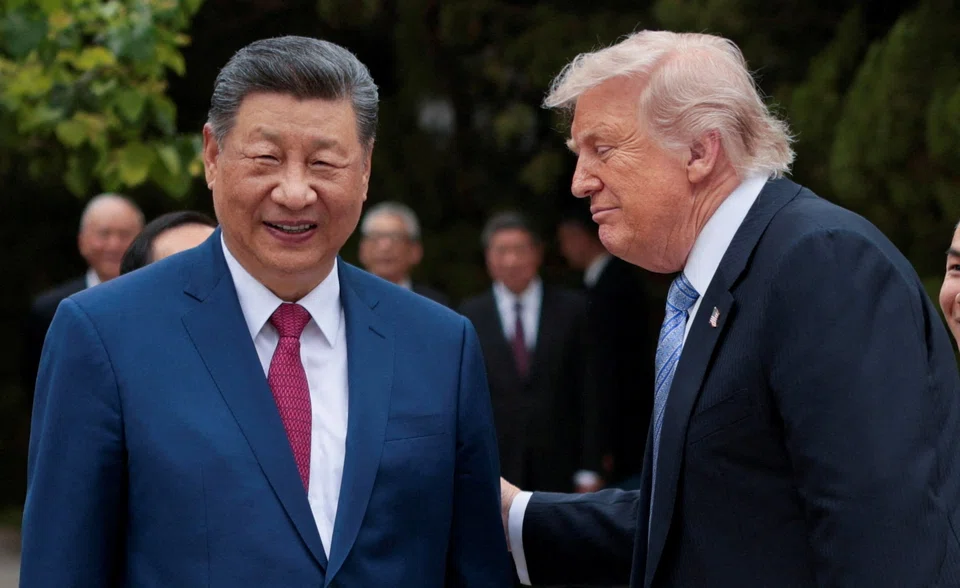
[WASHINGTON] US President Donald Trump is about to have the opportunity of a lifetime, if he is up for it.
As OpenAI’s Sam Altman and others have noted in recent days, making a deal with China around artificial intelligence could actually win him the Nobel Prize he has long sought.
Where better to seal such an agreement than his one-day summit with Chinese President Xi Jinping on Sep 24?
Getting there would require a critical change in strategy. In his thinking to date, the best way forward is adversarial.
“We’re leading China in AI,” he said on Sep 13, after Altman and Elon Musk joined Dario Amodei of Anthropic in calling for the pace of AI development to slow to avoid a catastrophe.
“We’re the most sophisticated country in the world, and frankly I want to keep it that way, because whoever wins AI wins.”
But the reality is that China has already largely caught up, and the AI race has not worked out particularly well for either country.
Incidents such as OpenAI’s models attacking Hugging Face, another AI company, show the threat AI agents can pose to the stability and infrastructure of both countries. If the AI bubble pops, both countries may suffer economically.
More Americans are concerned rather than excited about AI, and this has fuelled a growing resistance to data centres. China has its own growing segment of doomers and sceptics as well.
I have written about global AI policy for the past decade, and continue to speak regularly with key international players. I firmly believe that China would be open to discussing some kind of collaboration in AI.
On Sep 2, the Brookings Institution’s Kyle Chan, who follows the situation closely, wrote that China seems to be signalling that it “is willing to agree to joint restrictions (on AI) with the US as long as the terms... are not unilaterally set by the US”, a characterisation I have personally heard dozens of times.
Indeed, Xi himself indicated openness to collaboration in a speech in July, directly acknowledging the importance of historic American contributions to AI, which could be interpreted as an olive branch.
Moreover, he asked for “the whole international community” to try to find a path forward.
It is time to stop casting AI as a winner-take-all, zero-sum race. America and China must instead work together to reconceive the tech as a grand collaboration across the globe.
This could be undertaken in the spirit of the European Organization for Nuclear Research – perhaps best known for the Large Hadron Collider and its contributions to particle physics – and the US-Soviet Union scientific collaborations on things such as eradicating smallpox and the Apollo-Soyuz international space mission in the second half of the 20th century.
Three strands of the AI relationship
Hawks will raise legitimate concerns. America should not share its crown-jewel intellectual property with China; nobody could realistically expect the two countries to waive the possibility of using autonomous weapons.
But pragmatically – and for the best outcomes – the Sino-American relationship around AI should have three strands: one that is adversarial, one that is competitive and one that is collaborative.
On the adversarial side, neither country is, for example, going to want to give up the freedom to use drones in war.
And although the world might be better off if there was a mutual agreement to forsake drone warfare, reaching such an agreement is so unlikely that it would be a waste of negotiating energy to try.
On the competitive side, both countries will want to be – and should be – free to develop chips that are faster and better.
Both will keep trying to make the best, cheapest AI that they can. And both would like to sell their wares. Tussling over export controls might not be the best use of energy in the upcoming meeting.
If the two leaders are open to making progress on the third strand, collaboration, where would a breakthrough most likely be?
One promising area is medicine, particularly cancer research.
China now contributes quite a bit to developing new cancer treatments. Its pioneering immunotherapy drug Ivonescimab, for instance, outperformed a comparable American drug, Keytruda, in a trial, with patients surviving without observable tumours for about twice as long.
By running joint drug trials, and sharing suitably anonymised data, the countries could collaboratively run bigger, more accurate studies at a speedier pace, facilitating the development of medical AI worldwide, and thus potentially come up with better candidate drug targets more quickly.
Likewise, sharing AI models that focus on biological processes, such as how proteins interact with one another, could yield new insights that benefit medicine more broadly. They might even lead to new kinds of treatments altogether.
A second target for collaboration is in cybersecurity, especially after the increasingly unsettling safety incidents reported by frontier AI companies this summer.
Neither country wants its banking system or electrical infrastructure to collapse because some runaway AI takes them down. Even worse would be an AI-led deepfake-propaganda campaign that led to an accidental war.
Both countries should work towards AI that is better able to follow easily stated precepts such as “do not hack into systems” and “do not steal credentials”. Neither side has been able to solve this critical problem on its own.
Moreover, newly developed techniques are making the actions of AI models even harder to monitor and interpret.
Neither country should favour this, and they can work together to ensure that AI systems can continue to be tracked and understood.
Growing incentive for a deal
All of this could begin with an agreement, formal or informal, between Trump and Xi. There would be difficult details to sort out, such as the sharing of intellectual property, including both in advances made directly in technical AI and for any drugs that might be developed.
Restrictions around espionage, mutual monitoring and data exchange would no doubt be tricky, too. But there is a substantial – and growing – incentive for both sides to be reasonable, and reach a deal.
The alternative is grim.
As American author Robert Wright recently put it: “America’s preoccupation with ‘winning’ the AI race with China could well lead to unprecedented catastrophes, even catastrophes on a global scale.”
The summit on Sep 24 is a chance for Trump to change tack, help defuse AI’s most explosive risks, and in doing so, secure that cherished Nobel honour. The prize is there for the taking. ©2026 The Economist Newspaper Limited. All rights reserved
The writer is emeritus professor of psychology and neural science at New York University and the author of six books, including Rebooting AI and Taming Silicon Valley