



AirAsia’s hunt for cheaper debt won’t be easy with US$100 oil
Elevated oil prices may make it tough for carriers selling cheap flight tickets to make money
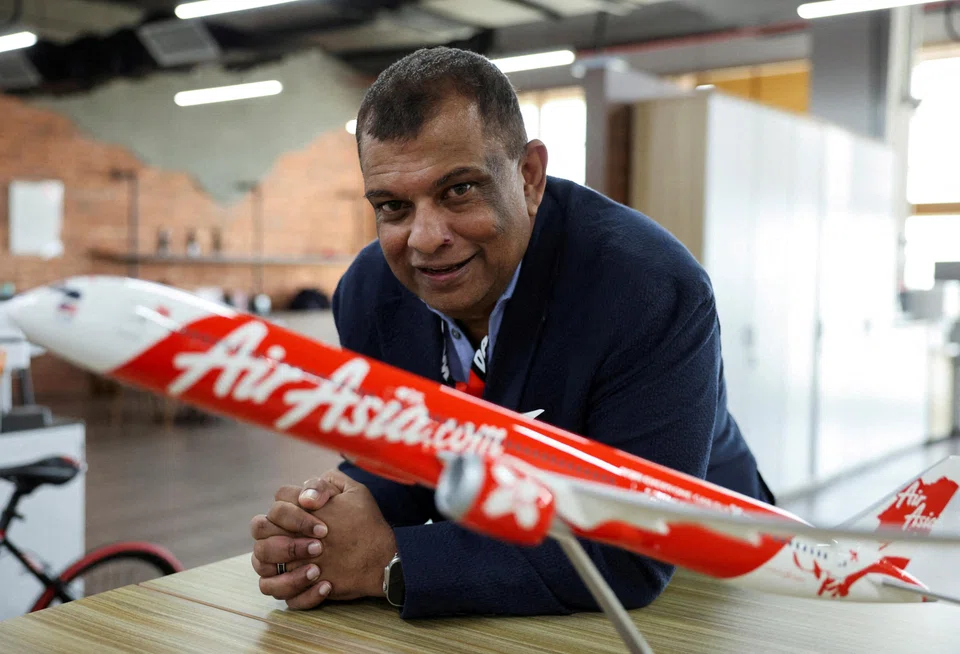
[JAKARTA] AirAsia’s Tony Fernandes is fed up with private credit and the exorbitant interest rates they charge.
“I don’t want to take any more private credit debt because it is expensive,” the co-founder of one of the biggest South-east Asian budget carriers said at a briefing last week.
“I don’t want more debt. I don’t like debt.”
While Fernandes is seeking to reduce interest payments – some as high as 11 per cent – through a US$1 billion refinancing package, it may be tough for a company that sells cheap flight tickets to make money when oil prices are above US$100 a barrel.
AirAsia’s finances are so strained that it loses money, has more liabilities than assets, and has a cash-to-revenue ratio that is well below the industry standard.
“AirAsia likely needs either a real improvement in operating cash flow or credit enhancement,” said Linus Benjamin Bauer, founder of aviation consultancy BAA & Partners. “Without that, cheaper money is difficult to justify.”
Like most airlines, the Iran war hit AirAsia hard but the carrier, which does not hedge its fuel costs, has been grappling with soaring prices to such an extent that it went through two straight quarterly losses.
Its total debt had surged to a record US$4.1 billion at the end of June, according to data compiled by Bloomberg.
While the jump largely reflected Fernandes’ consolidation of all its airline businesses into AirAsia from sister firm Capital A, AirAsia’s liabilities exceeded assets by 606 million ringgit (US$149 million) as at end-June, according to the company’s first half financial report.


It also shows it had 954 million ringgit in cash and 18.4 billion ringgit in current liabilities due over the next 12 months, suggesting coverage of only 5 per cent.
The cash represents 4.3 per cent of AirAsia’s annualised revenue of 22 billion ringgit and “normal airline practice is to have cash and facilities of at least 10 per cent to 20 per cent of annualised revenue”, said independent aviation analyst Andrew Light.
Fernandes has received an offer for US$1 billion of financing from Middle East banks to refinance existing debt, but he is holding off on a final signoff while he searches for cheaper alternatives.
AirAsia, which is also seeking 700 million ringgit in local credit facilities, aims to complete the refinancing by December or January.
AirAsia declined to comment on its recent fundraising efforts and whether talks with creditors reflected liquidity pressures or raised concerns about its ability to meet obligations without additional financing.
“Unless Tony can present a credible business plan to get the airline back to positive cash flow, raising the money AirAsia needs on commercial terms will become increasingly difficult,” said Gerry Soejatman, an independent aviation analyst based in Jakarta.
“That challenge will only get harder if oil prices stay elevated or rise further.”
Highlighting its financial strain, AirAsia fell behind on dues to some suppliers and asked lessors to defer rental payments on more than 16 aircraft after fuel costs surged, Bloomberg reported in June.
It had also asked private credit lenders Ares Management and Indies Capital Partners to allow aircraft lessors to share revenue from routes pledged to their US$200 million facility.
And since the start of 2025, it sold six brand new Airbus planes without ever putting them into service.
Fernandes denied renegotiating with Ares, and said the jet sale reported by Bloomberg was inaccurate, adding the company was returning planes it did not need “in this crisis”.
The planned US$1 billion in refinancing debt would save AirAsia around 200 million ringgit a year in interest expense if it is able to lower the interest rate on debt raised during the Covid-19 pandemic and private credit to 7 to 8 per cent from around 11 per cent, said Samuel Yin, associate director for equity markets research at Maybank Investment Bank.
“The debt is not maturing this year, but the airline wants to prepare ahead of upcoming obligations. Given the rise in fuel prices, the costs are increasing,” said Yin, who said he met with AirAsia management earlier in September.
Behind its fundraising efforts is a business that is not generating enough cash. AirAsia’s operations consumed 582 million ringgit in the first half of 2026, according to its financial statement.
Citigroup downgraded its rating on AirAsia stock to “sell” from “buy” in a report this week, saying that its limited cash and equity buffers leave little room for another fuel-price shock.
“We see jet fuel prices as the key determinant of future liquidity and profitability as balance sheet constraints remain,” Citigroup said.
The Iran conflict has hit budget airlines particularly hard because they have less ability than full-service carriers to pass on higher fuel costs to passengers.
The industry’s biggest casualty so far has been US low-cost carrier Spirit Aviation Holdings, which collapsed in May amid soaring fuel prices and the failure of a government bailout.
Fernandes has said his airline does not need to be rescued by the Malaysian government, dismissing the idea of an intervention as “the most ludicrous statement I have seen in 25 years”.
“AirAsia survived the pandemic without a government bailout and the brand has shown demand resilience,” said Bauer from BAA & Partners. “But with liquidity this tight, the margin for execution error remains limited.” BLOOMBERG
Decoding Asia newsletter: your guide to navigating Asia in a new global order. Sign up here to get Decoding Asia newsletter. Delivered to your inbox. Free.
Share with us your feedback on BT's products and services






