



Asean ‘compelling’ for businesses looking for long-term growth amid tensions: Tan See Leng
Asean is collectively the world’s fourth largest economy with a gross domestic product of around US$4 trillion
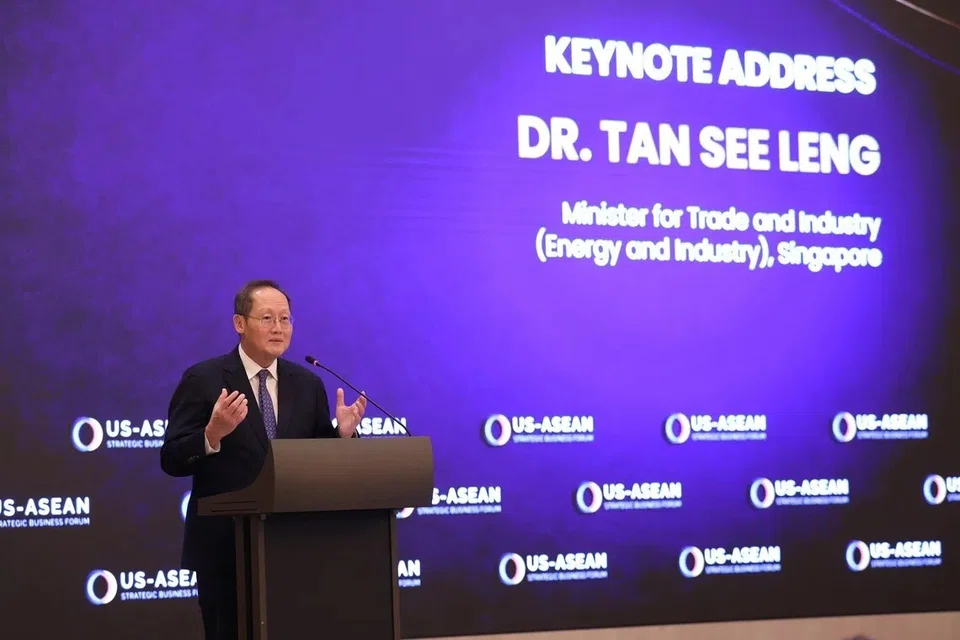
[SINGAPORE] Businesses are increasingly having to consider a variety of factors, including tariffs and other trade restrictions, when making decisions, and the calculations have become more complicated, said Minister for Trade and Industry (Energy and Industry) Tan See Leng.
Against this backdrop, Asean can be the answer for firms – including those from the US – searching for reliable partners, stability and opportunities for long-term growth.
“I believe Asean offers a compelling answer. Not because Asean is insulated from the changes taking place around us,” Tan said at a speech at the US-Asean Strategic Business Forum on Friday (Sep 4).
“Asean continues to do three things that matter greatly to businesses: remaining resilient, deepening integration amongst Asean member states, and always staying open and connected to the world.”
His remarks come as Singapore is due to take over the Asean chairmanship from the Philippines on Jan 1, 2027.
Tan noted that Asean has remained a region of growth, stability and resilience. It is collectively the world’s fourth largest economy with a gross domestic product of around US$4 trillion.
The region is also home to around 700 million people, which is the third-largest population after China and India.
Despite external headwinds in 2025, the Asean economy grew by around 4.5 per cent and drew around 15 per cent of global foreign direct investment, worth over US$240 billion.
Tan said these numbers reflect the deep economic linkages within Asean, which allow companies to access regional production networks, capabilities and consumer markets.


“These connections support growth in good times. They also strengthen resilience when disruptions occur, by giving businesses more options for where they source, produce and sell,” he added.
He cited the recent energy crisis, when Asean countries agreed to keep trade open and avoid export bans on essential goods, as oil prices rose and supply chains came under pressure.
The grouping is increasing its ability to respond to shocks, by working towards the ratification of the Asean Petroleum Security Agreement, to tackle future oil and gas supply disruptions, Tan said.
It is also strengthening the rules governing trade within Asean by bringing the upgraded Asean Trade in Goods Agreement, which was signed in October 2025, into force by the end of 2026.
Asean’s value lies in connecting its 11 economies and making it easier for goods, services, capital, data, energy and people to move across borders, reducing friction for businesses.
The countries are working towards signing the Digital Economy Framework Agreement at the 49th Asean Summit in November, Tan noted.
The agreement sets out common rules on cross-border data flows, electronic payments and cooperation in emerging technologies such as artificial intelligence, and will make it easier for businesses to access opportunities and operate across borders.
Tan added that Asean remains open and engaged with established partners, while building ties with new ones.
The Asean-Australia-New Zealand free trade agreement (FTA) was recently upgraded, while discussions are under way with Canada for an FTA and with South Korea to upgrade the Asean-Korea FTA.
“More markets provide more sources of demand. More supply chain connections provide more ways to respond when disruption occurs, and stronger partnerships make the region more resilient as a whole,” Tan said.
“So even as fragmentation grows elsewhere, Asean remains an open and well-connected node in the global economy.” THE STRAITS TIMES
Decoding Asia newsletter: your guide to navigating Asia in a new global order. Sign up here to get Decoding Asia newsletter. Delivered to your inbox. Free.
Share with us your feedback on BT's products and services






