Asean’s diversity does not mean its integration is stalling: Tan See Leng
This is an Asean century, and the region is a relative oasis of calm, says the Singapore minister

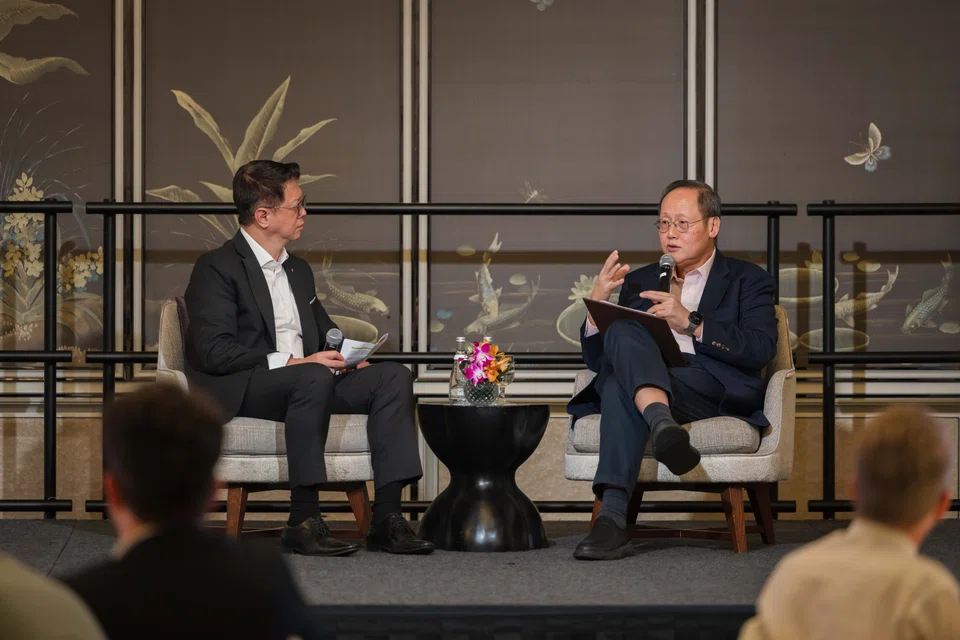
[SINGAPORE] Asean’s diversity does not mean the regional integration is stalling, said Minister for Trade and Industry (Energy and Industry) Tan See Leng, despite the bloc being made up of “a diverse group of nations”.
“I am a firm believer in the Asean story. Just because different economies within Asean have different growth rates…does not mean that integration is not proceeding, or there is a dichotomy in terms of how economies are progressing,” he said at an event on Wednesday (Sep 16).
“The beauty of Asean is that while we are all independent… regionally and externally I think we are very like-minded, so it is how we continue to build that interwoven mesh and get it stronger and stronger,” he added.
The minister was speaking during a dialogue at the launch of a report titled From Tailwinds to Trade-Offs: Southeast Asia Outlook 2026-2035 – the third edition of the 10-year regional outlook report by Bain & Company, DBS Bank and Vriens & Partners.
His remarks come as Singapore is due to take over the Asean chairmanship from the Philippines on Jan 1, 2027.
“This is an Asean century…given the rapid geopolitical disruptions, the uncertainties and the tensions happening all over, we are in a relative oasis of calm…of peace and stability,” said Tan.
“Particularly next year, when we assume (the) chairmanship, we want to deepen… the sort of chairing Asean has done,” said Tan, adding that Singapore and the bloc want to deepen the integration and remain open and connected regardless of crises and pandemics.
“We also want to expand our trade agreements with more countries outside of Asean, and continue to extend our reach with all the corners of the world,” said Tan.
The report noted that South-east Asia’s six largest economies – Indonesia, Malaysia, the Philippines, Singapore, Thailand and Vietnam (SEA-6) – are projected to grow by an average of 4.8 per cent annually between 2026 and 2035, a slight deceleration from the 5.1 per cent annual growth forecasted for the 2024 to 2034 period in the 2024 outlook.
Near-term policy choices will be decisive, with the current environment placing greater weight on three priorities: strengthening institutional resilience, fortifying energy systems and capturing the AI dividend.
This growth however, is subjected to globalisation and trade, technology and industrial competition, as well as conflict and escalation, which could lead to a different growth outcome, said Taimur Baig, managing director and chief economist at DBS.
Global conditions will still be key to setting the boundaries for the region’s growth over the next decade, as South-east Asia’s growth and opportunities remain linked to external demand due to its high dependence on trade – with trade volume in 2016 to 2025 equivalent to about 89 per cent of regional gross domestic product, more than twice the global average.
In 2025, net foreign direct investment (FDI) inflows into the SEA-6 economies rose 25 per cent even as inflows into China contracted by 34 per cent, but investment has become increasingly concentrated in a small number of hubs and sectors.
Dividing growth paths
Despite firm headline growth, the report noted that there is a divergence between countries in the region.
Vietnam grew by 7.5 per cent over the two-year period, while Thailand recorded 2.7 per cent.
Meanwhile, Singapore, Malaysia and Vietnam outperformed the regional average, supported by AI-linked semiconductor demand, manufacturing exports and investment momentum.
Hans Vriens, founder and managing partner of Vriens & Partners, noted that Malaysia has benefited greatly from artificial intelligence and data centre growth, while Vietnam in particular, saw its manufacturing share continue to rise as China+1 investment in export manufacturing continues.
Indonesia fell short of the earlier forecast amid institutional and execution constraints, while the Philippines was impeded by weaker investment and public-sector execution.
The report noted that South-east Asia’s growth trajectories are pulling apart due to differing levels of institutional strength, energy security and technological readiness – factors that determine how well each economy withstands shocks and captures new opportunities.
“The key thing is how do we ensure that the countries that are proceeding faster can be integrated to the other economies (and) the neighbouring states, so that they can be uplifted simultaneously,” said Tan.
Singapore’s positioning in Asean
According to the report, Singapore remains the region’s most resilient economy, underpinned by its safe-haven status, deep capital markets, fiscal buffers and trusted hub credibility.
It draws more than 60 per cent of South-east Asia’s FDI, and is the largest single source of FDI into Indonesia, Malaysia, Thailand and Vietnam.
Regional FDI has surged and its source mix has shifted, reflecting the broader realignment of global supply chains.
This two-way role – drawing in capital while channelling it back out to the region – lets Singapore connect global capital and capabilities with businesses across South-east Asia.
The level of transparency, consistency and stability is good for companies wanting to come into the region, and see Singapore as a base, Tan noted.
“We are not the destination for this capital, we are sort of a point, a connection point. What we hope to do is that as companies come in here, it makes us the regional HQ … to get comfortable and operate out of here, then venture into the region itself,” he said.
Decoding Asia newsletter: your guide to navigating Asia in a new global order. Sign up here to get Decoding Asia newsletter. Delivered to your inbox. Free.
Copyright SPH Media. All rights reserved.