



Asean’s manufacturing sector struggles to scale AI adoption – not for lack of awareness: panellists
Hurdles include concerns over returns on investment and integrating new technologies with legacy systems

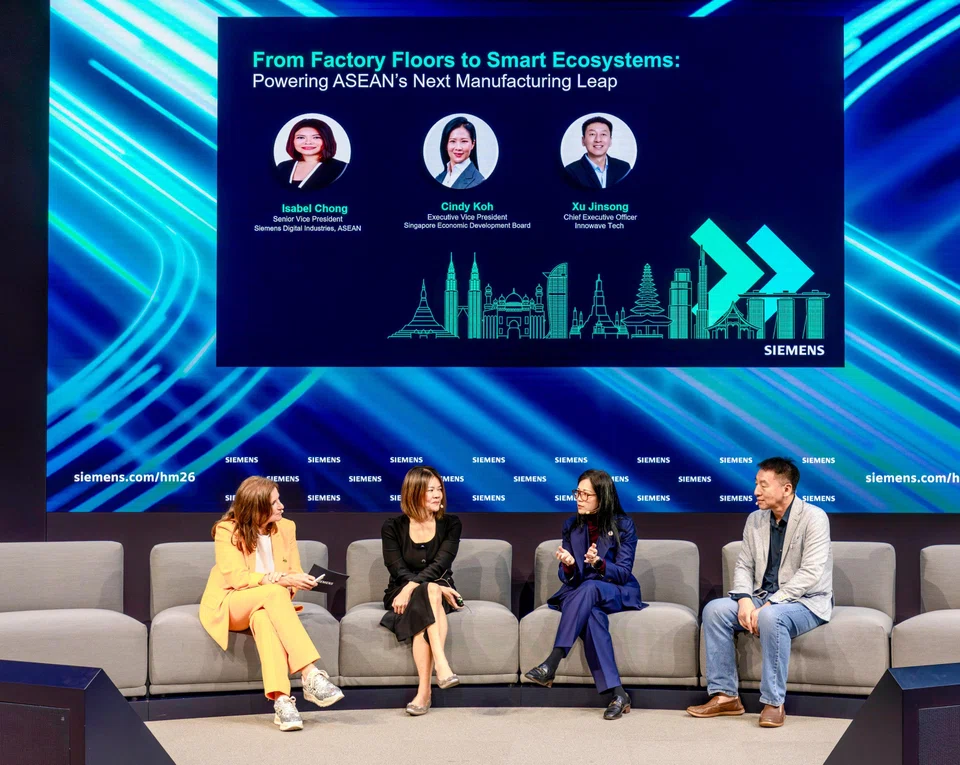
[HANNOVER] Asean’s manufacturing sector is growing, but companies are still struggling to scale the adoption of advanced technologies such as artificial intelligence, said panellists at a dialogue session at a recent industrial trade fair in Germany.
However, they added that the challenge is no longer a matter of awareness, but execution.
Speaking during a panel discussion on powering Asean’s next manufacturing leap at the Hannover Messe on Monday (Apr 20), Singapore Economic Development Board (EDB) executive vice-president Cindy Koh said there are “a lot of opportunities in Asean” to upgrade its existing manufacturing base and improve costs.
Manufacturing currently contributes about 22 per cent to Asean’s gross domestic product, she said – “much higher” than Europe’s 15 per cent and North America’s approximately 10 per cent.
Within foreign direct investment in Asean, manufacturing is a key sector, too, Koh noted.
Asean data showed that total foreign direct investment in the region rose about 8 per cent in 2024 from the previous year to US$226 billion, with manufacturing accounting for the second-largest share at US$44 billion.
The investments were not only in “high-growth, emerging areas”, but also in the development of a smart factory ecosystem, said Koh, whose agency is leading Singapore’s participation at Hannover Messe. The Republic’s pavilion features government bodies such as the Agency for Science, Technology and Research (A*Star), Enterprise Singapore and JTC Corporation, alongside local enterprises showcasing innovations in areas such as AI, robotics and additive manufacturing.
“Not about awareness any more”
While some companies in Asean – such as Singapore software firm Innowave Tech, whose CEO Xu Jinsong was also on the panel – are beginning to use agentic AI systems to monitor factory conditions in real time and support decision-making, such use remains limited.
“It’s not about the awareness any more,” said Isabel Chong, Siemen’s senior vice-president of Asean, digital industries.

She added that Asean faces similar challenges as the rest of the world in scaling the adoption of advanced manufacturing solutions.
Outlining two hurdles, she said the first is that small and medium-sized enterprises (SMEs) in Asean operate on very tight margins, and hence “return on investment is always something on the minds of SME bosses”. Unless companies see the value of adopting solutions such as AI, scaling will remain a challenge, Chong noted.
The second is that many factories are more than a decade old, and using different brands, systems and applications, making it difficult and complex to integrate these systems and apply AI.
Infrastructure and manpower key
A possible solution, Chong suggested, is for countries to adopt “sandbox” environments similar to Singapore’s Advanced Remanufacturing and Technology Centre, a collaboration between Siemens and A*Star.
The centre aims to address industry challenges by giving companies faster access to industrial AI and automation expertise.
“They allow industry players – SMEs and technology players like Siemens – to come into a risk-free environment to grow AI adoption,” said Chong.
She added that such sandboxes have enabled the city-state to develop more than 100 factory solutions to address problems that industry players face.
But while having the right infrastructure in place is important, workforce development is equally critical, said EDB’s Koh.
She noted that manufacturing contributes about 20 per cent of Singapore’s GDP, and that the government has made a long-term decision to maintain this share.
This includes ensuring that education and training remain relevant through industry participation in tertiary institutions, as well as supporting workers through continuous education, upskilling and retraining programmes.
Koh added that the Republic is also open to global talent, particularly in areas such as advanced manufacturing, semiconductors and biopharma.
Today, Singapore is among the most advanced in the region in areas such as automation, with the country the only Asean member in the global top 10 for robot density, ranking second behind South Korea, she said.
Chong noted that, against this backdrop, driving the adoption of AI and smart manufacturing requires a “very strong ecosystem” that brings together governments and SMEs to support scaling.
“At the end of the day, it’s about how fast we can bring innovation, because… that is where industry impact happens,” she added.
Decoding Asia newsletter: your guide to navigating Asia in a new global order. Sign up here to get Decoding Asia newsletter. Delivered to your inbox. Free.
Copyright SPH Media. All rights reserved.
TRENDING NOW

LTA proposes combining car COE categories, adding rebate-surcharge system

StarHub to acquire MyRepublic’s mobile business amid ongoing telco consolidation

DBS, OCBC, UOB rout lops billions off STI as inflation, rate concerns spook investors

Grab CEO’s wife Chloe Tong on life with Anthony Tan and finding her purpose

