Asean Business logo
SPONSORED BYUOB logo
NEWS ANALYSIS

Bank Indonesia’s emergency rate hike buys time for battered rupiah, but investor doubts linger

The currency has fallen by around 8% this year, and is among the world’s worst performers

Summarise
Elisa Valenta
Published Tue, Jun 9, 2026 · 05:54 PM
    • The rupiah strengthened modestly to around 18,085 per US dollar after the central bank's announcement on Jun 9, recovering from the record low of 18,190 touched a day earlier.
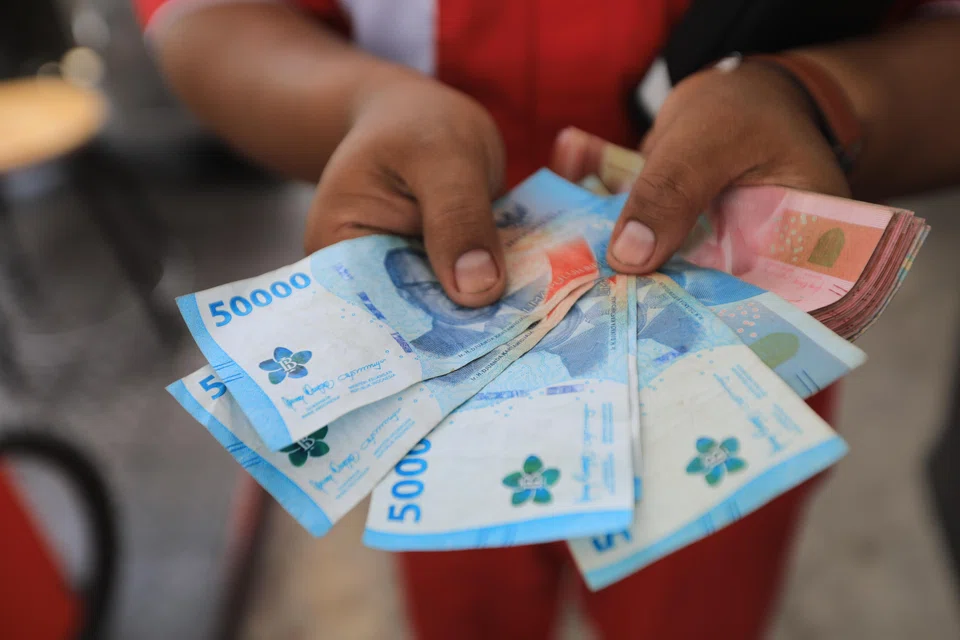
    • The rupiah strengthened modestly to around 18,085 per US dollar after the central bank's announcement on Jun 9, recovering from the record low of 18,190 touched a day earlier. PHOTO: EPA

    [JAKARTA] Bank Indonesia’s (BI) surprise emergency rate hike may buy the battered rupiah some breathing room, but it also reveals the conundrum facing policymakers as external shocks, capital outflows and investor unease over policies collide in South-east Asia’s largest economy.

    The decision also highlights the tension between the immediate need to stabilise a falling currency and the government’s broader push to stimulate economic growth.

    The central bank raised its benchmark seven-day reverse repo rate by 25 basis points (bps) to 5.5 per cent on Tuesday (Jun 9), in an unscheduled move that analysts described as necessary to defend the rupiah after it became one of the world’s worst-performing emerging-market currencies this year, amid growing global volatility from the conflict in the Middle East.


    Economists largely backed the move, saying BI had little choice but to act after the rupiah tumbled to a record low and conventional interventions failed to halt its slide.

    “We think the emergency rate hike is warranted, as the rupiah has been one of the worst-performing emerging-market currencies in the year to date,” said Surya Wijaksana, economist at UOB Kay Hian.

    He expects further rate hikes, with BI likely to raise rates to 6 per cent by the end of the year.

    This latest move also follows recent legal changes that broaden BI’s mandate to support growth and job creation, adding to investor unease over the central bank’s policy direction.

    Unexpected move

    Tuesday’s move was deemed unusual for BI, which typically adjusts policy only during scheduled meetings. The next bank governors’ meeting is due on Jun 17 to 18.

    The last time the central bank effectively made two rate decisions within a single month was during the 2018 emerging-market turmoil, when policymakers aggressively tightened monetary policy to shield the rupiah from the impact of rising US interest rates and a strengthening dollar.

    Tuesday’s decision also made BI only the second central bank in South-east Asia to raise rates this year, after the Bangko Sentral ng Pilipinas’ move in April.

    BI said its action was triggered by a rupiah that has weakened more than expected since the May 20 governors’ meeting, when it raised the rate by 50 bps.

    In a statement on Tuesday, BI noted that further policy measures were needed to support the rupiah, including higher yields and other incentives designed to encourage foreign investment inflows.

    Wijayanto Samirin, an economist from Universitas Paramadina, said that the off-cycle move was “appropriate”, given the urgency and growing investor concerns that have pushed the rupiah to historic lows.

    “Investors now require higher yields to stimulate capital inflows as the spread between the 10-year government bond and US Treasuries has narrowed,” he pointed out.

    The rupiah strengthened modestly to around 18,085 per US dollar after the announcement, recovering from the record low of 18,190 touched a day earlier.

    The currency remains down roughly 8 per cent this year, while foreign investors have pulled more than US$3.5 billion from Indonesian equities, dragging the benchmark index down over 35 per cent.

    Meanwhile, government bonds extended their sell-off, with the 10-year yield rising 23 bps to 7.51 per cent, its highest since November 2022. The five-year yield earlier climbed to 7.52 per cent, a level last seen in May 2020.

    Indonesia’s foreign exchange reserves have fallen by about US$12 billion this year as BI spent aggressively to support the rupiah.

    The central bank and the government pledged on Saturday to work together to strengthen the appeal of Indonesian assets and attract portfolio inflows, with the authorities also committing to maintain adequate market liquidity and support higher yields to draw in capital.

    Surya from UOB Kay Hian said BI’s decision to simultaneously reduce hedging costs for foreign investors should help improve market conditions, as rupiah hedging costs have risen significantly during the recent bout of volatility.

    A mounting challenge

    The emergency hike underscores the increasingly difficult challenge facing Indonesian policymakers as they battle capital outflows, weakening investor confidence and rising political uncertainty.

    Analysts said the move could provide temporary relief for the currency, but warned that interest rate policy alone cannot solve the broader issues weighing on market sentiment.

    Josua Pardede, chief economist at Bank Permata, said that the rupiah’s weakness reflects a combination of external shocks and domestic concerns.

    On the external front, investors continue to grapple with elevated oil prices, geopolitical tensions and higher-for-longer US interest rates, which have intensified capital outflows and a risk-off sentiment across emerging markets.

    Domestically, however, markets have become increasingly focused on issues such as fiscal credibility, regulatory certainty, and the broader direction of economic policy under President Prabowo Subianto’s administration.

    In recent months, investors have grown increasingly cautious over a series of policy initiatives seen as expanding the state’s role in the economy. This also includes plans to centralise exports of key commodities through a state-controlled mechanism.

    Those developments have fuelled debate among investors about policy predictability and the long-term independence of key economic institutions.

    Adding to the uncertainty are persistent rumours surrounding Indonesia’s top economic leadership.

    Speculation over a potential reshuffle at the finance ministry and BI has intensified in recent days, after parliament and the government formally passed revisions to the Financial Sector Development and Strengthening Law last Thursday.

    Market chatter has centred on whether Prabowo can overhaul parts of his economic team as pressure mounts to stabilise financial markets.

    While none of the speculation has been confirmed, analysts said the uncertainty itself has become a factor affecting investor sentiment.

    Pardede from Bank Permata said that the effectiveness of the rate hike would hinge on the ability of policymakers to maintain fiscal discipline, preserve regulatory consistency, and reassure investors that Indonesia remains committed to a stable and investment-friendly policy environment.

    “The rupiah requires not only attractive returns, but also credible assurance that Indonesia’s economic policy direction remains consistent, prudent and investment-friendly,” he noted.