



Can the Johor-Singapore RTS Link help soak up the 61,000 new high-rise homes expected across the Causeway?
Challenge for developers and investors is timing: buying now to capture value, while also managing the risk of new supply flooding the market
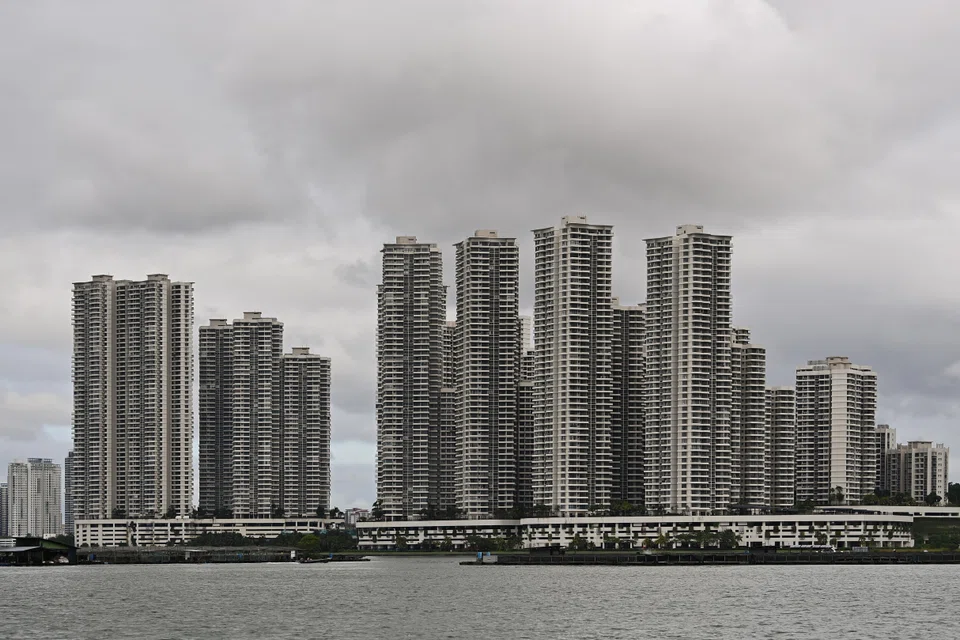
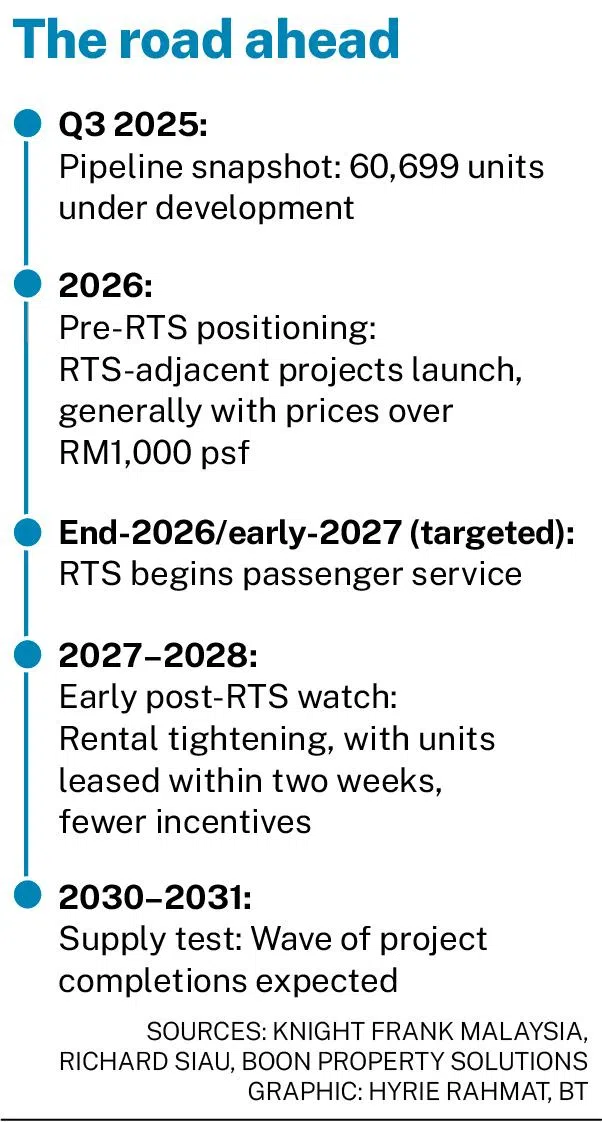
[JOHOR BAHRU] Johor’s property market is being judged by two clocks. One counts down to early 2027, by when the Johor Bahru-Singapore Rapid Transit System (RTS) Link is expected to be operational, easing cross-border friction. The other runs to 2031, when many project launches are due for completion.
Between those dates sits a headline-grabbing figure: 61,000, an estimate of how many high-rise units are in Johor Bahru’s development pipeline, underpinning warnings of oversupply.
Yet, rental agents report robust take-up rates, firmer rents and fewer incentives, suggesting demand may already be tightening ahead of the RTS’ opening.
While one camp sees the oversupply as manageable against an existing overhang, the other is betting that demand will lift by 2027 – early enough to absorb the completion wave expected in 2030 and 2031.
The oversupply case
Knight Frank Malaysia reckons there is a significant pipeline of future supply that could test the market’s absorption capacity.
Johor Bahru is at the front and centre of real estate action in Malaysia’s southern state. As at the third quarter of 2025, the city had 60,699 high-rise residential units under development.
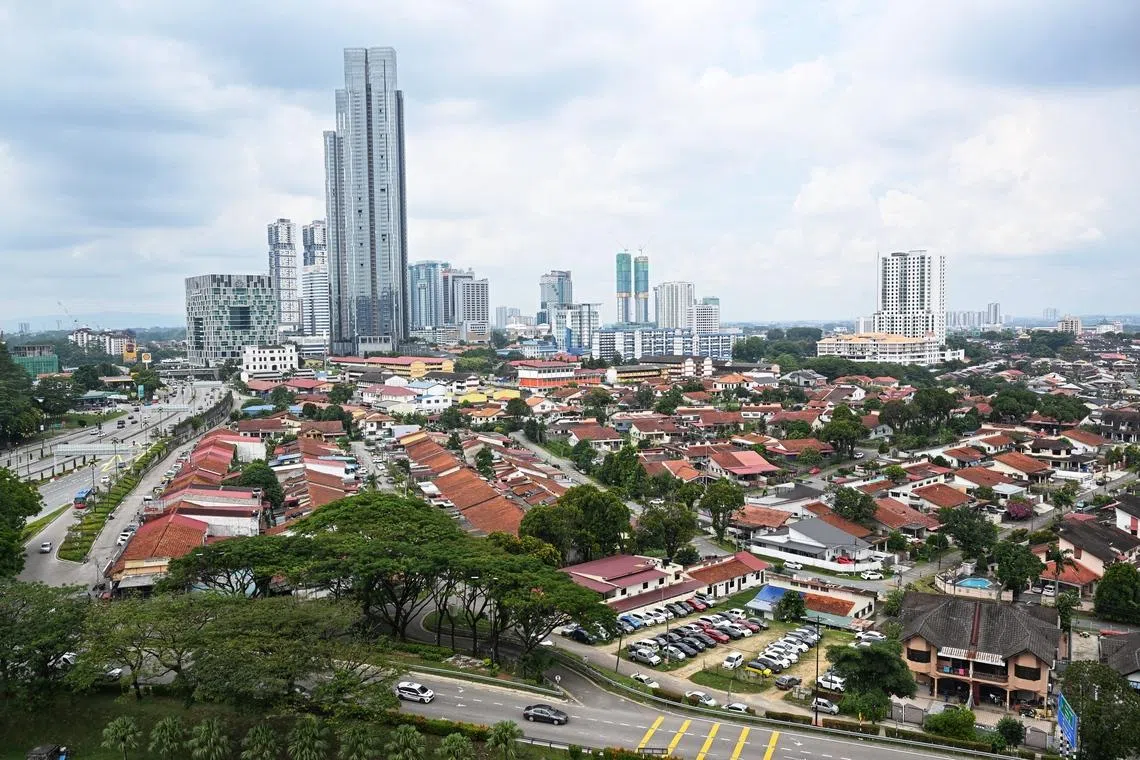
This accounts for almost all – or 96 per cent – of the state’s total future high-rise stock, noted Lee Kun Thye, director and head of Knight Frank’s Johor Bahru branch.
“The market is transitioning into a more normalised phase following the rapid price growth seen in the post-pandemic period, as demand gradually shifts away from speculative-driven purchases to more prudent investment decisions,” she said.
She pointed out that oversupply risks, financing difficulties and long-term capital value uncertainties remain buyers’ key concerns.
The high-rise residential projects in Johor Bahru’s city centre near the RTS station are fetching handsome premiums at launch – above RM1,000 (S$316) per square foot of built-up area, Knight Frank data indicated.
The price trajectory is patchy based on location.
“Prices in Johor Bahru city have appreciated 20 to 30 per cent since Covid, though other parts of Johor such as Iskandar have seen flatter high-rise pricing, with only landed properties showing strength,” said Lee.
A different lens: lifestyle demand and timing
Ryan Khoo, director of real estate consultancy Alpha Marketing, posited that the market is not oversupplied – it is simply misunderstood.
“Right now, it’s unclear if there is oversupply or undersupply. There will be a jump in demand in 2027 after the RTS Link starts and as travel friction drops,” he said.
Following that, the majority of new launches over the next year will come to market in 2030 and 2031, which will lead to “some stabilisation”, he added.
Khoo said that the disconnect stems from assessing Johor’s property market largely through investor metrics – rental yields and capital appreciation – when many buyers fall into two lifestyle segments: Malaysians working in Singapore who can no longer afford to rent indefinitely, and Singaporean retirees seeking convenience and freehold assets to pass on.
Longer-term investors are also buying property as a hedge ahead of the RTS Link opening.
“Market analysis focuses heavily on investor metrics while overlooking the two key buyer segments,” said Khoo, who runs a popular YouTube channel focusing on the Johor property scene.
“Most buyers today are purchasing for their own use or retirement planning, which is very healthy for the Johor market. Making money is secondary.”
Demand tightening
Meanwhile, rental market activity supports Khoo’s theory that demand is robust.
Richard Siau, operations director at Boon Property Solutions, noted double-digit rental growth from levels two or three years ago. He added that units are now typically getting leased within two weeks, compared with much longer vacancy periods previously.
“Landlords don’t need to reduce asking rents, or give incentives like free months or furnishings to secure tenants,” he said. “Owners who work in Singapore or are Singaporean are generally happy with rental yields now. I don’t see more of them wanting to sell.”
Based on Knight Frank’s observations, property demand from across the Causeway appears healthy.
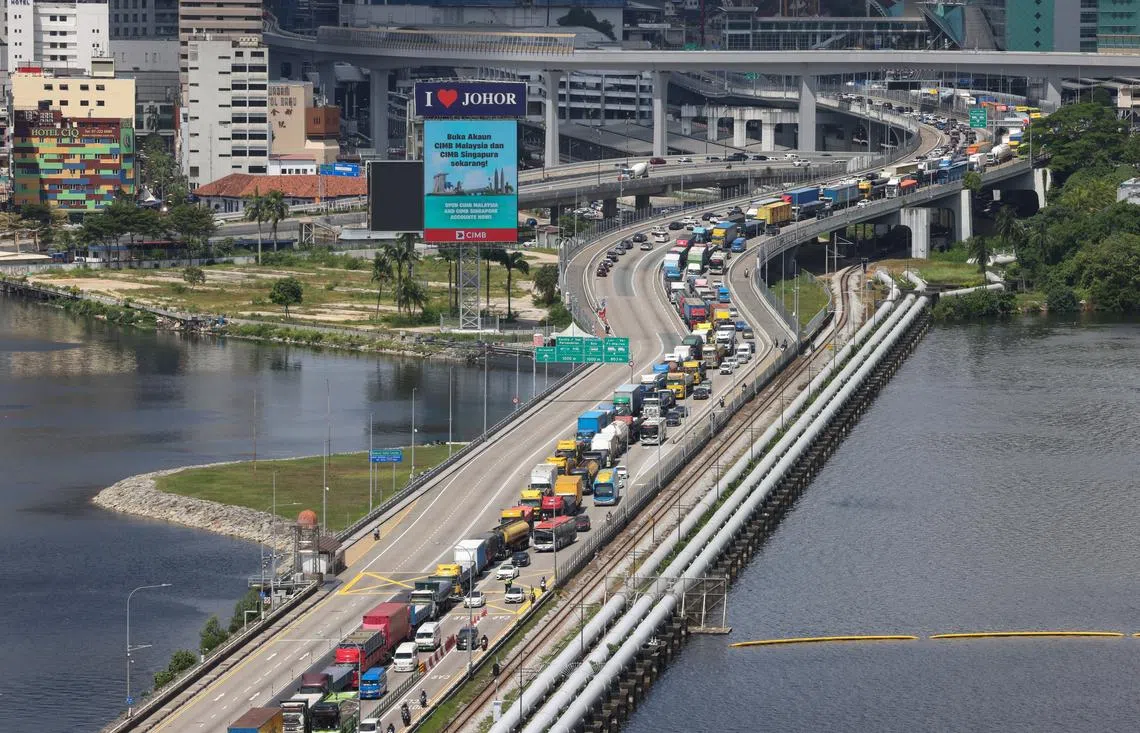
Lee said nearly half the buyers of certain high-rise residential projects within and around the Johor Bahru city centre are either Singaporeans or Malaysians working in Singapore.
There is also rising interest from investors outside Johor state for properties with direct access to the upcoming RTS station.
Uptick in industrial properties
The challenge for developers and investors is timing: buying now to capture value before the 2027 RTS Link opening, while also managing the risk that new supply could flood the market just as demand stabilises in 2030 or 2031.
If demand does not materialise as expected, it will compound the state’s overhang dilemma, Knight Frank cautioned.
Beyond the residential space, the Johor-Singapore Special Economic Zone is reshaping the industrial landscape.
Knight Frank found that asking prices and rental rates for industrial properties have surged by 40 to 60 per cent in some cases, with strong demand for manufacturing facilities and logistics warehouses in well-planned industrial parks.
Industrial expansion is moving northward from Iskandar Puteri to Senai, Kulai and Sedenak, as land prices rise in prime industrial hot spots near the Second Link.
TRENDING NOW

NEA identifies 7 firms responsible for haze fires, notices issued urging action: Grace Fu

DBS remains analysts’ pick ahead of Q3 earnings after Singapore banks’ share slump

High Court rules against Julius Baer’s Singapore trust arm in US$50 million family trust dispute

Could stablecoins be the future of money?

