Asean Business logo
SPONSORED BYUOB logo
NEWS ANALYSIS

Can Thaco’s in-house car brand jump-start sliding assembly sales?

One of Vietnam’s richest men is preparing for his boldest move yet, which can reshape the country’s auto space

Summarise
Jamille Tran
Published Mon, Mar 2, 2026 · 11:59 AM
    • Tran Ba Duong says Thaco Auto will introduce its Thaco-branded passenger cars in 2027.
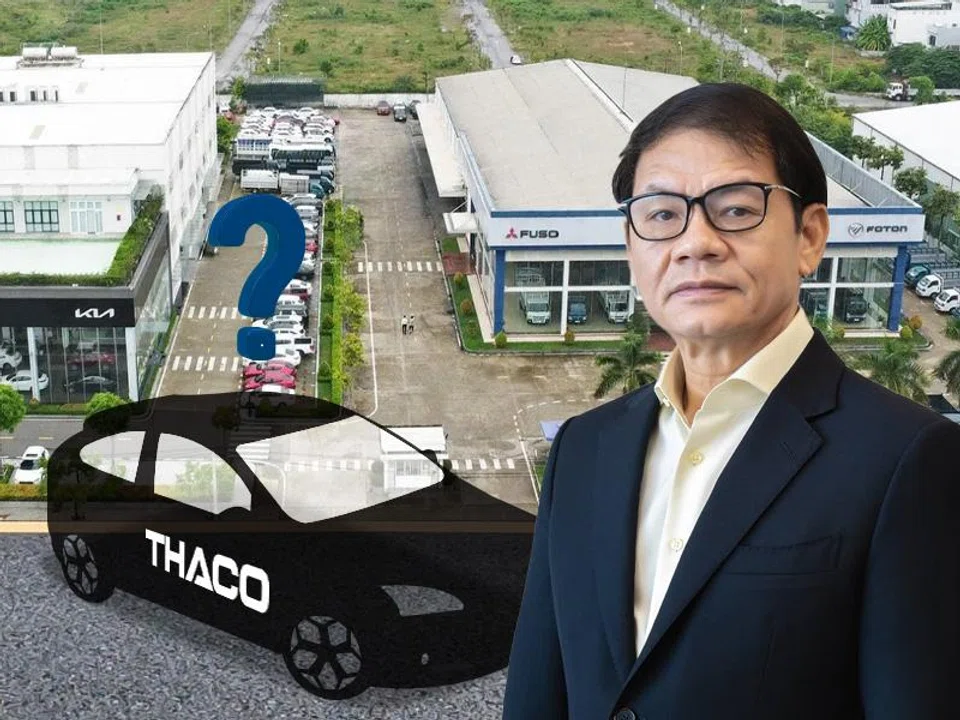
    • Tran Ba Duong says Thaco Auto will introduce its Thaco-branded passenger cars in 2027. IMAGE: BT VISUAL, WITH AI ASSISTANCE

    [HO CHI MINH CITY] For years, Thaco founder and chairman Tran Ba Duong and Vingroup founder and chairman Pham Nhat Vuong have been benchmarked against each other on their net worth and the scale of their infrastructure bets, including their high-speed rail ambitions.

    Now, the stakes have shifted to a more structural challenge: Can Thaco transition from an assembler to Vietnam’s second home-grown passenger car brand after electric vehicle (EV) maker VinFast, also founded by Vuong?

    Thaco’s move is no doubt a defensive play as its traditional assembly and distribution business under foreign brands – from South Korea’s Kia, Japan’s Mazda to France’s Peugeot and Germany’s BMW – shows signs of strain. Its line-up also includes British brand Mini, with American marques Jeep and Ram expected to join.


    The delicate balancing act lies in positioning the new passenger car brand to fill gaps within Thaco’s portfolio without competing against the global brands it currently assembles as a contract manufacturer.

    Brands assembled and distributed by Thaco account for about 15 per cent of Vietnam’s car market, yet nearly all of those vehicles carry foreign badges, excluding Thaco’s own truck and bus lines. 

    Nguyen Quoc Binh, the administrator of OFFB – one of the largest Facebook groups for car enthusiasts in Vietnam with more than 1.7 million members – said Thaco faces a difficult task in carving out growth space for its own brand, given it already manages a handful of international marques across multiple segments.

    “Many of them – despite strong branding, competitive pricing and stylish designs – are also struggling,” he said.

    The automotive giant had targeted sales of more than 100,000 vehicles in 2025, but full-year results came in roughly 10 per cent lower – just more than 90,000 units, broadly flat from 2024. That lagged the Vietnam market, which expanded 22 per cent to 604,000 cars of all types last year.

    Data from the Vietnam Automobile Manufacturers’ Association showed that sales of the five passenger car brands assembled and distributed by Thaco fell from 81,553 units in 2023 to 71,738 in 2024. In 2025, the group reported deliveries of around 64,000 units in this segment.

    Two of its biggest contributors underperformed. Kia sales dropped 21 per cent to 27,176 vehicles in 2025 – one of the steepest declines among mass-market passenger brands and about 40 per cent below its 2021 peak. Mazda was largely flat, as were higher-end marques Peugeot, BMW and Mini.

    Meanwhile, VinFast EVs have risen to the top as best-selling models in Vietnam, surpassing other Japanese and South Korean internal combustion engine names that have long dominated the domestic market.

    Against that backdrop, Thaco’s push into brand ownership marks a strategic shift of the automotive empire.

    In a Lunar New Year message to employees on Feb 23, Duong said Thaco Auto will introduce Thaco-branded minibuses in June, followed by Thaco-branded passenger cars in 2027.

    He added that the company will focus on “researching and developing products to meet the specific requirements of customers and personalisation”, while also aiming at “boosting export sales and spare parts service business”.

    For 2026, Thaco Auto has targeted sales of more than 96,600 vehicles and revenue of 65.5 trillion dong (S$3.2 billion) – up 21.6 per cent from the previous year. Sales in 2027 are projected to reach 72 trillion dong – a target that appears closely aligned with its entry into the passenger car segment with its own brand.

    Timothy Wong, principal at Roland Berger and head of its automotive and mobility practice in South-east Asia, said Thaco’s manufacturing and distribution footprint provides a base to build upon.

    It has a strong production track record through its partnership with global brands over the past decade, as well as an extensive downstream network of about 450 showrooms and service centres nationwide.

    “These manufacturing, sales and distribution capabilities provide a solid foundation to explore the feasibility of launching its own brand,” he said.

    From assembler to brand owner

    For three decades, Vietnam’s auto industry has been shaped by global names such as Toyota, Hyundai and Ford.

    More than 10 local manufacturers largely operate as assemblers and distributors, with supply chains and product strategies dictated by parent companies abroad.

    Thaco built its empire on that model, particularly through its automotive and mechanical complex at Thaco Chu Lai Industrial Park in the former central province of Quang Nam, now part of Da Nang City.

    The timing of the industrial group’s move from contract manufacturing towards full brand ownership is a significant shift in a market long dominated by foreign marques. It also coincides with the government’s push to elevate and integrate Vietnam’s automotive industry more firmly into global value chains.

    The Ministry of Industry and Trade is finalising a development strategy to 2030, with a vision to 2045. The draft targets annual market growth of 8 to 10 per cent, reaching 800,000 to 900,000 vehicles by 2030.

    Domestic output is projected at 550,000 to 650,000 units, meeting up to 75 per cent of local demand, while export turnover of vehicles and components could reach US$14 billion to US$15 billion.

    “The emergence of a second national passenger car brand... would help future-proof Vietnam’s auto sector by deepening local capabilities and supply chains,” said Koketso Tsoai, automobiles analyst at BMI.

    “It would also signal that barriers to entry are manageable, which can support additional investment across components, manufacturing and supporting services,” he added.

    Thaco is obviously not starting from scratch.

    The group already manufactures trucks and buses under the Thaco brand, achieving localisation rates of as much as 70 per cent in some segments. Its in-house models account for roughly 70 per cent of Vietnam’s bus market.

    The giant has also experimented with deeper product development, such as the Thaco Yoyal, built on the Kia Carnival platform and positioned as a domestically refined offering.

    However, analysts cautioned that the new car brand could create competitive tension and unintentionally cannibalise partner brands in ways that damage long-term relationships.

    BMI’s Tsoai said global experience shows that combining an in-house brand with third-party distribution can succeed, but cautioned that it typically requires “clear segmentation rules, separate sales targets and disciplined portfolio positioning to minimise friction”.

    “There is a real risk of friction with foreign partners if Thaco’s own brand displaces their volumes or receives preferential retail treatment,” he added, though acknowledging the “long-term autonomy” and “reduced reliance on international licensing and partner agreements”.

    The ecosystem question

    If Thaco moves into EV, the challenge becomes even more complex.

    “To sell EVs like VinFast, you must have charging infrastructure and a usage ecosystem (through affiliated taxi and mobility business) – not to mention extremely strong competition from Chinese cars,” OFFB’s Binh said.

    “Right now, Vinfast is not just selling electric cars, but an entire ecosystem that comes with them. If you cannot build the ecosystem, how can you sell the cars?”

    Although Thaco operates a massive showroom network nationwide, Binh noted that many of these outlets are shaped by the requirements of specific brands under distribution agreements. Launching a new marque may require a separate legal entity and a new distribution system.

    Truong Bui, partner at Roland Berger in Vietnam, said that while the government strongly supports localisation and supplier development – and Thaco benefits from tax incentives in the Quang Nam economic zone – the key concerns would be that the local research and development capability and talent in areas such as EV systems and batteries remain relatively underdeveloped compared with global leaders.

    “Competition extends beyond VinFast to include highly competitive Chinese brands in both product quality and pricing,” he added.

    Developing full end-to-end brand capabilities would also require heavy capital and resource commitments, raising potential financial and operational risks without careful execution.

    Binh said Thaco’s Duong could be well aware of the stakes. 

    “Perhaps he only intends to make a limited, symbolic model to assert the brand,” he added, suggesting that the 2027 debut – coinciding with Thaco’s 30th anniversary – may be more a statement of capability than the start of a full-scale market push.