



From chillies, chicken and rice, Indonesia’s food costs surge amid free meal rollout
President Prabowo Subianto’s US$10 billion free nutritious meal programme may be stoking price pressures of food staples

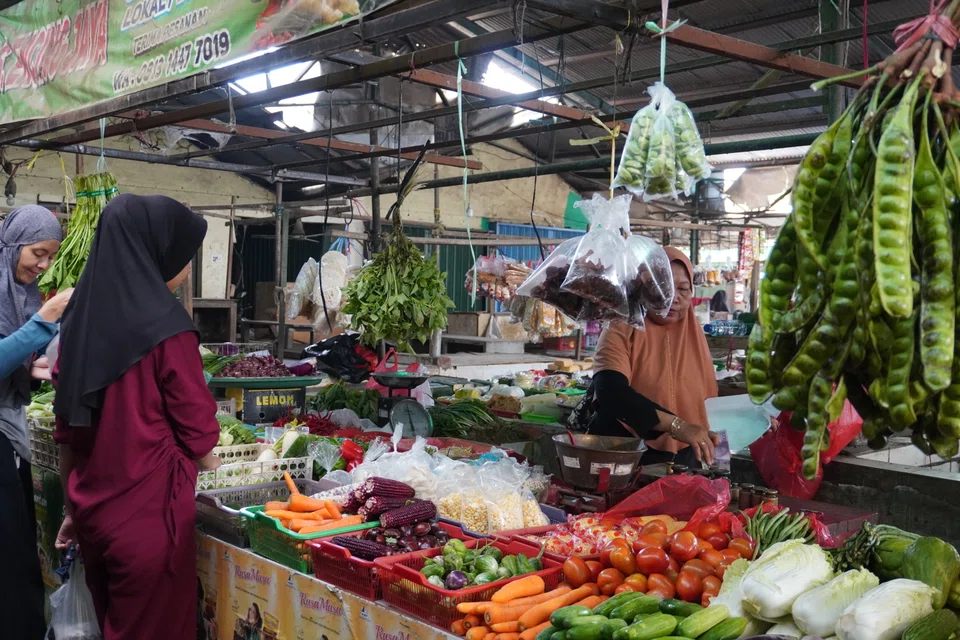
[JAKARTA] For the past couple of months, Bilal Hilman has been cutting back on the sambal portions in his popular dishes to cope with the surging prices of key ingredients such as red chillies, eggs and chicken.
The 38-year-old, who has a stall in Jakarta, is trying to avoid raising prices for his loyal customers. “It’s better to reduce the portions. If I increase the price, customers will surely stay away,” he remarked.
Bilal’s dilemma is echoed nationwide. Indonesia’s food inflation climbed to a 16-month high in September to 6.4 from 4.5 per cent in August.
The steepest price increases were seen in staples such as eggs, broiler chicken and rice. Maybank economists said that it is a worrying trend as household purchasing power is eroded.
The free meal effect
Officials and economists said the surge in price was partly due to President Prabowo Subianto’s flagship free nutritious meal programme, which has inadvertently fuelled demand and strained local food supplies and distribution networks.
Home Affairs Minister Tito Karnavian, who recently convened all regional leaders to coordinate efforts to rein in local inflation, said previously: “This is likely because the programme has sparked a jump in demand,”.
The US$10 billion free meal programme, launched earlier this year, currently serves around 36 million students daily across Indonesia. Its implementation intensified in the late second quarter as the government plans to expand coverage to 82.9 million beneficiaries by year-end.
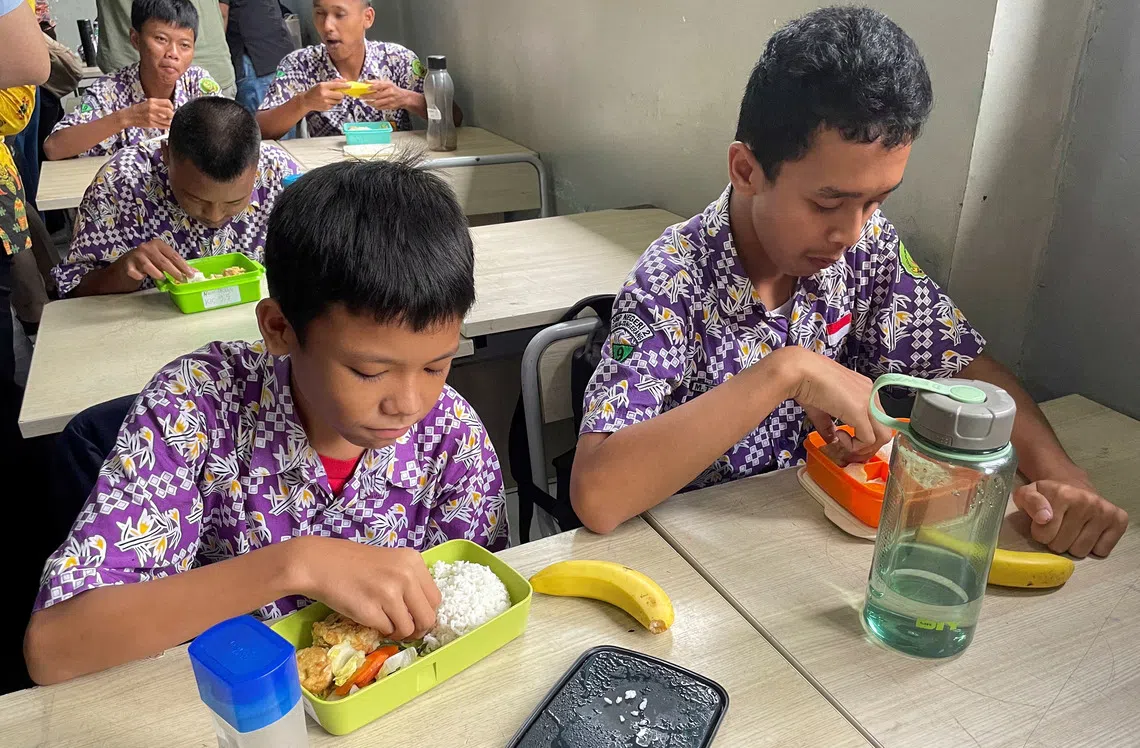
The pressure on egg prices has become particularly noticeable in recent weeks.
On Oct 17, the National Nutrition Agency, which oversees the free lunch programme, instructed all kitchens to prepare Prabowo’s favorite dish – fried rice topped with a sunny-side-up egg, to mark his birthday.
Parjuni, chairman of the Central Java Poultry Farmers Association, said farmers are struggling to keep up with rising demand, which has driven prices higher. The main challenge, he explained, lies in the different production cycles of laying hens and broiler chickens.
“Each laying hen produces only one egg a day,” Parjuni said. “By contrast, broiler chickens can yield one to 3 kg of meat, and farmers can simply extend the feeding period by a few days to boost their weight by about 10 per cent. But with laying hens, output is fixed.”
To avoid supply shortages, Parjuni said Indonesia needs more poultry farmers to scale up the production of both chickens and eggs. He added that the challenge is also linked to feed availability and affordability, since poultry feed relies heavily on corn.
Indonesia imports most of its corn for feed, averaging around one million tonnes annually. The rupiah’s depreciation, among the weakest in Asia this year, has further pushed up import costs, driving up the price of animal feed.
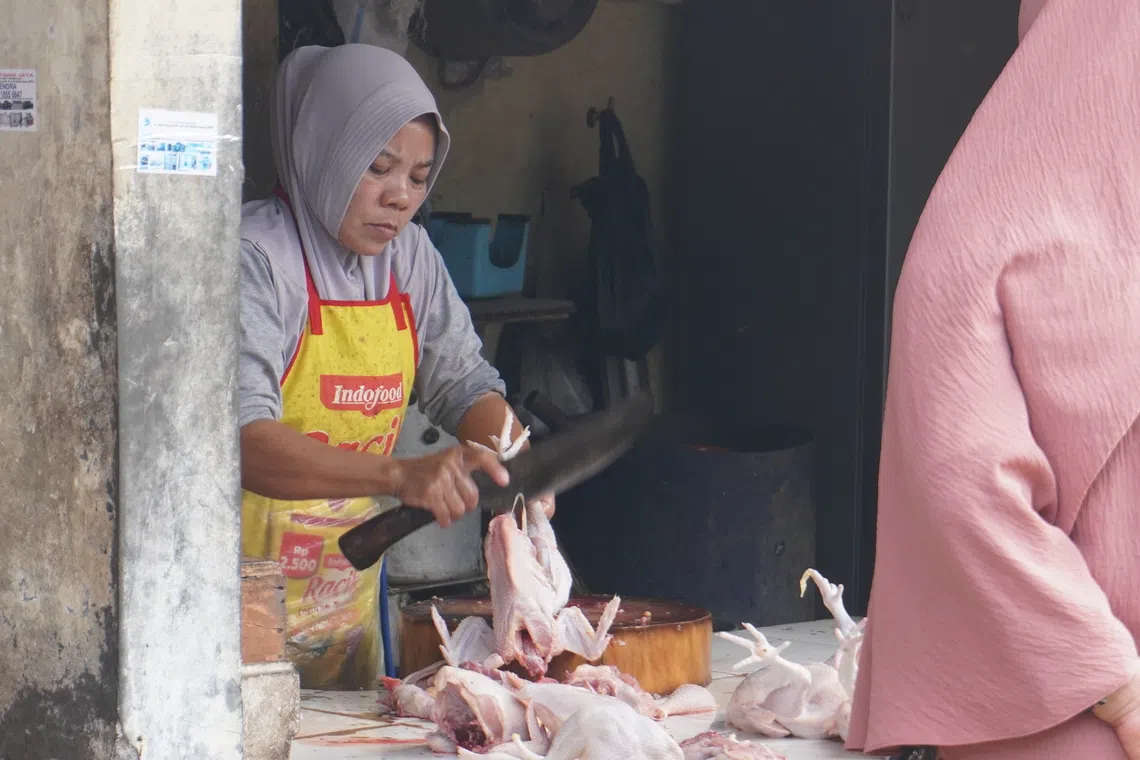
The sharp rise in chicken prices has also forced poultry sellers in Jakarta’s traditional markets to cut back on their stock, fearing that high prices will drive customers to buy less.
Itok, a chicken vendor in Jakarta, said she now stocks around 30 chickens a day. This is down from 50 previously, as sales have fallen by about 30 per cent over the past month.
The Centre for Economic and Law Studies warned that the free meal programme could stoke food inflation and deal a blow to small and medium enterprises.
The think tank noted most third-party caterers running the programme rely on large-scale industrial kitchens that source ingredients from big suppliers, rather than buying chickens from traditional markets or local farmers.
As a result, small traders are left high and dry, with fewer buyers in the market, shrinking chicken supplies, and prices climbing through the roof.
Wider economic impact
Eko Listiyanto, vice-director of the Jakarta-based think tank Institute for Development of Economics and Finance, said: “This should serve as a warning for the government and Bank Indonesia, as higher inflation could dampen consumer appetite for spending.”
He further warned that Indonesia has also entered the La Nina rainy season, with extreme rainfall expected in some regions, which could damage crops and disrupt supply chains.
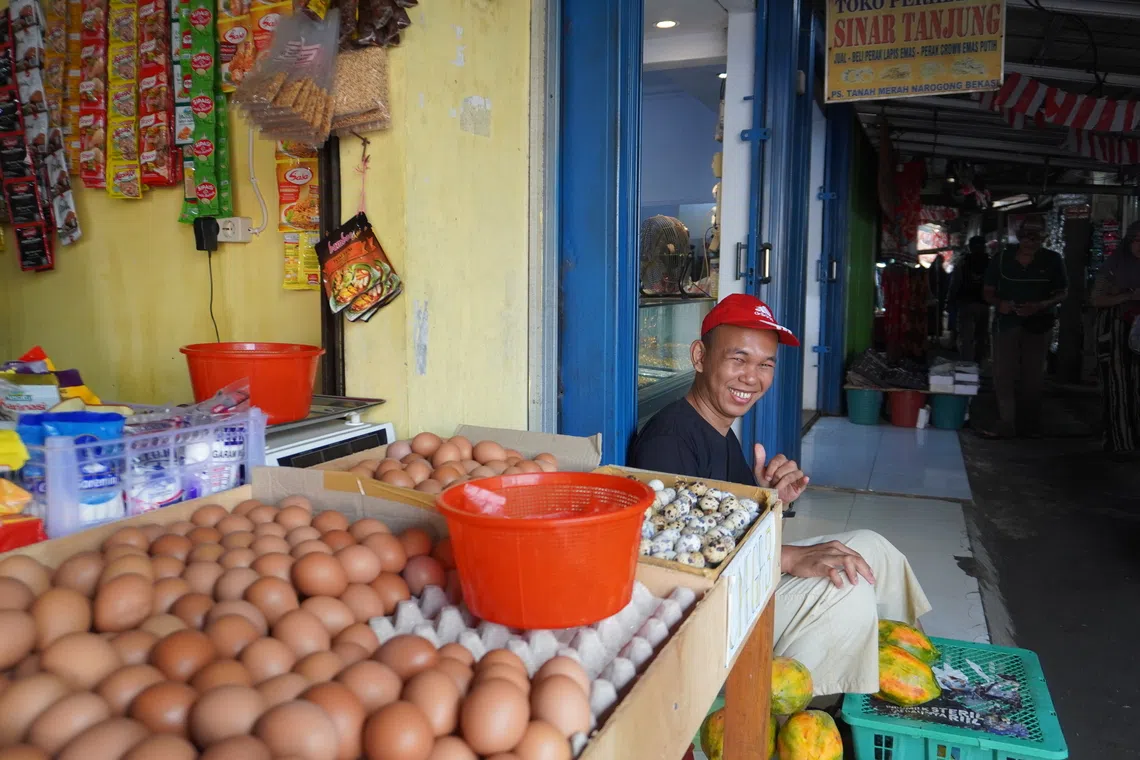
In some parts of Bekasi, West Java, the price of chicken eggs has jumped about 30 per cent since the beginning of October, rising from 27,000 rupiah (S$2.10) to 35,000 rupiah per kg.
Beyond Java, rising staple food prices have also been making waves in several regions, including North Sulawesi, West Nusa Tenggara, South Sumatra and South Kalimantan.
Maybank noted that food accounts for about 22.5 per cent of household spending in Indonesia’s consumer price index. Purchasing power woes are unfolding despite despite the central bank’s 125-basis-point rate cuts.
The consumer confidence index has fallen for four consecutive months, slipping into contraction territory, rendering the government’s 8 per cent gross domestic product growth target by 2029 as a tad ambitious.
This in turn has prompted a shift in lifestyle and habits – more home cooking.
Clara Chintya, a 32-year old housewife, said she has cut back on dining out to save money, as she’s setting aside funds for a Christmas trip back to her hometown with her family of four later this year.
“Now we only eat out on weekends,” she said.
Analysts said prices could spike further as demand peaks over the fast-approaching year-end holidays.
Rice bowl issues
The rise in food prices comes as Prabowo pushes to make Indonesia self-sufficient in food production and reduce imports this year.
The government has allocated 253 trillion rupiah to strengthen food security. The funds will go towards purchasing fertilisers, improving agricultural infrastructure and developing new rice fields.
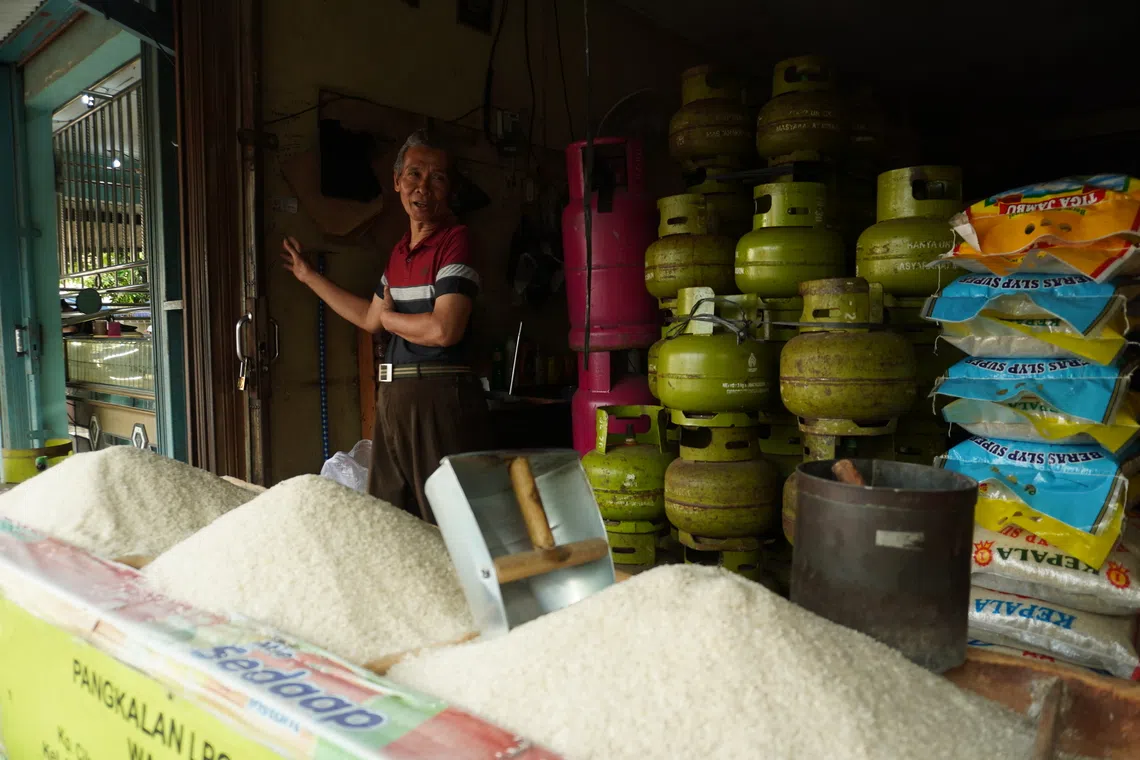
Rice, which the government has decided not to import this year, is expected to reach a total production of 34 million tonnes by the end of the year. With annual domestic consumption estimated at around 25 million tonnes, the government believes current output will be enough to meet national demand.
Yet, despite ample supply, rice prices remain above the government’s reference level. The price of medium-grade rice on Tuesday (Oct 28) reached 13,610 rupiah per kg, up about 5 per cent from the beginning of the year.
Alex Indra Lukman, a member of parliament overseeing food affairs, said the problem stems from inefficiencies in supply chains on the ground. He urged the government to step in and improve the country’s distribution and logistics systems to help ease the burden of high delivery costs on traders.
“It’s also important to ensure that stimulus and food assistance programmes are directed toward vulnerable groups,” he said.
Indonesia is set to release its third-quarter GDP figures on Nov 5. Several analysts expect the pace of expansion to slow from the previous quarter’s 5.1 per cent.
Finance Minister Purbaya Yudhi Sadewa recently warned that economic growth could be dampened by the impact of the violent protests that erupted in late August. However, he pledged to push growth to 5.2 per cent this year as government spending accelerates.






