China pips the US if Asean is forced to choose, but analysts warn against reading it like a sports result
Sentiments in the region over the two major powers flip again in Iseas-Yusof Ishak’s annual South-east Asia survey

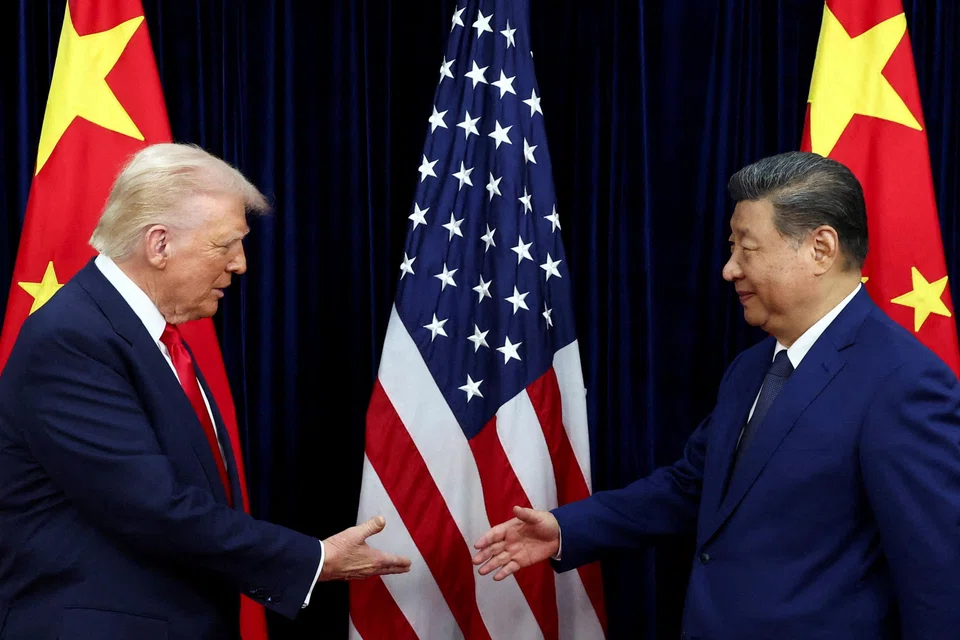
[SINGAPORE] When presented with a hypothetical binary choice between choosing to align with either Beijing or Washington, more respondents in the latest annual survey by a home-based think tank picked China.
In Iseas-Yusof Ishak Institute’s State of Southeast Asia poll, 52 per cent selected China, and 48 per cent, the US – a swing back towards Beijing from last year, when 52.3 per cent chose the US, and 47.7 per cent, China.
This year’s survey, conducted between Jan 5 and Feb 20, polled 2,008 respondents from all 11 member nations of Asean. More than half the respondents were graduates, with 43 per cent working in the private sector; the remaining respondents were a mix of academics and representatives of government, regional and international groups.
Analysts in an online panel discussing the eighth edition of the survey on Tuesday (Apr 7) said that while this particular question generates a lot of attention, the results should not be read as one side winning and the other, losing.
Scot Marciel, a senior adviser at the consultancy BowerGroupAsia and former US ambassador to Myanmar and Indonesia, said: “These numbers are useful as a barometer of mood, levels of concern and levels of trust.
“It makes it sound like it’s a sporting event that one side is going to win or not, which is obviously not the case.”
The question was first asked in the 2020 edition of the survey. The US was the preferred choice from 2020 to 2023.
In 2024, China became the preferred choice, before Asean flipped back to the US last year, and then to China again this year.
Wang Zichen, deputy secretary-general at the Center for China and Globalization, a Beijing-based think-tank, also urged caution: “I would personally be very careful with this finding. I do not think it means South-east Asia has somehow chosen China.”


He also noted that the authors of the survey also observed that regional sentiment remains finely balanced.
The survey found that 55.6 per cent of the survey respondents expected relations with China to improve, or improve significantly over the next three years – five percentage points more than last year.
Respondents emerged more cautious about the state of relations with the US in the next three years, under US President Donald Trump’s second administration.
A majority of respondents, 55.9 per cent, perceived China as the most influential economic power in the region, and 49 per cent viewed China as being the most influential political and strategic power in South-east Asia.
However, even while the region’s respondents acknowledged China’s influence, they were also wary of Beijing’s growing reach; the concern over this was especially high in Vietnam, the Philippines and Thailand.
Some concerns that emerged about China from the survey included Beijing’s encroachments in the exclusive economic zones and continental shelves of South-east Asian littoral states, and accidental conflicts between China and an Asean state.
Where leadership in upholding a rules-based order was concerned, the survey respondents harboured less confidence in China doing this than the US, despite China being viewed as the most influential political-strategic power in the region.
Marciel argued that actions by the Trump administration, such as the imposing of the trade tariffs, may push South-east Asian nations away from the US, but it does not mean that these nations would want to work more with China as a result. They could instead opt to do so with countries like Japan, Korea or India.
A trend that emerged more clearly in this year’s survey was that of a stronger consensus within Asean that alternative supply chains need to be built to cushion the region from the fallout of the ongoing trade tensions, and that the region should step up on integration in response to rising protectionism and nationalism.
Yet, even as the respondents saw the need for deeper integration, they also acknowledged that the region’s diversity could present a challenge.
Specificallly, they cited domestic technocratic implementation capacities (30.2 per cent) and the disparity in member states’ economic development (30.1 per cent) as impediments to deeper economic integration.
Geopolitical pressures affecting regional interests came in third (27.5 per cent).
In a positive for the region, most respondents think that the Asean Digital Economic Framework Agreement (DEFA) is expected to significantly contribute to raising digital capabilities and enhancing regional digital trade.
This was despite limited details on how the talks in late 2025 ended.
The DEFA negotiations on boosting cooperation in areas including digital trade, e-commerce and cross-border data flows opened in late 2023. Once completed, the value of Asean’s digital economy is expected to grow from a projected US$1 trillion to US$2 trillion by 2030.
The pact is expected to be signed later this year.
Decoding Asia newsletter: your guide to navigating Asia in a new global order. Sign up here to get Decoding Asia newsletter. Delivered to your inbox. Free.
Copyright SPH Media. All rights reserved.