China’s Pinglu Canal likely to benefit Singapore, other South-east Asia ports in the long term
Strategic enhancement could slash logistics costs by a third, say observers

[SINGAPORE] The opening of the Pinglu Canal in Guangxi, China, is likely to bring benefits to Asean in the long term, although currently the impact is “minimal” on South-east Asia ports including Singapore, observers say.
Associate Professor Loh Hui Shan of the Singapore University of Social Sciences believes that the Republic could benefit from additional trade, feeder traffic and maritime services.
That said, the academic – who has a PhD in maritime studies – pointed out that some transhipment flows could also be redirected from Singapore if shipping lines introduce more direct services to regional destinations from Guangxi’s Beibu Gulf ports.
The impact may be felt across the wider region, rather than in Singapore alone, she added.
Aditi Rasquinha, CEO of DHL Global Forwarding Greater China, said the canal is a strategic enhancement to an already fast-growing China-Asean trade corridor.
“By giving south-western China a more direct route to the Beibu Gulf and Asean markets, it reduces distance, transit complexity and logistics costs for cargo originating from inland provinces,” she said, adding that the canal shortens some routes by more than 500 km and could slash logistics costs by up to a third.
A major development
According to Xinhua, total trade between China and Asean from January to July this year reached US$744.4 billion, up 24.7 per cent year on year, and accounting for more than one-fifth of China’s foreign trade.
In 2025, China-Asean trade exceeded US$1 trillion for the first time, at US$1.1 trillion; China has remained Asean’s largest trading partner for 17 consecutive years, while the bloc has been the country’s biggest trading partner for six successive years.
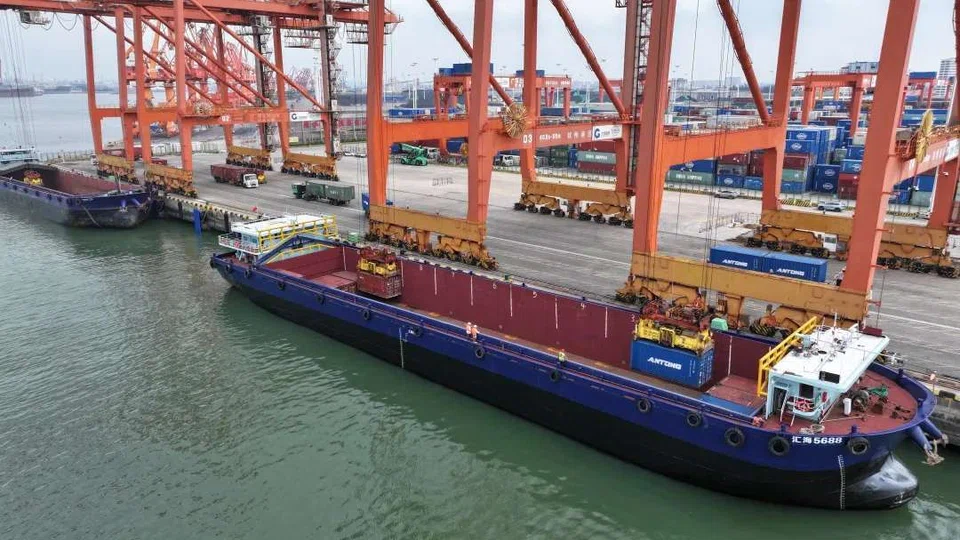
Pinglu Canal opened on Wednesday (Sep 16). It cost over 70 billion yuan (US$10.4 billion) and directly links Guangxi’s coastal city Qinzhou with the inland river networks of south-west China. The waterway is capable of handling large-scale cargo and container ships up to 5,000 tonnes.
It stretches 134.2 km southward from Hengzhou, under the jurisdiction of Nanning, the capital of Guangxi, and flows into the Gulf of Tonkin, also known as the Beibu Gulf in China.
It is regarded as a pivotal development for Guangxi.
Before this channel was opened, freight ships from Guangxi and south-western China had to detour eastward along the Xi River via Guangdong to get to the sea, creating the awkward situation where, according to the historical phrase, “Guangxi’s goods do not depart from Guangxi’s ports”.
Media reports said it also grants landlocked provinces such as Sichuan and Chongqing a direct logistics gateway to South-east Asian markets.
China-Asean trade boost?
Singapore’s PSA International, which holds a joint venture stake in the Beibu Gulf-PSA International Container Terminal located in Qinzhou, is bullish about the prospects of the new maritime route.
“The opening of the Pinglu Canal further strengthens connectivity between China’s western provinces, South-east Asia and global markets, and reflects the evolving and diversifying regional trade networks,” a spokesperson told The Business Times on Thursday.
Also, it introduces a new stream of river-to-sea transhipment volumes at Qinzhou Port.
DHL’s Rasquinha said that China’s south-western provinces – including Guangxi, Yunnan, Guizhou, Sichuan and Chongqing – would benefit from the canal.
“These provinces have historically faced longer distances and higher costs in accessing international shipping routes, and the canal provides these regions with a more direct maritime gateway to Asean and beyond,” she said.
Meanwhile, Asean countries with strong manufacturing, sourcing and trade linkages with China, particularly Vietnam, Thailand and Malaysia, are well positioned to benefit from increased connectivity as well.
Strategic benefits
Sector players also said that the canal could eventually help China-Asean supply chains mature further.
Rasquinha said that the canal strengthens the connectivity underpinning the New International Land-Sea Trade Corridor by linking manufacturing centres that are inland in China more efficiently with regional and global markets.
The corridor is a rail-sea trade passage between China and Asean that is a joint effort between a number of western Chinese provinces and Singapore.
“This is especially important at a time where Chinese companies are seeking greater supply chain resilience and diversification: improved multimodal connectivity can support deeper economic integration between China and Asean,” she said.
Over a longer time period, manufacturing supply chains spanning the two regions could be strengthened, as South-east Asia and China are increasingly interconnected in higher-value-chain sectors such as electronics, machinery, automotive components and industrial manufacturing.
“Improved connectivity can facilitate the movement of intermediate goods between production locations, supporting more integrated regional supply chains,” Rasquinha added.
Birth of a canal
Not all observers are convinced the canal will affect South-east Asia in a major way, though.
Tan Hua Joo, analyst at container shipping intelligence provider Linerlytica, said there is “minimal” spillover impact on Singapore and other South-east Asian ports as south-west China is not a major trading region for South-east Asian countries.
A Singapore fruits distributor told BT that she has observed more interest in the Republic for fruits from Yunnan, a south-western Chinese province.
But she said her Chinese supplier’s export manager told her it is too early to tell whether exporters in western China will reroute to the Pinglu Canal.
While savings appear clear-cut for the time taken for Guangxi exports – going through Guangdong entails trucking over 500 km or two days on the road – the cost savings may not be as direct.
There are other considerations, based on what the export manager told her; for instance, the Guangdong logistics providers might be willing to undercut their Guangxi counterparts to persuade customers to continue taking the longer route as the Chinese market is highly competitive.
Therefore, the question of whether exporters in Guangxi and western China will take to the Pinglu Canal is yet to be answered.
DHL’s Rasquinha said she expected trade flows to be boosted, but cautioned that the scale of these flows will depend on whether the new route can demonstrate reliable transit times, efficient transfers and competitive end-to-end logistics costs.
TRENDING NOW
He built the Vingroup empire. Now South-east Asia’s richest man is handing some key roles to his sons
Suntec Reit to increase Singapore focus, sell three Australia properties
Despite the de-dollarisation debate, demand for dollar liquidity in Asia is growing
Not just a warehouse: Industrial players pump hundreds of millions into high-spec automated logistics assets