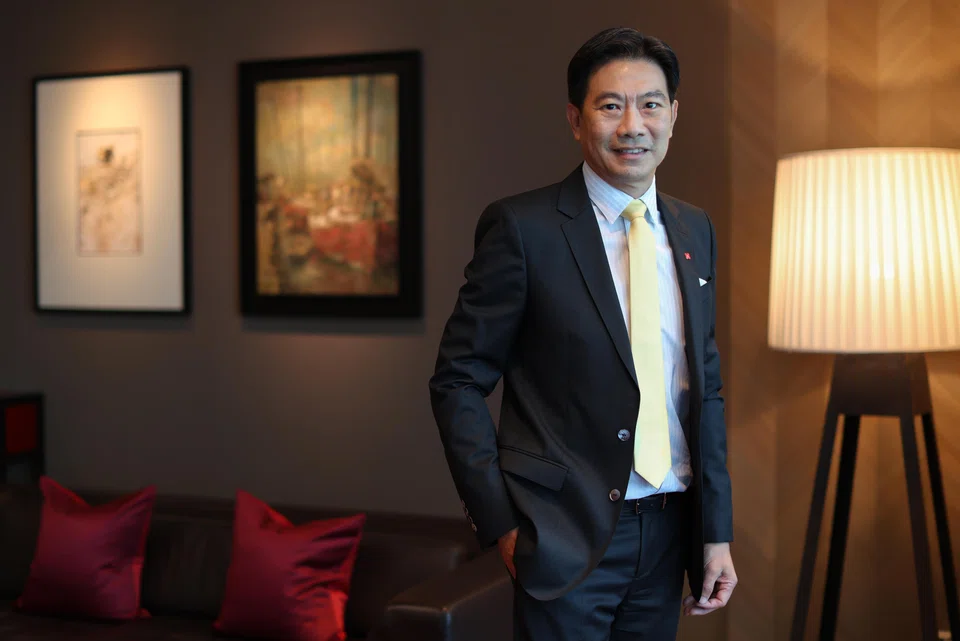
DBS COO’s most important tip for AI transformation: Lead with ‘why’
In executing the bank’s artificial intelligence strategy, Derrick Goh sees his role as a ‘midfielder’

The strategies and stories that shape today’s leaders
[SINGAPORE] Derrick Goh, DBS’ first-ever group chief operating officer (COO), is leading the execution of the bank’s artificial intelligence strategy.
A recent milestone was the roll-out of an agentic AI assistant to all its corporate clients in Singapore, with plans to expand into Hong Kong and other key markets in the coming months.
Scaling up the capabilities of this assistant, named DBS Joy, and a transformed call centre are two outcomes Goh is proud of – mostly because they directly benefit the bank’s customers.
Since becoming group COO in April 2025, Goh has spearheaded an initiative to redesign how work gets done using AI, translating strategy into tangible results.
“Transformation is key to adapt, compete and establish a competitive advantage,” he told The Business Times during his first one-on-one interview with Singapore media in his current role.
While driving transformation is nothing new for Goh, who has been in the financial services industry since 1997, this time the changes he is executing involve leveraging the latest AI advancements to ensure the bank stays ahead in a rapidly evolving technological landscape.
For Goh, the journey starts with being able to explain the “why”.
“You can’t drive change alone, and (transformation) can’t be a dictate because it’s a team effort; everyone is a key piece,” he said.
Emphasising that clarity is “critical”, he added. “When people are convinced, they will come along and also be able to bring different perspectives.”
Under Goh’s leadership, DBS leveraged AI applications to upgrade its call centre’s capabilities.
Chatbots are now able to resolve routine customer queries in a natural language format, which has reduced the amount of calls operators need to handle. For more complex requests, the bank has invested in co-pilot assistants to aid call centre operators.
DBS has also integrated its consumer and corporate call centres into a single operation with AI. The bank said it transitioned all its call centre operators into new or upgraded roles after the transformation.
For Goh, the call centre is just one illustration of how the latest AI advancements can streamline operations and increase employee proficiency.
Importantly, it started with leadership explaining the “why” behind the shift.
A pioneering path
Goh, 58, did not begin his career in banking. He spent three years at the American confectionery Mars Wrigley before moving to American Express where he spent 11 years, during which he was mostly based in Paris, London and New York.
“Different perspectives matter,” Goh said, reflecting on how his time abroad influenced his leadership style. “When there are issues or challenges, different perspectives need to be taken into account when coming up with a solution.”
He returned to Singapore and started at DBS in 2008, the year before former CEO Piyush Gupta joined the bank and two years before current CEO Tan Su Shan.
At DBS, Goh held several leadership positions ranging from consumer banking to audit. By the time he was approached for the newly created group COO role, he felt confident to step in.
“This role is about connecting the dots and driving the transformation,” he said. “Piyush brought us to a stage where we were the best digital bank, and so the question is how do we do even better?”
As group COO, Goh oversees operations, transformation and data, as well as marketing and communications. He sees himself as a “midfielder” in football parlance, executing the coach’s vision on the field and orchestrating the plays from the strategy book.
His strategy for leading DBS’ AI transformation is influenced by those early lessons on perspective, as well as two trips he took earlier this year.
In February, the bank’s senior leadership and board travelled to Silicon Valley, where they were struck by the sheer acceleration of innovation, from individual AI models to agentic AI capable of reasoning, planning and executing tasks.
Then in May, he visited China and was impressed with how quickly organisations had scaled AI adoption.
Goh’s takeaway was that since Singapore and DBS are not tied to a particular system, the bank’s approach should be to learn from and adopt the best practices from both East and West.
That view mirrors his own career path; working in globalised cities around the world allowed him to absorb the best practices from the different cultures he interacted with.
Now, as group COO, he is encouraging DBS’ employees to explore opportunities in the bank’s international operations, as he believes the human capital investments will augment the bank’s AI investments.
“When you move overseas, you move out of your comfort zone. It’s a good time to learn new cultures, and absorb and learn what’s out there.”
Leveraging AI
With Tan championing AI’s critical role, Goh sees it as his job to ensure the bank can redesign workflows with the aid of AI applications or pursue new opportunities that are now made possible because of technology.
For him, the bank’s 11 ongoing enterprise-wide transformation initiatives reflect its belief that real opportunity lies in enabling human-AI collaboration and reimagining how work is done.
For example, DBS’ plan to accumulate more than S$1 trillion in assets under management across its retail and wealth segments by 2030 is being boosted by AI, with enhanced portfolio tools augmenting advisers and digital assistants better supporting mass-market clients.
While Goh is passionate about leveraging AI advancements to accelerate certain objectives, speed is not the only priority. He is also involved in ensuring that the bank scales its AI use responsibly.
“Data quality, data governance, responsible AI and proper controls are critical if we want to scale with AI safely and responsibly,” he said. “The stronger our governance foundations, the more confidently we can scale.”
As DBS adopts more agentic AI tools, Goh is overseeing the development of an internal “Agentic Control Plane”. This framework provides full oversight of the bank’s AI ecosystem, allowing teams to track every AI agent and ensure it operates strictly within defined guard rails.
Three questions with Derrick Goh, DBS’ Group COO
Q: Was there a pivotal moment in your career or personal life that changed your approach to leadership?
It’s hard to pin down a single moment, but I can reflect on a few key experiences that shaped how I think about leadership.
One was the move overseas to work in Paris, London and later New York. I was 30 years old then and decided to take the plunge to take on the role as chief financial officer of Amex International Personal Financial Services & Insurance based in Paris.
That move pushed me out of my comfort zone very quickly, exposing me to different languages and culture. It taught me to be comfortable with ambiguity, to listen better and to appreciate that there is never just one perspective and approach as context matters.
Another defining moment was the decision to uproot a successful career in New York and return to Singapore after completing my MBA to join DBS in 2008.
The learning trips from business school to Beijing and Shanghai made me sense the strong growth in Asia. What drew me back to Singapore was the opportunity to not just do something purposeful, but to also raise my family grounded in Singaporean values.
This move back home was not only about building a career, but also a calling to what I felt was a larger purpose in life.
The common thread across these experiences is that leadership, to me, is less about having all the answers and more about asking the right questions, reflecting and developing the wisdom to discern and take the right action. In this way, we can create a supportive environment for our people.
None of us can succeed alone; we need not just strong, empowered teams, but to also create clarity of purpose so that together we can find a good way forward.
That, to me, is what leadership is really about.
What is one piece of “unconventional wisdom” you swear by, but which most business schools would tell you is wrong?
In assessing and managing talent, I believe that attitude matters more than credentials or grades. Skills can be taught but values such as integrity, a genuine curiosity to learn, willingness to collaborate and caring for others are much harder to instil.
My learning from MBA school was that my study team performed best when we worked well together, leveraged each other’s strengths and trusted each other.
This contrasted with a group of all-star Ivy League teammates whom I was paired with in my first semester. The issue was that we each had strong views and couldn’t align or coordinate well.
Therefore, in managing my team, it is not about having the smartest people but about having the right people who can work effectively together. Organisations and leaders that invest in their people tend to come out stronger as the coherence of their actions results in a more sustainable performance.
When you feel burnout creeping in, what is your non-business-related “panic button” activity or routine that reliably resets your focus?
I’ve never really felt the need to hit the “panic button”.
I remember a time in New York, when I was in a big rush at work and my boss asked me if in my finance role we saved lives. I got the message and have always strived to maintain a balance ever since. This means being intentional about making time for work, family and personal well-being.
That said, I don’t see a strong boundary between the three, and I practise what I hear people term as “work-life integration”. This means that when there are urgent and key matters to be resolved even when I am on holiday, I will attend to them so that the issues are resolved early.
By the same token, even when I was busy as an elected Member of Parliament, I made sure that I took time on weekends to have quality time and activities with my family.
Over the years, I’ve made it a point to play Supercell’s Clash Royale with my son every night when we can. The gameplay allows him to direct the mode of attack. We coordinate very well, winning many battles against opponents globally.
When we do well, we will do our high five… But I still get told off when my placements could be better executed!
TRENDING NOW
Grab CEO’s wife Chloe Tong on life with Anthony Tan and finding her purpose
Hwa Seng Builder, two China companies win S$1.2 billion Tuas Road Viaduct phase two contracts
Deal between tycoon friends sparks scrutiny of Philippine power sector
Canada is upping oil flows to Asia, but South-east Asia’s refineries aren’t ready to handle them yet