



Domestic demand could support South-east Asia growth if Middle East conflict stabilises early: ADB
The energy shock is unlikely to crush longer-term growth ambitions, say economists

[SINGAPORE] Economists from the Asian Development Bank (ADB) are hopeful that South-east Asia’s growth can remain robust this year, provided the Middle East conflict eases soon.
US President Donald Trump’s announcement of a ceasefire on Wednesday (Apr 8) sparked momentary hopes of de-escalation as equity markets rebounded, oil prices plummeted and traders revived bets of the US Federal Reserve cutting rates later this year.
Assuming oil and gas prices peaked in March and gradually move towards pre-conflict levels near the end of 2026, ADB projected gross domestic growth for developing South-east Asia – which includes all Asean countries except Singapore – to remain robust at about 4.7 per cent for the year, supported by strong domestic demand.
This would mark a marginal slowdown from the 4.8 per cent growth in 2025, ADB forecasted in its Asian Development Outlook report released on Friday. In 2027, the region’s growth could tick back up to 4.8 per cent.
ADB chief economist Albert Park acknowledged during a press briefing that uncertainty remains extremely high, with downside risks to South-east Asia’s growth rising dramatically.
Under a more protracted scenario where oil prices rise to US$130 a barrel and remain elevated into the third quarter, Dr Park said that countries in developing Asia could shave about 0.7 percentage point off their growth projections across 2026 and 2027, compared with the earlier stabilisation scenario.
In a severe scenario where oil prices rise to US$155 per barrel and remain elevated into 2027, Asia-Pacific’s developing countries could instead face a 1.3 percentage points loss in cumulative growth over the next two years.
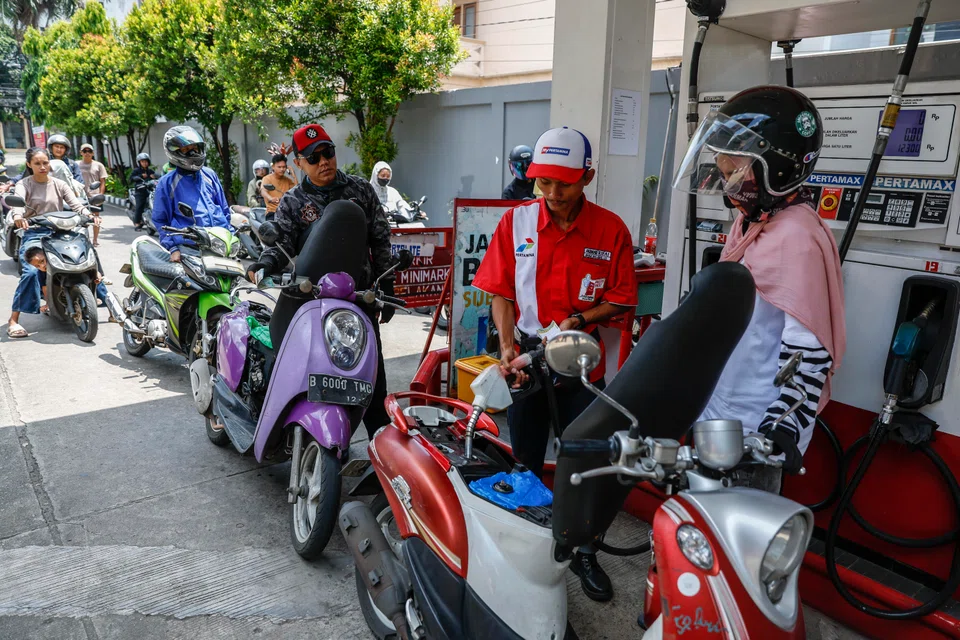
Amid a deteriorating external environment, developing South-east Asia would need to rely on domestic demand for support. Domestic consumption is expected to remain largely resilient through 2026, supported by the lagged impact of sustained monetary policy easing and increased public investment.
Indonesia and Timor Leste are likely to witness strong consumption in 2026, while Myanmar’s disaster reconstruction could support a rebound in domestic activity, which had contracted in 2025.
Conversely, growth in Malaysia, Thailand and Vietnam could slow slightly amid weaker global trade and the impact of the conflict, though technology exports may provide some cushion.
Stagflation
Still, a prolonged Middle East conflict could result in higher costs, placing stagflationary pressure on regional economies – rising prices erode household real incomes and reduce consumption, weakening domestic demand and growth, explained the report.
Even amid a scenario where the conflict de-escalates and energy prices ease in the second quarter, ADB projected that inflationary pressures would hit the region hard – dragged higher by the combined effect of the Middle East conflict and strengthening domestic demand.
“Consumer prices are forecast to edge up in most economies, with further upward pressures from higher energy and food production costs if the Middle East conflict is prolonged,” it said.
Beyond the impact of elevated energy prices, the report also noted that the disruption to transport routes could also result in higher freight costs and delivery times, while weakening broader confidence across the region.
In 2026, data from January and February has already pointed to Indonesia and the Philippines as the most affected by rising prices, particularly for food, housing and utilities, said ADB.
Yet in Thailand, deflation has persisted as caps on electricity and fuel prices continue to keep energy-induced inflation moderate.
Dr Park noted that countries such as Cambodia, Laos and Myanmar are likely to be impacted the most in the region under a prolonged crisis, as they rely more heavily on imported fuels as a proportion of their GDP.
“These countries may struggle more and will face difficult trade-offs about how to respond to these challenges,” he said.
Less impact than previous crises
But Matteo Lanzafame, director of macroeconomic research at ADB, said that the long-term implications for South-east Asia’s economies may not be as severe as initially thought, with several countries remaining on track to reach middle-income status by the end of the decade.
He noted that the overall impact on growth among South-east Asian countries is likely lower than previous crises, including the Covid-19 pandemic, the 2008 global financial crisis and the 1997 Asian financial crisis.
“Putting it in perspective, the real impact on the economy so far from this energy shock is not strong enough to derail the trajectory of growth for economies like the Philippines,” Dr Lanzafame said.
However, he cautioned that a protracted conflict could inflict a larger blow on the region’s growth.
“It really depends on whether the conflict is going to be longer, and whether the disruptions related to the conflict are going to be persistent,” Dr Lanzafame said.
“If we see these disruptions becoming a new normal in the way that the global economy trades energy, then we are in a different scenario.”
Decoding Asia newsletter: your guide to navigating Asia in a new global order. Sign up here to get Decoding Asia newsletter. Delivered to your inbox. Free.
Copyright SPH Media. All rights reserved.
TRENDING NOW

LTA proposes combining car COE categories, adding rebate-surcharge system

StarHub to acquire MyRepublic’s mobile business amid ongoing telco consolidation

DBS, OCBC, UOB rout lops billions off STI as inflation, rate concerns spook investors

Grab CEO’s wife Chloe Tong on life with Anthony Tan and finding her purpose

