



Fatal accidents shake Thailand’s faith in once-dominant builder
Italian-Thai Development’s financial problems were getting progressively worse prior to the accidents
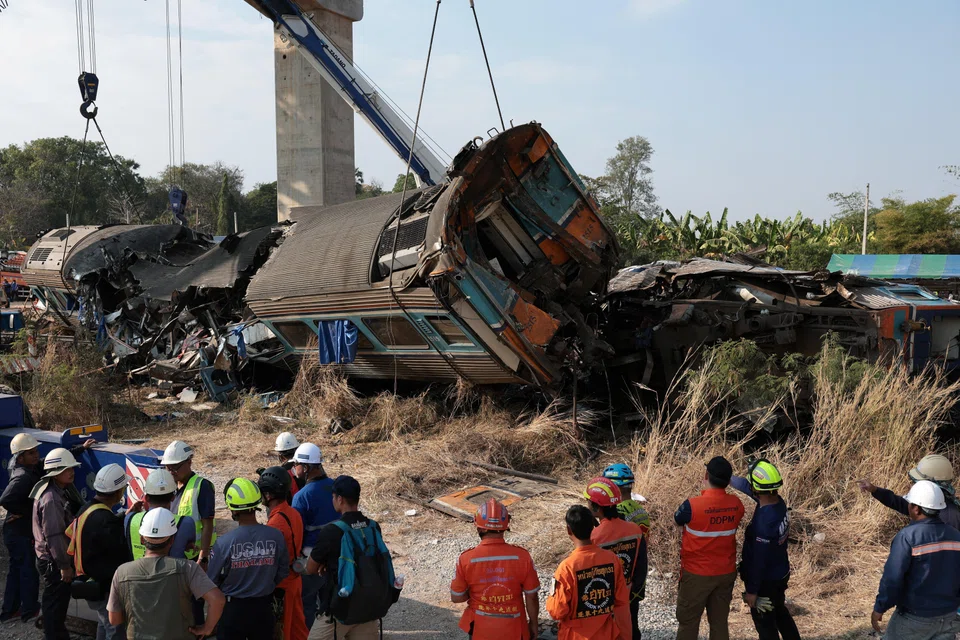
FOUR construction disasters that claimed more than 100 lives have exposed the risks of relying on a single powerful contractor to erect much of Thailand’s public infrastructure.
At the center is Italian-Thai Development, a once-dominant builder restructuring almost a half billion dollars of debt. It’s facing mounting public scrutiny and a possible ban from all government work.
It wasn’t always like this for the business that started in 1954 salvaging ships sunk in Bangkok’s Chao Phraya River. A friendship between Chaijudh Karnasuta, a Thai national, and Giorgio Berlingieri, an Italian, led to ITD’s formation a few years later, although it’s a Thai-run company now.
Until recently, ITD, which listed on the Thai stock exchange in 1994, was the government’s contractor of choice.
It’s run by President Premchai Karnasuta, who made headlines in 2018 when he was caught by park rangers inside a Thai wildlife sanctuary with hunting rifles and the carcasses of protected animals, including a black panther.
ITD helped build some of the South-east Asian nation’s most recognisable infrastructure, including the capital’s Suvarnabhumi International Airport and the Bangkok Transit System. For decades, its white and red circular logo was synonymous with national development, stamped across the country’s largest public works.
A spate of accidents have damaged that reputation, sparking questions by some legislators over ITD’s design and safety practices, and its use of contractors.
ITD’s financial struggles, which predate the four deadly incidents, have also fuelled concerns among engineering experts and the public that corners may have been cut to save costs. And with Thailand in full election mode, the pressure is on politicians to act.
“It’s shameful these accidents are allowed to keep happening,” Suchatvee Suwansawat, leader of the Thai Kao Mai party and a prime ministerial candidate, said.
“They continue because those responsible are allowed to get away with it. Responsibility lies not just with the company, but every government involved in awarding, approving and overseeing the projects.” Suchatvee is a civil engineer by training and a former chairman of the Council of Engineers Thailand.
ITD has said it’s saddened by the events and has pledged to cooperate fully with authorities to “restore the situation to normal.” It didn’t respond to Bloomberg’s requests for comment.
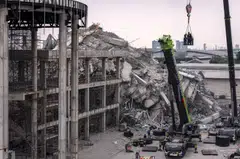
The firm’s deadliest failure was in March 2025, when a 7.7-magnitude earthquake hit Bangkok, a city that’s peppered with high-rise buildings and is famous for its roof top bars.
Of all the skyscrapers, only one crumbled — a 30-story under-construction tower that was to be the new location for Thailand’s State Audit Office.
Scores of workers were trapped and about 90 people perished. ITD-CREC, a joint venture between ITD and China Railway Number 10 Thailand, was the company in charge. CREC didn’t respond to a request for comment.
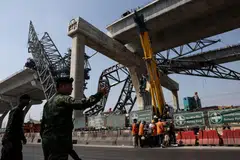
Days earlier that same month, another joint venture of ITD’s that was building an expressway section had a segment partially collapse onto Rama II Road in Bangkok’s Chom Thong District in the early hours of the morning, killing at least five people.
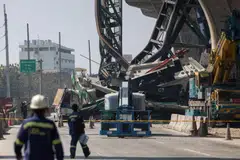
This year, on Jan 14, a crane collapsed onto a moving passenger train, killing 32. ITD was the main contractor responsible for the segment of the line where the crane buckled. The next day, another crane and concrete beam at an elevated highway construction site run by the firm fell onto traffic below, leaving two dead.
“The most important element in maintaining engineering standards is people, and hiring top talent costs money,” Amorn Pimanmas, president of the Thai Structural Engineers Association, said. “It raises the question of what was happening financially that created an environment where proper engineering oversight couldn’t be maintained.”
But before ITD’s safety record unravelled, its financial problems were getting progressively worse.
After decades of domestic growth, the company expanded aggressively overseas, taking on large infrastructure projects in India, Taiwan and Myanmar. Losses were most severe in Myanmar, where the 2021 military coup stalled projects.
By the end of last year, the strain had turned into full-blown liquidity crunch.
According to ITD’s interim financial statements for the nine months ended Sept 30, liabilities exceeded current assets by around 17.9 billion baht (S$733.8 million) and the company said that as a result of various factors including negotiations to collect revenue from contractors, “material uncertainties exist that may cast significant doubt on the group’s ability to continue as a going concern.”
A failure to file audited financial statements triggered a brief trading suspension in 2024 and the stock exchange has placed a so-called “caution-business” sign on ITD’s securities, which slumped 53 per cent last year, following three consecutive years of net losses and weakened equity levels.
Late last month, ITD won investor approval to restructure about US$468 million of debt. In return, the securities, which were originally due between 2026 and 2028, will carry higher interest and provide partial principal payment before maturity.
While ITD reported a profit for the nine-month period, that was overwhelmingly driven by significant one-off gains from asset disposals and investment reclassifications rather than core operating performance. The government’s threat to cancel existing contracts and bar ITD from bidding on new ones further complicates its financial outlook.
Suphanat Minchaiynunt, a lawmaker from the opposition reformist People’s Party, said the government of Prime Minister Anutin Charnvirakul should have signed into law regulations that would allow authorities to downgrade and exclude substandard contractors.
“Signing those regulations would have made a real difference,” Suphanat said. “Giving the state clear authority to ban or blacklist contractors from government work is the strongest possible sanction, and it would act as a powerful deterrent. Right now, even if your actions lead to hundreds or even thousands of deaths, you can still bid for public contracts.”
Siripong Angkasakulkiat, deputy leader of the Bhumjaithai party and spokesman for Anutin’s government, said he’s not aware of the specific proposals but affirmed that the prime minister’s intent has always been to address the issue structurally.
A Thai government probe into the building collapse after the earthquake found that contractors used substandard steel bars made by a factory that had been shuttered by authorities months prior.
Samples of two different sizes of bars collected from the site failed tests by the Iron and Steel Institute of Thailand for their mass, chemical composition and ability to withstand stress before breaking. An ITD executive said the construction underwent rigorous inspections and “there was no reason for us to use substandard materials.”
Premchai, along with other executives and engineers, faces criminal negligence charges for his role in the building collapse and those investigations are ongoing. Premchai was arraigned in the Criminal Court in August and is currently out on bail, although he has to wear an electronic monitoring bracelet and stay within the country.
The accidents have also highlighted broader public concern about Thailand’s highly concentrated economy, where a small group of conglomerates dominate key sectors, including construction and infrastructure.
Decades of reliance on national champions have limited competition, with firms like ITD consistently winning major contracts through the government-run bidding process.
Anutin, whose father founded rival construction company Sino-Thai Engineering & Construction, has threatened to cancel government agreements with ITD.
“Speaking as an engineer, there must be proper planning, supervision and close attention to the risk involved in the work,” he said after a cabinet meeting on Jan 20. The deaths involved “innocent people simply passing by. This is what truly causes damage to the country, and it’s something that must be addressed.”
The Transport Ministry’s initial investigation of the Jan 14 train disaster found construction work was being carried out without closing the area to traffic, according to a statement. That’s despite clear regulations that state work should only be done during periods when no trains are in operation.
Public confidence in the safety of some of ITD’s projects has already frayed. Some commuters say they’re avoiding Rama II Road out of fear — a Facebook community page has taken to calling it Rama II phobia.
SCB X Pcl’s Economic Intelligence Centre said the incidents not only shook confidence in government construction projects but also underscore the need for structural reform, like strengthening oversight and regulatory mechanisms for contractors. Contractors must “exercise greater caution in pursuing ultra-low bid strategies that prioritise price competition at the expense of safety,” the centre said.
Since 2019, the Transport Ministry has been the portfolio of Anutin’s Bhumjaithai Party, except during a two-year period between 2023 to 2025. Similar to previous governments, Anutin’s administration has also awarded public work contracts to ITD since he became prime minister in September.
But despite the government’s newly tough rhetoric, Somchai Jitsuchon, research director at think tank Thailand Development Research Institute, doubts meaningful reform to curb entrenched corporate influence will follow the Feb 8 vote.
“It’s likely to be lip service as the election approaches,” Somchai said. BLOOMBERG
Decoding Asia newsletter: your guide to navigating Asia in a new global order. Sign up here to get Decoding Asia newsletter. Delivered to your inbox. Free.
Share with us your feedback on BT's products and services
TRENDING NOW

Once staunchly pro-China, Malaysian Chinese businesses are now distancing themselves from Beijing

Looking beyond looming CEO succession, should UOB potentially pursue a transformative merger?

Could stablecoins be the future of money?

Grab CEO’s wife Chloe Tong on life with Anthony Tan and finding her purpose

