



Floods compound Philippine growth woes from public-works scandal
The country’s governance and climate risks are further dampening investor confidence
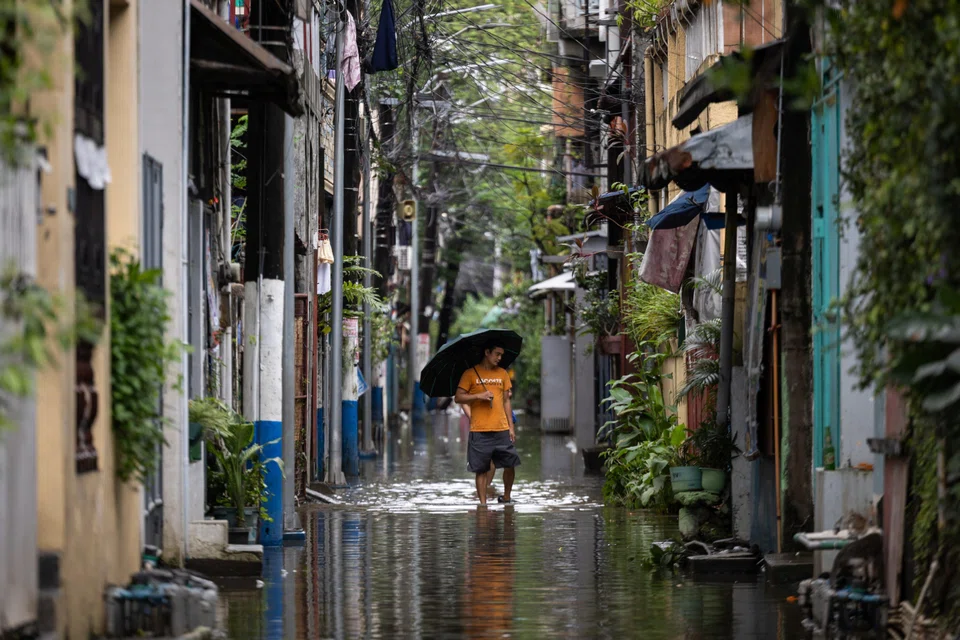

[MANILA] Severe flooding across the Philippines is threatening to add a fresh drag to an economy already reeling from the fallout of a public-works corruption scandal that has slowed infrastructure spending and hurt investor confidence.
The disruption comes as Manila tries to capture a larger share of South-east Asia’s China+1 manufacturing windfall.
The latest storms and crippling floods have affected about 9.4 million Filipinos and has hit major industrial corridors, such as the manufacturing hubs of Calabarzon, Central Luzon and Metro Manila, which are vulnerable to extreme and recurrent flooding.
At the same time, the Philippine government is struggling with the economic consequences of a far-reaching investigation into its flood-control programme.
Together, they are exposing the country’s investment risks – vulnerability to extreme weather and governance gaps – just as foreign direct investment (FDI) has fallen sharply.
A nationwide investigation, led by the Department of Public Works and Highways (DPWH), found that 421 out of 8,000 flood-control projects inspected so far were ghosts or non-existent, DPWH secretary Vince Dizon confirmed during an October 2025 briefing with the Independent Commission for Infrastructure.
Based on Department of Finance (DOF) estimates presented to the Senate, corruption in flood-mitigation projects drained between 42.3 billion pesos (US$675.6 million) and 118.5 billion pesos from the economy from 2023 to 2025 – a drag that DOF said cost the country roughly 95,000 to 266,000 jobs.
Official data from President Ferdinand Marcos Jr showed that an estimated 100 billion pesos, or 20 per cent of the government’s 545 billion peso flood-control budget, were allocated to just 15 contractors out of 2,409 accredited nationwide.
A Senate Blue Ribbon Committee inquiry examined allegations of collusion and kickbacks involving contractors and public officials.
Corruption costs
The scandal has raised concerns over whether billions of pesos in flood-control spending delivered the protection intended for major industrial corridors.
“Notwithstanding the disruption to lives and the consequential suffering of people, the recent flooding has wrought havoc to businesses,” said Mara Bautista, former executive director of the Bulacan Chamber of Commerce in Central Luzon, the hardest-hit region during the recent monsoonal floods.
In August alone, the combined effects of the south-west monsoon and tropical cyclones cost the Philippines more than six billion pesos in infrastructure damage and more than three billion pesos in agricultural losses.
Despite being heavily prone to severe weather, Bautista’s home province of Bulacan remains an economic powerhouse, generating 695 billion pesos in gross domestic product in 2025. As the country’s fourth-largest provincial economy, it accounts for 3 per cent of national output.
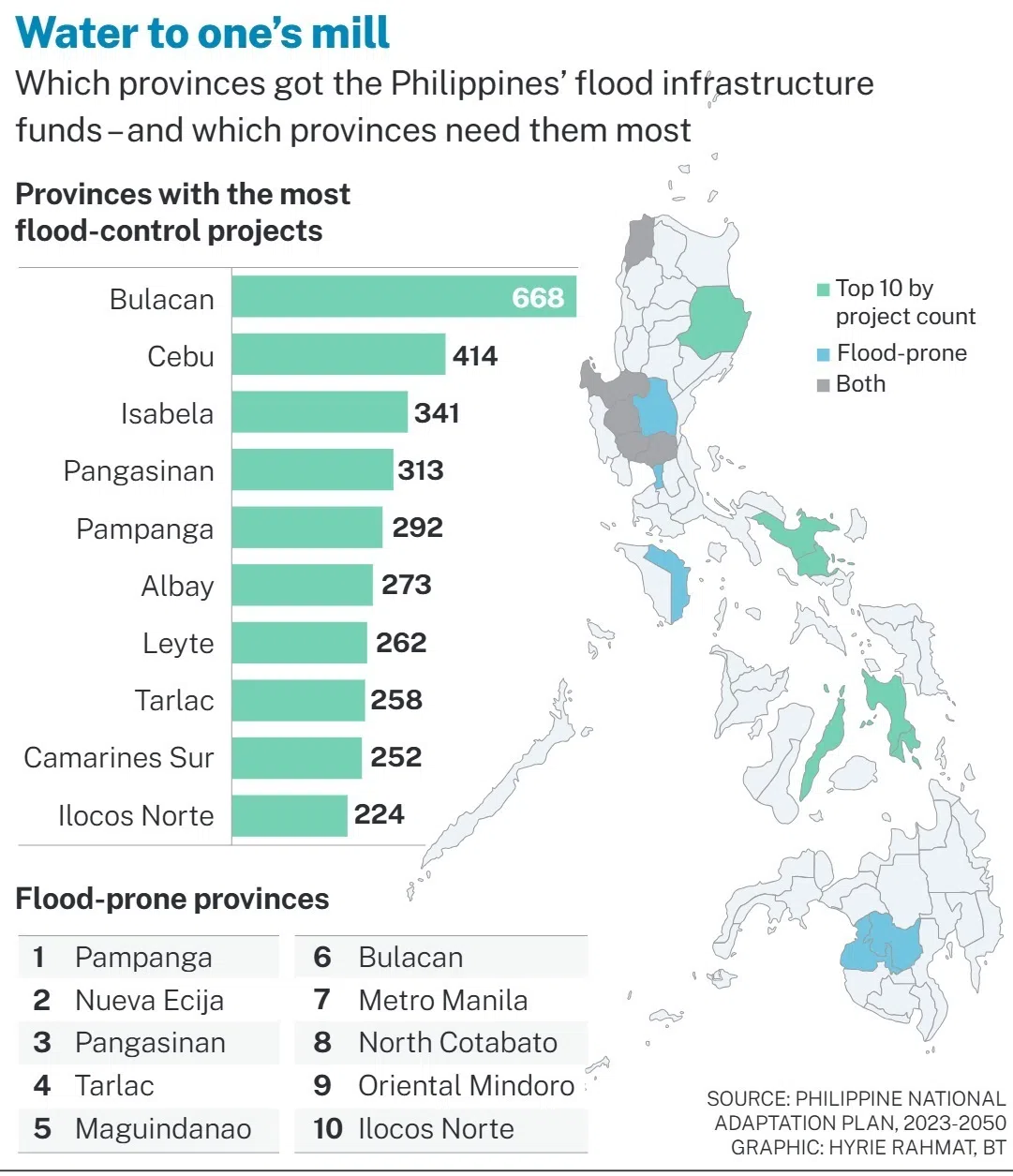
Bulacan hosts 668 flood-control projects – the most out of any province – and takes up 44 billion pesos (45 per cent) of Central Luzon’s flood mitigation budget.
However, it became the focus of the Senate probe after members of the province’s First District Engineering Office were implicated in project anomalies. The DPWH has since filed graft charges against at least 20 personnel.
“Disaster and its effects can be managed – just take corruption out of the equation,” Bautista said.
The scandal has reverberated through the capital markets.
Eleven global fixed-income managers, including BNP Paribas Asset Management, Robeco, Amundi and Fidelity International, sent a confidential joint letter to the Philippine Treasury and the Securities and Exchange Commission in March, demanding strict procurement oversight.
About 168 billion pesos of the proceeds of the Philippines’ sustainability bonds have been allocated to flood-control projects, Bloomberg reported, citing calculations based on government reports.
Investment retreat deepens
In its mid-2026 Philippine Economic Update, the World Bank identified uncertainty surrounding infrastructure procurement as one factor weighing on investment, alongside energy shocks from the Middle East conflict.
“Allegations of corruption led to increased scrutiny and audits of infrastructure projects from mid-2025, slowing public investment,” the global lender noted.
It added that the infrastructure probe “transmitted through both public budgets and private confidence, producing a sustained investment contraction”.
Speaking at the report’s release, Zafer Mustafaoglu, division director at the World Bank, said: “Uncertainty around infrastructure procurement has made investors more hesitant.”
The collapse in investments deepened when FDI net inflows crashed 64.7 per cent year on year in May, to a decade-low of US$210 million. This pulled the cumulative five-month FDI down 33.4 per cent to US$2.2 billion.
Leonardo Lanzona, economist at Ateneo de Manila University, attributed these in part to the scandal’s “chilling effect on investor confidence” on top of lingering geopolitical uncertainty.
Infrastructure funding freeze
The DPWH slashed 252 billion pesos or nearly 30 per cent off its 2026 budget by removing allocations for new locally funded flood-control projects flagged for irregularities.
But while market watchers agree that cleaning up public works is vital to restoring state credibility, they believe a freeze on public works spending has also stalled economic growth.
Diwa Guinigundo, analyst at GlobalSource Partners, warned against institutional inertia. “The fact that there was corruption and bad governance with respect to flood-control projects should not necessarily lead to zero budgeting,” he said.
Gross capital formation – the primary measure of domestic and public investment – fell 9.2 per cent year on year in the second quarter of 2026, driven by a 13.7 per cent contraction in fixed investment, its sharpest non-pandemic drop since 2011.
Although the funding freeze applies to 2026 projects, audits that began in mid-2025 had already slowed public investment and weighed on 2025 disbursements.
Infrastructure budget releases fell 14.3 per cent from more than 1.5 trillion pesos in 2024 to 1.3 trillion pesos in 2025, or 4.7 per cent of GDP, as the scandal triggered tighter scrutiny and delayed project implementation.
Improving governance should be done efficiently and effectively, said World Bank senior country economist Jaffar Al-Rikabi.
By Q2, general government construction contracted by 32.4 per cent, dragging real GDP growth down to a post-pandemic low of 2.3 per cent and pinning first-half growth at 2.6 per cent, a steep drop from the 5.4 per cent expansion a year earlier.
Socioeconomic Planning Secretary Arsenio Balisacan said that the economy would have grown by at least one percentage point more, had public construction merely flattened out rather than collapsed.
TRENDING NOW

Once staunchly pro-China, Malaysian Chinese businesses are now distancing themselves from Beijing

Looking beyond looming CEO succession, should UOB potentially pursue a transformative merger?

Could stablecoins be the future of money?

Grab CEO’s wife Chloe Tong on life with Anthony Tan and finding her purpose

