



The ‘four’ behind Vietnam: Can 2026 political reset deliver the growth it promises?
What investors should know as the country heads into its most consequential leadership transition in decades
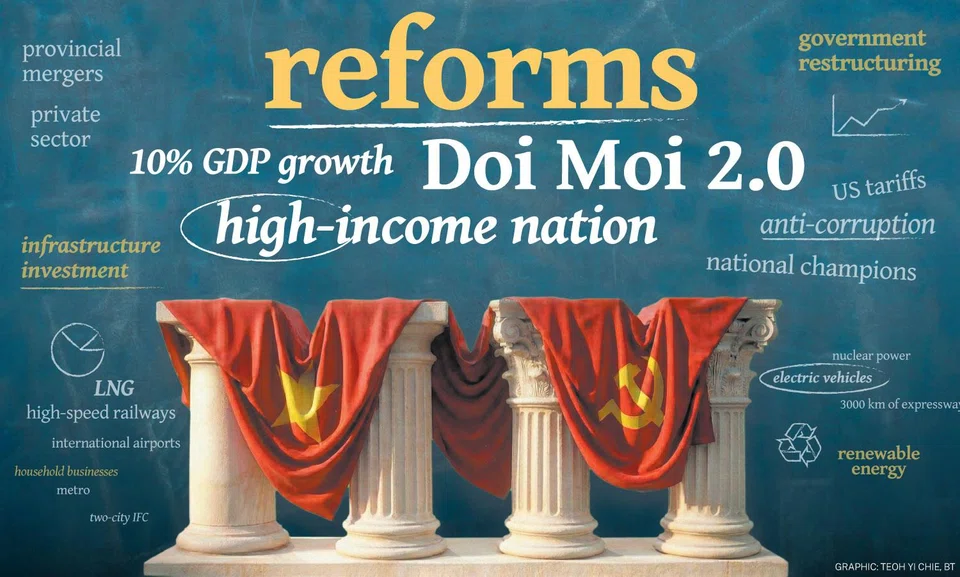
VIETNAM enters 2026 with momentum, ambition and rare political alignment behind what Communist Party chief To Lam has described as an “era of national rise” – a drive to propel the country to high-income status by 2045.
The ruling Communist Party is set to convene its twice-a-decade Congress in January 2026 to select its leaders, followed by nationwide elections for deputies of the National Assembly and local legislative bodies in March.
While past Congresses largely ratified consensus outcomes, the coming transition coincides with the most aggressive development agenda since Vietnam’s Doi Moi liberalisation of the 1980s, as well as rising global trade uncertainties and geopolitical tensions.
Investors are watching for signs of whether the recent wave of reforms – dubbed “Doi Moi 2.0” by proponents – can translate into faster, more durable growth, including annual expansion of at least 10 per cent over the next five years, or whether execution limits will surface just as ambitions peak.
“This is arguably one of the most consequential Party Congresses since Doi Moi,” said Nguyen Khac Giang, visiting fellow at the Vietnam Studies Programme of the Iseas-Yusof Ishak Institute. “This is not just a routine leadership reshuffle, but a referendum on whether Vietnam truly commits to the reforms that have gathered pace under To Lam, or quietly pulls back from them.”
Since taking over the country’s most powerful post in August 2024, Party chief To Lam has overseen a sweeping overhaul of the state apparatus, slashing layers of bureaucracy, merging provinces, elevating the private sector’s role and pushing an industrial policy aimed at moving Vietnam beyond low-cost manufacturing.
As these reform agendas signalled a more coordinated and disciplined approach to governance, the question confronting the country is no longer simply who governs next, but whether this disruptive trajectory receives a durable mandate.
“Foreign investors are looking forward to further policy breakthroughs and new development initiatives,” said Le Truong Giang, an analyst at London-based risk consultancy Control Risks.
He highlighted the country’s electricity sector reforms, free trade zone and international financial centre.
“The upcoming Party Congress will provide Vietnamese leaders the political mandate to enact changes, and businesses the certainty in their government engagement,” he added.
Continuity at the top?
About 1,600 delegates representing more than five million Party members will gather in Hanoi from Jan 19 to 25 to elect a new 200-member Central Committee for the 2026-2030 term. That body will then select between 17 and 19 members of the Politburo – the Communist Party’s highest decision-making organ – from which Vietnam’s top leadership, known as the “four pillars”, will emerge: the party chief, prime minister, president and chair of the National Assembly.
Candidates have been nominated, and markets broadly expect continuity, at least in the top job.
Maybank economists Brian Lee and Chua Hak Bin said incumbent leadership is likely to be reaffirmed, providing stability for an agenda already well under way.
They expect To Lam to secure a full term as general secretary or party chief, reinforcing confidence in a pro-growth strategy that has reshaped Vietnam’s administrative and policy landscape, especially through the four Party resolutions on science and technology, international integration, rule of law and private-sector-led growth.
Formerly public security minister under his late predecessor Nguyen Phu Trong, Lam, 68, for years oversaw an expansive anti-graft campaign that ensnared hundreds of business executives and Communist Party officials, including figures at the very top of the political hierarchy.
In roughly 18 months in the top post, Lam has then pushed through many of the most politically sensitive reforms – including halving the number of provinces and streamlining ministries. These were advanced in the year leading up to the Congress, a period when policy execution typically slows.
“The rapid roll-out of such bold measures without visible pushback suggests a high level of confidence in his political backing and re-election,” the Maybank economists wrote in a December note.
Private-sector bet
At the heart of Vietnam’s growth strategy is a recalibration of the state’s relationship with private capital.
Under Resolution 68, the Communist Party has elevated the private sector as the economy’s most important driving force, while encouraging domestic conglomerates to play a larger role in national development projects traditionally dominated by the state.
Iseas’ Giang said the shift marked an unusually radical move for a one-party communist system – one that, if implemented effectively, could give Vietnam a genuine chance to escape the middle-income trap.
But the strategy carries risks. “Empowering private champions could deepen cronyism rather than foster competitive markets,” he said.
In his recent paper on Vietnam’s industrial policy under To Lam, Nguyen Khac Giang warned that many prospective “national champions” remain concentrated in property and banking rather than manufacturing, complicating efforts at deep structural transformation.
Rent-seeking and collusive state-business practices – in which powerful conglomerates can shape policy outcomes – have also become embedded in the country’s political economy, he added.
“This manifests through discretionary enforcement mechanisms that create opportunities for sectoral lobbying and soft corruption,” Nguyen Khac Giang wrote, citing Hanoi’s swift decision to restrict petrol motorcycles in certain downtown areas from July 2026 – a move seen as delivering a significant boost to the electric-vehicle (EV) arm of Vietnam’s largest private conglomerate, Vingroup.
Meanwhile, Control Risks’ Giang noted that amid the ongoing infrastructure push, the government also faces challenges in ensuring a level of technocratic leadership and management to supervise projects’ planning, execution and quality, including through closer cooperation with the private sector.
He said that the Vietnamese party-state, particularly under the current leadership, retains both incentive-based and coercive tools to influence private conglomerates’ participation in nation-building projects. Yet besides political considerations, commercial viability, risk-sharing mechanisms and incentive structures remain decisive.
Several major firms have already narrowed their exposure despite initial enthusiasm. Vingroup has withdrawn from the US$67 billion North-South high-speed rail scheme, while Deo Ca and MIK exited Hanoi’s US$32.5 billion Red River Scenic Boulevard project, citing resource constraints and accountability concerns.
Foreign capital, with conditions
Foreign investors form another pillar of Vietnam’s emerging industrial coalition, but the terms of engagement are shifting.
Rather than maximising headline inflows, policymakers are increasingly targeting multinationals with advanced technological capabilities in strategic sectors such as semiconductors, artificial intelligence, software, renewable energy and digital services.
Vietnam is also offering preferential incentives to firms willing to transfer technology, meet sustainability standards and integrate domestic suppliers into global value chains.
The shift reflects frustration with an earlier growth model led by foreign direct investments that boosted exports but produced thin domestic spillovers and entrenched Vietnam’s dependence on Chinese intermediate inputs and machinery.
“Vietnam is increasingly distinguishing between investment that builds capability and investment that simply exploits cost advantages,” said Mickael Driol, chief executive of Mekong Partners, which provides corporate solutions for cross-border investments across Asia.
Large anchor investments could prove decisive in the coming period, he added.
When a semiconductor packaging plant, EV platform, hyperscale data centre or renewable-energy cluster chooses Vietnam, it creates gravitational pull for an entire ecosystem.
“If Vietnam lands several of them in 2026, it will change its position in regional value chains for the next decade,” he stated.
However, Driol also flagged potential “deal-breakers”, including persistent energy shortages, uneven provincial capacity and geopolitical shocks that could disrupt Vietnam’s carefully balanced foreign policy that traditionally drew in global companies.
Can execution keep pace?
For many investors, the decisive variable increasingly lies not at the top leadership, but at the provincial level, where land allocation, permitting and infrastructure delivery are determined.
Provinces have been merged, district-level government eliminated, and tens of thousands of officials displaced in a bid to cut red tape and improve coordination in the country.
Yet uneven local capacity has long been a feature of Vietnam’s investment landscape, and the restructuring risks amplifying short-term divergence.
Iseas’ Giang cautioned that transitional inefficiency at provincial levels is inevitable given the “extraordinary” scale of reform, even as he sees limited long-term risk to leadership quality, noting that the new cohort is younger and more technocratic.
“Once the new administrative map settles, execution could actually improve,” he said.
“The risk lies less in who is in charge, and more in how quickly the new system learns to run smoothly,” he noted.
Despite criticism that the pace of change leaves little room for adjustment – particularly for roughly five million household businesses – supporters argue the reform push is unavoidable.
As Vietnam seeks to upgrade its industrial base, growth now hinges on administrative efficiency, regulatory transparency and governance quality.
“Vietnam’s attractiveness depends more on the durability of its governance reforms than on the identity of its leaders,” Driol said.
“(Its) ambition is high, but the country must show that execution can keep pace,” he added. THE BUSINESS TIMES






