



Indonesia names companies with high ownership concentration following MSCI transparency push
List includes Barito Renewables Energy and Dian Swastatika Sentosa
 Add BT as a preferred source
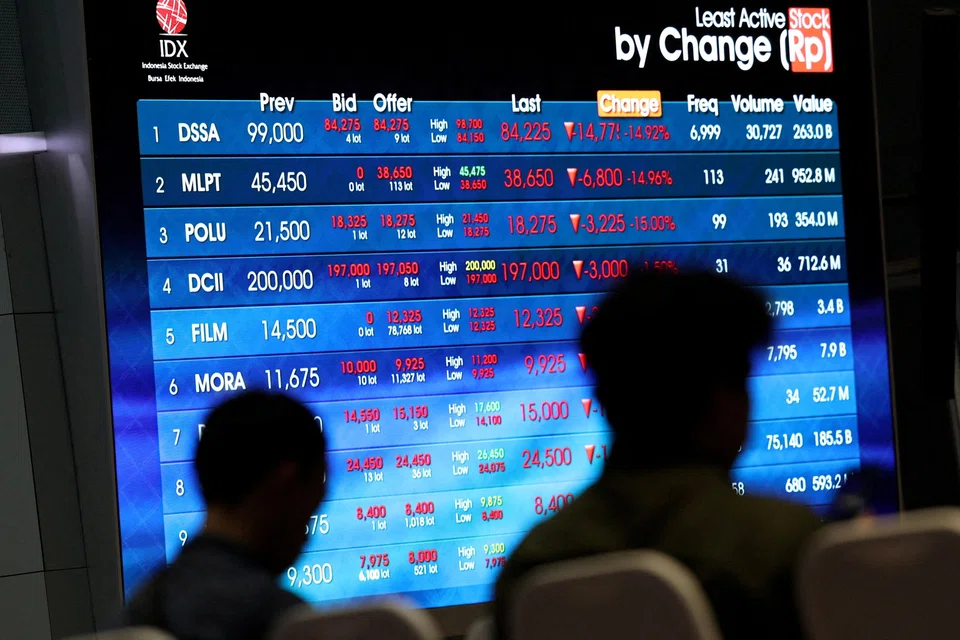
[JAKARTA] Indonesia published a list of stocks with highly concentrated shareholdings on Thursday (Apr 2), marking the latest move in a series of market transparency reforms prompted by global index provider MSCI’s concerns over ownership structures in the country’s equity market.
The list of companies with high shareholder concentration was made available on the Indonesia Stock Exchange’s (IDX) website.
It includes a number of companies such as tycoon-linked Barito Renewables Energy and Dian Swastatika Sentosa, where share ownership is concentrated among a relatively small group of shareholders.
Other firms identified in the exchange’s documents include Abadi Lestari Indonesia and Samator Indo Gas.
Jeffrey Hendrik, interim president of IDX, said the disclosure aims to provide investors with clearer visibility on ownership structures in listed companies, particularly those where a large portion of shares is held by a small number of investors.
The shareholder concentration list reveals the level of ownership concentration among a company’s shareholders.
A joint committee of IDX and the Indonesia Central Securities Depository determines which stocks fall under the high shareholding concentration framework, similar to practices used by bourses such as the Stock Exchange of Hong Kong, but with additional follow-up mechanisms to allow companies to improve investability.
Hendrik emphasised that having concentrated ownership does not automatically mean that a company is breaking capital market rules.
“Even if a company’s shares are held by a few shareholders, it does not automatically violate free float requirements. This disclosure is meant only to provide information to investors,” he said.

Listed companies will also be allowed to request a voluntary assessment if they believe their shareholding structure has changed and no longer meets the concentrated ownership criteria.
The initiative is part of a broader set of four reforms introduced by Indonesia’s capital market authorities following a late-January warning from MSCI, which highlighted the risk of a market downgrade due to concerns over limited transparency in stock ownership and trading practices.
The warning triggered sharp sell-offs, wiping out around US$120 billion in market value on the Jakarta stock exchange.
In response, Jakarta pledged reforms aimed at strengthening market integrity and investor confidence.
Hasan Fawzi, an official from the Financial Services Authority, said that authorities have now completed the full set of reforms requested.
In early March, IDX introduced measures including enhanced disclosure of shareholders owning more than 1 per cent of a listed company.
That new rule took effect on Mar 3, allowing regulators and investors to better monitor ownership distribution across the market.
Meanwhile, changes to the free float policy, which set a minimum public float requirement of 15 per cent, came into effect on Mar 31.
The rule will be implemented gradually over a three-year transition period to give listed companies time to adjust their shareholding structures.
Companies with a market value of under five trillion rupiah (S$379 million) will have to meet the minimum level of shares available for public trading by Mar 31, 2029.
Authorities said the moves are designed to boost liquidity, reduce price manipulation risks, and align Indonesia’s equity market with international best practices.
Indonesia also introduced a more detailed investor classification framework starting Mar 31, aimed at improving market data transparency and strengthening regulatory oversight.
Decoding Asia newsletter: your guide to navigating Asia in a new global order. Sign up here to get Decoding Asia newsletter. Delivered to your inbox. Free.
Copyright SPH Media. All rights reserved.
TRENDING NOW

Singapore private housing is ‘decoupling’ from HDB market as buyer pools diverge: NUS survey

Simba’s 5G spectrum hurdle may accelerate Singapore’s telco market reset

Yen hits 40-year low in historic slide that’s rattled Japan

Malaysian tycoon Vincent Tan’s sell-downs point to pruning rather than an exit plan

