



Indonesia puts US$70 billion commodity exports under closer watch as Danantara’s platform goes live
The first phase will begin on Sep 1, with full implementation targeted by end-year

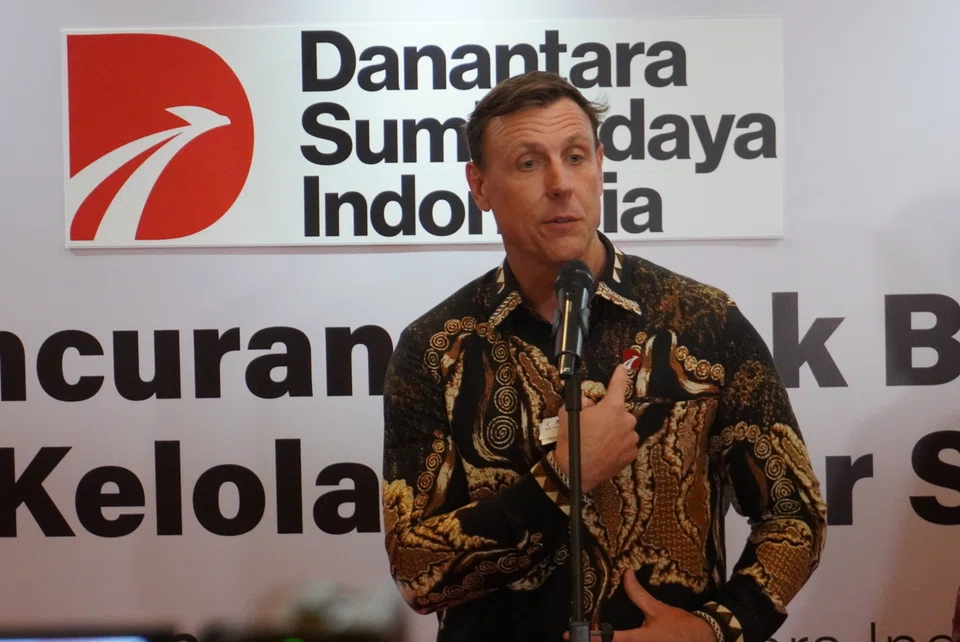
[JAKARTA] Indonesia’s commodity exporters face a new compliance regime, as Danantara Sumberdaya Indonesia (DSI) prepares to launch its export monitoring platform on Tuesday (Sep 1).
It introduces a government-backed mechanism that will bring more than US$70 billion in annual trade flows under closer government scrutiny.
The roll-out marks the first major test of DSI, the export arm of Indonesia’s sovereign wealth manager Danantara, since President Prabowo Subianto announced the initiative in May.
The platform will initially cover three of the country’s major export commodities – coal, palm oil and ferro-alloys – which together account for more than US$70 billion of Indonesia’s annual export value.
At a recent launch event in Jakarta, DSI CEO Luke Mahony said that the platform is designed to give the government greater visibility into the country’s commodity exports and help identify potential irregularities, including under-invoicing and transfer pricing.
Prabowo has repeatedly raised concerns over under-invoicing in Indonesia’s commodity exports, saying the practice has cost the country billions of dollars in lost state revenue by allowing exporters to report lower values for their shipments.
Ang Kai Wei, Asean economist at Bank of America (BOA) Securities, noted that the new framework could have a significant impact on the broader economy, given the size and importance of the commodities covered by the policy.
A balanced framework that provides greater oversight, while maintaining market flexibility, could help strengthen confidence in Indonesia’s market and support its position as a reliable supplier over the long term.
“If designed and executed effectively, it could potentially boost export earnings and fiscal revenues, while improving the supply-demand balance for foreign exchange,” he added.
Significant role
Since it was first announced on May 20, DSI has drawn significant attention over its potential to play a central role in overseeing Indonesia’s commodity exports.
In a recent presentation to market participants and the public, Mahony said that DSI will act as an intermediary, while exporters and buyers will remain as parties to the commercial transactions.
DSI’s system will enhance the verification of export data and transactions, covering the quantity, quality and classification of goods, pricing, shipping destinations, payment terms and the repatriation of export proceeds.
Existing export data from government ministries and agencies will be integrated to give DSI a more comprehensive view of commodity transactions. The first phase is set to begin on Tuesday, with full implementation targeted by the end of the year.
The approach marks a scaling back from the government’s initial plan to make DSI the sole exporter of Indonesian commodities. The proposal had raised concerns among investors and exporters.
Hit the ground running
DSI began formal operations in June, with its executive leadership team unveiled in late August. The team includes professionals from the mining industry, alongside a senior economist serving as a commissioner.
The agency has so far monitored more than 6,500 export declarations, covering roughly US$14 billion in shipments – equivalent to about one-fifth of the combined export value of coal, palm oil and ferro-alloys, data presented by DSI showed.
DSI chief financial officer Sinthya Roesly said that the agency’s mandate could eventually be expanded to other commodities, but the process would be gradual, allowing DSI to assess system readiness and operational efficiency before broadening its scope.
Clarity remains to be seen
Resource-rich Indonesia is the world’s largest exporter of thermal coal and palm oil, and a major producer, while ferro-alloys have become increasingly significant as the country expands downstream processing of its mineral resources.
South-east Asia’s largest economy is also a significant supplier of tin, copper, bauxite and other commodities, making the country’s export flows an important source of foreign exchange and government revenue.
For exporters, however, the transition means adapting to another layer of reporting and scrutiny, while questions remain over how existing commercial contracts, pricing benchmarks and different commodity-trading practices will be incorporated into the new system.
The Indonesian Coal Mining Association pointed out that businesses still need greater clarity on the mechanism, their obligations and the transition period.
One concern surrounding DSI’s implementation is the cost of its services. Sinthya said that, as a corporation, DSI would be able to charge reasonable fees to recover costs and generate margins while carrying out its mandate.
Gita Mahyarani, executive director of the coal-mining association, said that exporters also needed to know whether the new system would introduce additional costs or administrative processes. She added that any additional requirements or costs should be clearly communicated, so that the implementation does not end up hampering exports.
The concerns are echoed by Indonesia’s nickel-processing industry, although the sector has so far not reported significant disruption from DSI’s activities since June.
Ferro-nickel is a nickel-based ferro-alloy used in stainless-steel production and as an input in Indonesia’s nickel processing and downstream industries, including the production of materials for electric-vehicle batteries.
Arief Perdanakusumah, chairman of the Indonesian Nickel Industry Forum, explained that DSI’s progress since June had been “quite extraordinary”, but exporters were still asking how contracts already in force would be treated under the new system. He added: “The platform will need to accommodate the various characteristics and requirements of global commodity trading.”
That issue could become particularly complicated for ferro-alloy producers, whose products are traded through different global pricing mechanisms.
Ferro-nickel is typically traded through bilateral contracts rather than exchanges, because its varying grades and specifications make pricing more dependent on quality, nickel content and market conditions.
The issue of pricing benchmarks is also potentially linked to a broader government ambition to build an Indonesian mineral exchange.
Prabowo said on Aug 14 that the government would establish an Indonesian mineral and commodity exchange, increasing the possibility of DSI’s monitoring infrastructure eventually becoming connected to a broader effort to give Indonesia greater influence over commodity pricing.
Chan Ker Liang, an analyst at S&P Global Ratings, noted that Indonesia has significant influence over nickel prices, given that it accounts for about 60 per cent of global mined nickel ore production.
Decoding Asia newsletter: your guide to navigating Asia in a new global order. Sign up here to get Decoding Asia newsletter. Delivered to your inbox. Free.
Copyright SPH Media. All rights reserved.
TRENDING NOW

Malaysian king buys stake in Singapore-listed mining firm expanding into rare earths

Family offices ‘kept captive’ by relationship managers turn to independent advisers, direct deals

Once staunchly pro-China, Malaysian Chinese businesses are now distancing themselves from Beijing

Could stablecoins be the future of money?

