



Indonesia says no to US demand to buy American drones, but agrees to other terms in trade talks
Both countries are in the final stages of talks on a so-called reciprocal tariff deal
[JAKARTA] Indonesia has agreed to a significant number of terms demanded by the US in their trade talks, including a plan to import fuel from the US instead of Singapore, The Straits Times (ST) has learnt.
But Indonesia has rejected provisions that would violate its Constitution, including demands for it to buy US-made drones for surveillance in waters near the South China Sea, two senior government officials have told ST on condition of anonymity.
Indonesia and the US are in the final stages of talks on a so-called reciprocal tariff deal, which will see the US lower tariff rates on South-east Asia’s largest economy from the previously threatened 32 to 19 per cent.
Indonesia ran a US$18 billion (S$22.8 billion) trade surplus with the US in 2024. In return for lower tariffs, it has had to make concessions so as to balance its trade with the Americans.
Among other things, Indonesia has accepted US demands to ease curbs on American auto imports. Jakarta has also agreed to remove non-tariff barriers, specifically “local content requirements”, for US products in three key sectors – information technology and communications, medical equipment, as well as data centre equipment, said the two officials.
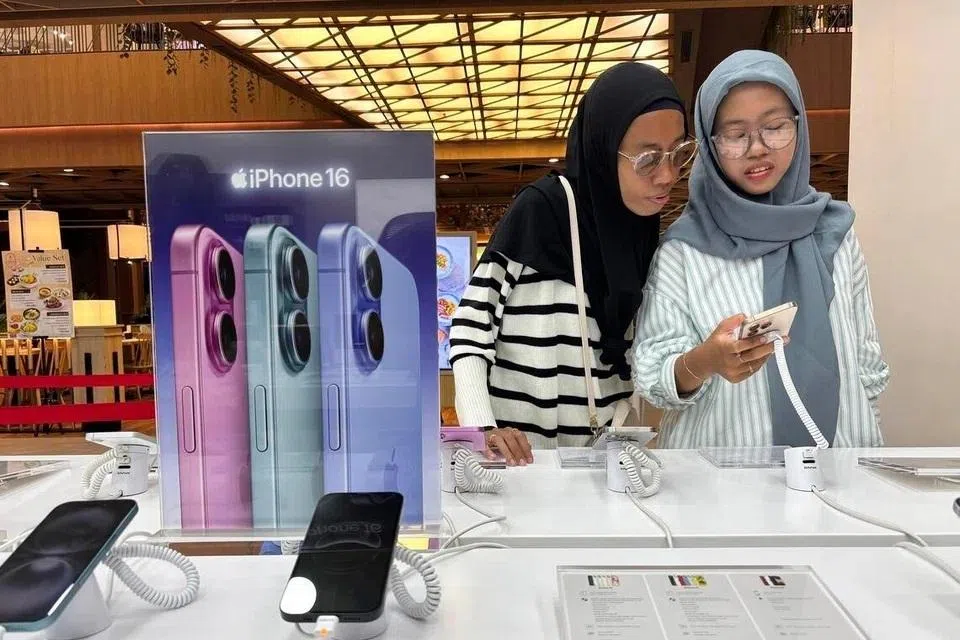
These concessions are significant. US tech giant Apple leads Indonesia’s mobile phone market by revenue, with imports of iPhones valued at roughly US$2 billion annually, according to government data. Sales of US medical equipment, such as GE HealthCare’s MRI and CT scanners, are valued at some US$100 million annually, and US giants Hewlett-Packard, Dell Technologies and IBM currently dominate Indonesia’s data centre equipment market.
Indonesia has also pledged to import significantly more fuel from the US while reducing purchases from Singapore. More than half of Indonesian fuel imports are from Singapore, which refines crude oil from the Middle East, Australia and Malaysia, ST reported in May 2025, while the US accounted for less than 0.1 per cent of Indonesia’s fuel imports in 2024.
Indonesia would accept US-made automobiles that meet the US Federal Motor Vehicle Safety Standards and the US emission standard, said one official. These imports would not have to meet the safety and emission test required by Indonesia’s transport authority.
Jakarta has also agreed to support the American electric vehicle industry by supplying to US companies any intermediate raw materials to make battery cells, such as nickel precursor chemical compounds.
The US also ventured into non-trade issues during the trade talks.
ST had earlier reported that the US was seeking “a commitment from Indonesia to readjust its South China Sea policy to safeguard its sovereign rights and national jurisdiction, ensure alignment with international law, and enhance maritime domain awareness and regional cooperation”.
However, Indonesia has told the US that it cannot meet this South China Sea demand, nor the demand to purchase US-made drones, said the two sources. Jakarta is adamant that these requests are not related to the aim of the tariff talks, which is to balance trade between the two countries, they added.
Indonesia also has an objection to Washington’s request for the South-east Asian state to consult with it before signing any digital trade agreements with third parties that could potentially harm US interests.
One of the sources told ST: “Regarding the digital economy, Indonesia emphasised the importance of respecting the sovereignty of both nations.”
He pointed to the US’ request to apply restrictions preventing Indonesia from establishing free trade agreements or preferential trade agreements with certain countries.
“That would constrain Indonesia’s foreign cooperation. Such restrictions are incompatible with Indonesia’s ‘independent and active’ foreign policy principle, as mandated by our Constitution,” the source added.
Contacted by ST, Haryo Limanseto, spokesman for Indonesia’s Coordinating Ministry for Economic Affairs, said: “We are trying to keep the negotiations strictly focused on tariffs for the purpose of trade rebalancing, without venturing into other issues.
“We always consider investment sustainability, job creation and market openness, as well as bilateral and multilateral cooperation with all nations. Therefore, we are employing best practices in these negotiations,” he added.
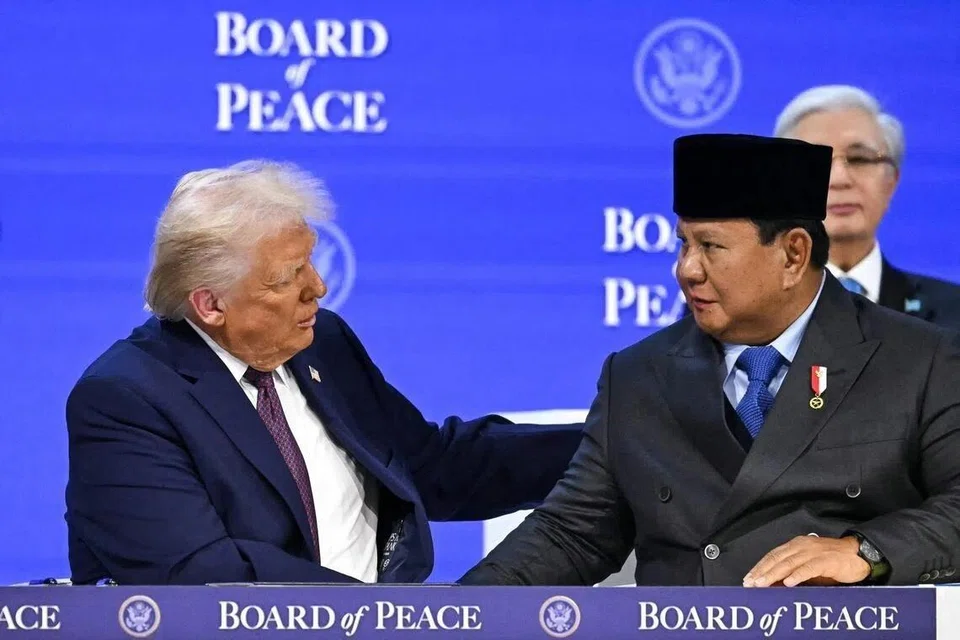
On Jan 22, Indonesian President Prabowo Subianto appeared alongside his American counterpart Donald Trump in Davos at the World Economic Forum.
The high-profile appearance coincided with Jakarta’s decision to support the Trump-initiated Board of Peace, a move interpreted by analysts as a geopolitical sweetener to smooth the process towards the trade deal.
At the launch of the Board of Peace in Davos, Trump shook Prabowo’s hand and was seen patting him on the back as a gesture of camaraderie.
“It appears that President Prabowo Subianto possesses excellent political instincts. Joining the Board of Peace serves as a very good move for Indonesia to curry favour while Indonesia is facing US pressures in tariff negotiations,” associate professor Teuku Rezasyah of Padjadjaran University and president University told ST.
Signing timeline
ST understands that another round of talks is scheduled for February and that Prabowo’s original itinerary included a flight from Davos to Washington to sign the deal.
But this did not materialise and Prabowo returned to Jakarta on Jan 24. The original itinerary was made on expectations that the negotiation teams of both countries would complete the legal drafting of the tariff deal by Jan 19.
ST sent queries to Indonesia’s government communication agency and the Indonesian Embassy in Washington, but both did not reply.
Coordinating Minister for Economic Affairs Airlangga Hartarto had told reporters on Dec 23 that he expected that both nations can prepare documents for official signing by Prabowo and Trump by end-January.
Asked about this, Haryo, the ministry spokesman, said the two sides have completed discussions on the key issues, meaning that any further talks would just touch on wording, legal drafting or administrative issues.
“The signing may not be in January, but we are open to any possibility. In principle, Indonesia would like to do it as soon as possible, subject to the time availability of both countries’ leaders,” he added. THE STRAITS TIMES
Decoding Asia newsletter: your guide to navigating Asia in a new global order. Sign up here to get Decoding Asia newsletter. Delivered to your inbox. Free.
Share with us your feedback on BT's products and services

