



Indonesia’s move to join Brics signals Prabowo’s global ambitions – but risks loom
Observers say Indonesia could open itself up to geopolitical risks, and also trade risks in the form of tariff hikes imposed by Trump

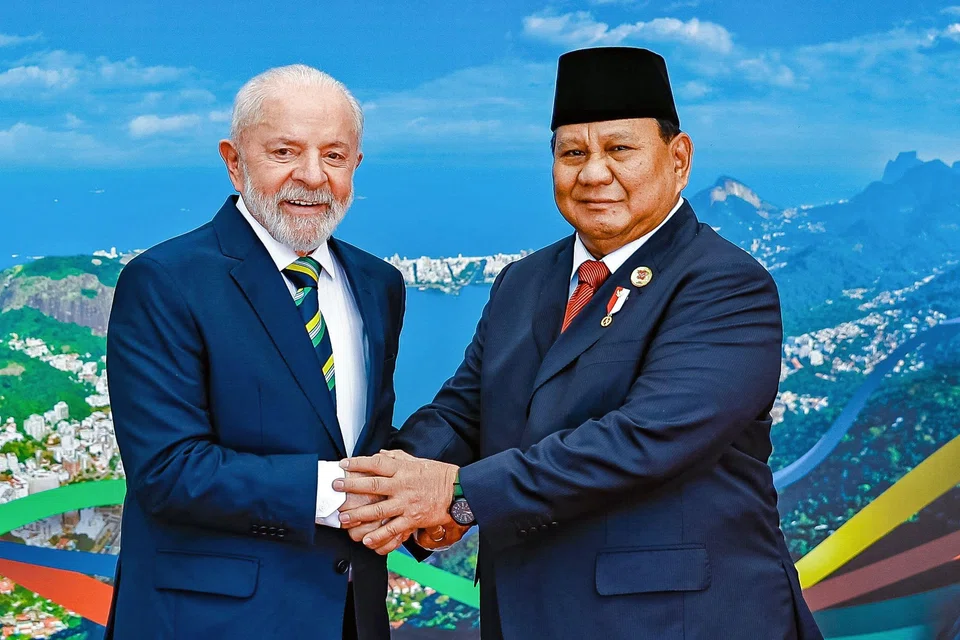
[JAKARTA] Indonesia’s full membership in Brics – the alliance among founding countries Brazil, Russia, India, China, and South Africa – is expected to beef up President Prabowo Subianto’s strategic ambition of attracting more foreign investments in an increasingly complex, multipolar world.
Market observers say the latest move to join the grouping led by China and Russia also reflects Indonesia’s aim to broaden its alliances and strengthen its geopolitical flexibility.
Dedi Dinarto, lead Indonesia analyst at the public policy advisory firm Global Counsel, said Indonesia’s entry into Brics positions the country to be nimble and ready for any shift away from Western-led systems.
He added that joining Brics is expected to open new markets for Indonesia, particularly in sectors such as palm oil and nickel, where the country holds significant natural resources.
On the other hand, other observers warn that Indonesia’s full inclusion in Brics opens the country to increased geopolitical risks, in the face of the country’s long-standing policy of free and active political engagement.
The South-east Asian economy could also potentially face trade-related risks – chiefly tariff hikes – if US president-elect Donald Trump walks the talk on his threat to impose tariff increases against countries that try to challenge the dominance of the US dollar.
The incoming Trump administration, which regards Brics as one such challenge, is likely to view this move as a potential threat to American interests.
“Indonesia would need to carefully navigate this problem in the coming years,” said Dinarto.
Indonesia’s full membership in Brics was announced late on Monday by Brazil, which holds the presidency of the association for 2025.
In an official statement Tuesday (Jan 7), Indonesia’s Ministry of Foreign Affairs emphasised that Brics is a pivotal platform for strengthening South-South cooperation, and ensuring that the voices and aspirations of the nations of the Global South are heard and represented in global decision-making processes.
Arsjad Rasjid, who chairs the Indonesian Chamber of Commerce and Industry, hailed the full membership as a major opportunity to expand economic, trade and investment collaborations with fellow Brics member nations, while also bolstering sustainable growth.
Indonesia needs investments totalling 13,528 trillion rupiah (S$1.14 trillion) over the next five years to meet its 8 per cent economic growth target, so Brics is a platform through which the country will explore new markets for its economic expansion.
“This membership also carries new responsibilities, including mitigating the intensifying challenges of global competition,” he said in a statement.
Enhanced China-driven advantages
Indonesia’s inclusion in Brics is poised to unlock significant opportunities through China’s economic stimulus policies, particularly in infrastructure development under the Belt and Road Initiative, the China-led infrastructure project stretching around the globe.
Karl Gading Sayudha, an analyst at Kiroyan Partners, emphasised that the Brics membership gives Indonesia access to vital funding and strategic partnerships for large-scale infrastructure projects, setting the stage for accelerated growth and development.
In recent years, China has solidified its position as Indonesia’s leading investment partner, with total investments hitting US$30 billion in 2024. This has fuelled transformative projects – mining operations and high-speed rail are examples – during former President Joko Widodo’s tenure.
Sayudha said this strong collaboration is likely to deepen under President Prabowo, ensuring continuity in leveraging China’s investments to fuel Indonesia’s ambitious development agenda.
“As the largest economy in South-east Asia, Indonesia is a lucrative market that China certainly won’t overlook,” he said.
While Indonesia’s trade relationships with China, India and Russia are already well-established and flourishing under various free-trade agreements, Dinarto suggested that Indonesia has the potential to tap into new markets in Africa and South America.
He identified one other significant benefit – access to the proposed Clean Energy Fund by the Brics New Development Bank, which could be transformative for Indonesia’s green-energy initiatives.
Talks are also ongoing among the Brics nations about integrating their carbon markets under their shared commitment to the Paris Agreement.
The Brics’ announcement solidifies Indonesia’s position as the first country to gain full membership since the association began its expansion at the Johannesburg, South Africa meeting in 2023.
The grouping now has 10 members, with Egypt, Iran, Ethiopia, the United Arab Emirates and Indonesia as its newest members. Within South-east Asia, Malaysia and Thailand have also expressed interest in full membership.
Balancing act
Indonesia’s push to join the bloc aligns with Prabowo’s “good neighbour” foreign policy, said observers who spoke to The Business Times.
The new president’s guiding proverb, “A thousand friends is too few, one enemy is too many”, encapsulates Jakarta’s strategic approach to expanding its international ties.
Indonesia’s interest in Brics began during his predecessor Joko Widodo’s administration; the country was first invited to be a partner nation in 2022, but Widodo took a cautious approach.
He said then that Indonesia was still weighing the pros and cons of membership, and emphasised that there was no urgency for Jakarta to join the bloc, underscoring a more neutral stance in global affairs.
Prabowo, on the other hand, has been more forthcoming. Just a week after his inauguration last October, he sent Foreign Minister Sugiono to attend the Brics Summit in Kazan, Russia, where Indonesia formally expressed its interest in becoming a partner nation.
But Indonesia has said it would continue to engage with other multilateral groups; it is also going through the accession process for the Organisation for Economic Co-operation and Development.
Sayudha from Kiroyan Partners noted that this pragmatic diplomacy reflects a nuanced approach to international relations under Prabowo’s leadership. He added that despite Indonesia’s full membership in Brics, Prabowo would continue to maintain a balanced relationship with Western countries, particularly the US.
With Prabowo’s growing international influence and recognition, he said there is significant potential for Brics to further expand its membership.
“Joining Brics is just one of the many ways Prabowo can elevate Indonesia’s global standing,” he said.
TRENDING NOW

Two Singapore-listed palm oil firms named in Greenpeace report on Indonesian plantation fires
Singapore Airlines flight returns to San Francisco after ‘unruly’ passenger incident

Singapore looking into which companies responsible for haze-causing fires: PM Wong
Deluge IPO 3.86 times subscribed ahead of SGX debut

