Indonesia’s sector stalwarts are growing, yet many are disappearing from global indices
The recent exclusion from benchmark gauges reflects broader investability concerns, say observers

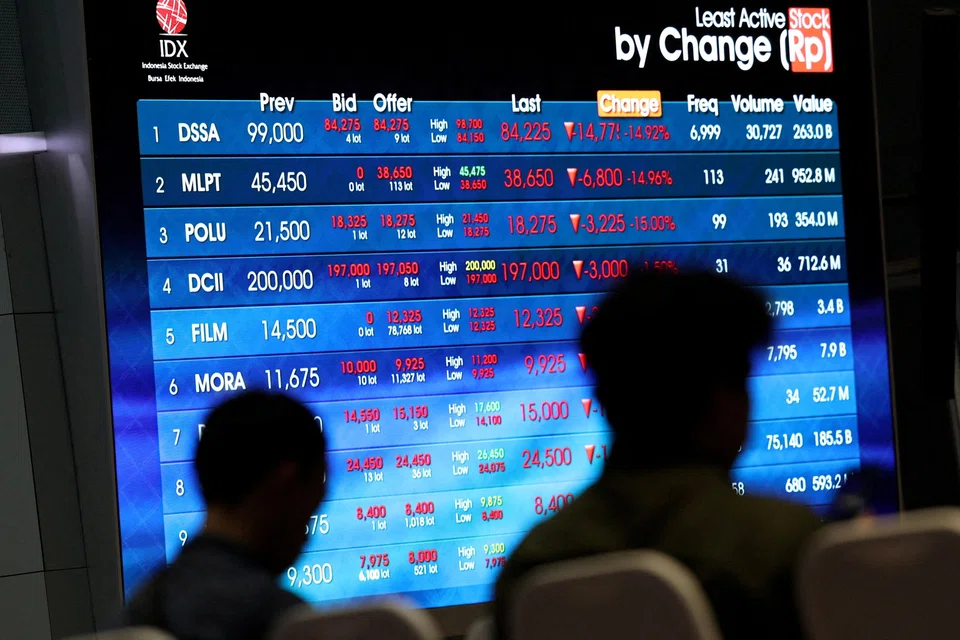
[JAKARTA] Indonesia’s biggest listed companies are increasingly being excluded from major global stock indices, raising concerns that South-east Asia’s largest economy is becoming less investable despite producing some of the region’s most valuable firms.
Mohit Mirpuri, senior partner for wealth management at SGMC Capital, noted that the recent exclusions reflect broader concerns about investability rather than a lack of corporate growth.
“The issue is not whether Indonesia has growth, but whether that growth is supported by sufficient free float, liquidity, transparency and institutional investability,” he said.
In May, index provider MSCI removed six Indonesian companies from its Global Standard Index – including energy giants Barito Renewables Energy and Dian Swastatika Sentosa – following concerns over the investability of several large-cap stocks.
Similarly, in its latest review in June, FTSE Russell removed several Indonesian companies from its global benchmarks after determining that they no longer met its eligibility criteria. The group included home-grown technology giant GoTo.
The changes will take effect on Jun 22.
A rough patch for markets
The developments come at a particularly challenging time for Indonesia’s financial markets. Investor confidence has been weighed down by a combination of factors.
Besides MSCI’s scrutiny of the investability of Indonesia’s equity market, there are concerns over potential sovereign credit rating downgrades, and questions about the fiscal sustainability of costly flagship programmes such as the government’s free meals initiative.
The uncertainty has triggered a broad sell-off in Indonesian assets this year.
The Jakarta Composite Index has fallen more than 30 per cent, while the rupiah weakened beyond the 18,000-per-US-dollar level on Thursday (Jun 4), extending the currency’s year-to-date losses to more than 4.5 per cent.
The market rout has also cost the country its position as South-east Asia’s largest stock market. By late May, Singapore had taken over the title after the sharp decline in Indonesian equities erased Jakarta’s market capitalisation advantage.
The latest deletions are particularly significant given Indonesia’s decades-long efforts to raise its profile in global benchmarks.
Once viewed as a high-risk emerging market after the Asian financial crisis, the country gradually increased its representation in MSCI and FTSE indices amid strong economic growth, a commodities boom and rising domestic consumption.
Structural issue
The index removals come despite many of the affected companies boasting multibillion-dollar valuations and having been among the biggest drivers of Indonesia’s post-pandemic stock market rally.
Fuelled by a wave of blockbuster listings and a growing retail investor base, Indonesia’s initial public offering market reached a record in 2023 with 79 listings, ranking it as the sixth-most active exchange globally by volume.
That momentum helped lift the broader market, with the combined market capitalisation of Indonesian-listed companies surpassing US$900 billion in January 2026, making it South-east Asia’s largest equity market.
Despite their massive valuations, several of Indonesia’s largest listed companies remain tightly held.
Companies controlled by some of Indonesia’s richest tycoons – including the Widjaja family behind Dian Swastatika Sentosa and Prajogo Pangestu of Barito Renewables Energy – have highly concentrated ownership structures, leaving only a small portion of shares available for public trading and raising concerns about their investability.
Those concerns came to a head in January when MSCI highlighted the concentrated ownership structures and limited free float of several large-cap stocks.
The warning sparked a broad market sell-off, forcing the Indonesia Stock Exchange to activate trading curbs for two consecutive days.
Indonesia’s minimum free-float requirement stood at just 7.5 per cent before regulators moved to gradually raise it to 20 per cent in response to MSCI’s concerns and preserve the country’s standing as an emerging market.
Capital outflows loom
Market participants warned that the effects of index exclusions can quickly feed through to capital flows and funding costs.
Ricky Ho, chief investment officer of Four Capital, said the immediate impact of index exclusions is forced selling by passive funds that track global benchmarks.
The greater concern, however, is the signal it sends to active investors.
“If Indonesia’s weight continues to decline because of investability concerns, active investors may increasingly question whether the market deserves a strategic allocation,” he said.
He noted that index providers often act as a first filter for global asset allocators when assessing emerging markets. As Indonesia’s representation in major benchmarks shrinks, actively managed funds may also reassess their exposure to the country.
“That can create a negative feedback loop,” he added. “Lower participation leads to weaker liquidity, weaker liquidity raises the cost of capital, and a higher cost of capital ultimately reduces the attractiveness of the market.”
Citigroup estimated that changes to MSCI’s free-float methodology and index rebalancing could result in foreign outflows from Indonesian equities of between US$1.6 billion and US$34.7 billion in a worst-case scenario.
Mirpuri from SGMC Capital described the recent exclusions as a “healthy but painful reset” for Indonesia’s equity market.
However, he cautioned that a continued decline in Indonesia’s representation within MSCI and FTSE benchmarks could leave the country increasingly underrepresented relative to the size of its economy.
Despite being one of Asia’s largest economies and home to more than 280 million people, Indonesia still accounts for a relatively small share of emerging market indices.
“If exclusions continue, Indonesia could become increasingly underrepresented relative to its (gross domestic product), demographics and market potential,” he said.
TRENDING NOW
Despite the de-dollarisation debate, demand for dollar liquidity in Asia is growing
He built the Vingroup empire. Now South-east Asia’s richest man is handing some key roles to his sons
Malaysian developer Eco World tops bids for Sin Ming area housing plot with S$1,612 psf ppr offer
As China trust-tax deadline looms, wealthy clients explore options across Asia