



Indonesia equities plunge as MSCI removal triggers broad sell-off; tycoon-linked stocks hit hardest
The global index provider has dropped six of the country’s companies from its Global Standard Index in latest semi-annual review

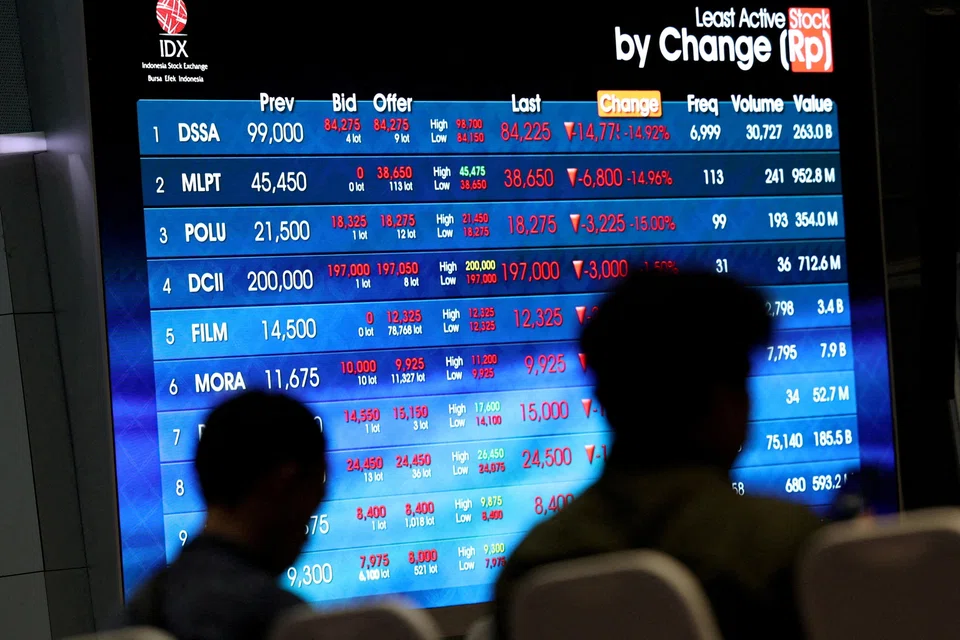
[JAKARTA] Indonesian equities fell on Wednesday (May 13), with tycoon-linked and large-cap stocks leading losses after MSCI removed six companies from its Global Standard Index in its latest semi-annual review.
The benchmark Jakarta Composite Index closed down as much as 1.9 per cent at 6,723.32, its lowest level since late April 2025; the rupiah weakened to a record low of 17,535 per US dollar, and then recovered slightly to 17,455 later in the day.
The sell-off followed MSCI’s decision to exclude six Indonesian companies from its Global Standard Index, most of which are linked to prominent business groups and fall under names with high ownership concentration.
The move comes after MSCI’s broader review of Indonesia’s equity market representation this year – an exercise which placed the country under scrutiny amid concerns over liquidity, free-float structure and accessibility.
Radhika Rao, senior economist at DBS, said: “Since MSCI’s broader review of Indonesia’s equity representation and weightage earlier this year, all related changes have been closely scrutinised by investors.”
The removal of six Indonesian companies from MSCI’s Global Standard Index is a short-term outcome of the country’s ongoing market reforms, said Jeffrey Hendrik, interim president of the Indonesia Stock Exchange, on Wednesday.
Rebalancing
The companies removed include copper and gold miner Amman Mineral Internasional, and Dian Swastatika Sentosa, an energy and infrastructure arm of the Sinar Mas Group.
Other deletions include companies linked to billionaire Prajogo Pangestu, namely Barito Renewables Energy, Chandra Asri Pacific and Petrindo Jaya Kreasi. Supermarket operator Sumber Alfaria Trijaya was downgraded to the MSCI Global Small-Cap Index.
The changes take effect at the close of May 29.
As part of its rebalancing, MSCI also removed 13 Indonesian stocks from its Global Small-Cap Index, reinforcing concerns that Indonesia’s equity weight in global benchmarks is gradually being diluted – just when the country has been trying to defend its emerging market status.
In Wednesday’s trading, selling pressure was heavily concentrated in the newly excluded names.
Barito Renewables and Dian Swastatika Sentosa, both linked to large conglomerates with high ownership concentration, fell sharply along with other deleted names, dropping by between 7.2 per cent and 11.59 per cent at Wednesday’s close. Chandra Asri Pacific, the chemical company controlled by the Pangestu family, slid 14.85 per cent.
Overhang
Indonesia’s equity market has emerged as the worst performer in South-east Asia so far this year, with year-to-date losses of 22.31 per cent. The market was weighed down by persistent uncertainty over the direction of fiscal policy, as well as heightened caution following MSCI’s warnings on market accessibility and index inclusion.
Earlier this year, Indonesia faced the risk of being reclassified to “frontier market” status, prompting regulatory efforts to improve market structure, including adjustments to free-float rules and trading mechanisms.
Analysts said that the latest MSCI review signals that global index providers are still cautious about the pace of reform.
Brokerage firm Stockbit Research Team noted that the index revision was broadly in line with expectations following MSCI’s April announcement, which already signalled a freeze on Indonesia’s inclusion in higher index segments and flagged the potential removal of names with high shareholding concentration.
The research house added that the more important catalyst lies in MSCI’s market accessibility review in June, which could determine whether Indonesia’s market classification risks ease.
Key questions include whether restrictions such as foreign inclusion limits and size-segment migration remain in place.
Cloud on currency
The combined pressure from MSCI-driven rebalancing, geopolitical uncertainty and domestic policy developments has left Indonesian equities vulnerable, and traders are monitoring whether further foreign selling will accelerate in the days ahead.
Beyond index mechanics, analysts warned that the implications extend to capital flows and macro stability.
Samuel Sekuritas economist Fithra Faisal estimated that the latest changes could reduce Indonesia’s weight in the MSCI Emerging Asia index by around 10 basis points, from 0.9 to 0.8 per cent, triggering potential foreign outflows of US$1 billion to US$1.7 billion.
“The weight dilution effect is not limited to excluded names,” he said. “Passive global funds may be forced to rebalance exposure across high-cap banking benchmarks, amplifying selling pressure even in non-index deletion stocks.”
He also cautioned that currency weakness could reinforce capital outflow dynamics, as the rupiah’s slide beyond 17,500 per US dollar increases hedging pressure for foreign investors and heightens macro risk perceptions.
Decoding Asia newsletter: your guide to navigating Asia in a new global order. Sign up here to get Decoding Asia newsletter. Delivered to your inbox. Free.
Copyright SPH Media. All rights reserved.
TRENDING NOW

LTA proposes combining car COE categories, adding rebate-surcharge system

StarHub to acquire MyRepublic’s mobile business amid ongoing telco consolidation

DBS, OCBC, UOB rout lops billions off STI as inflation, rate concerns spook investors

Grab CEO’s wife Chloe Tong on life with Anthony Tan and finding her purpose

