Asean Business logo
SPONSORED BYUOB logo

‘Keep things simple’: HP Greater Asia chief Michael Boyle on leading the tech giant beyond hardware

The managing director says setting a clear direction is biggest lesson he has learnt as a leader

Summarise
Lionel Lim
Published Fri, Jul 17, 2026 · 11:00 AM
    • Boyle says: “If we look at the relationship between cloud and the edge, HP is very much positioning ourselves to be not only at the compute level but also the orchestration around the edge and reducing that friction.”
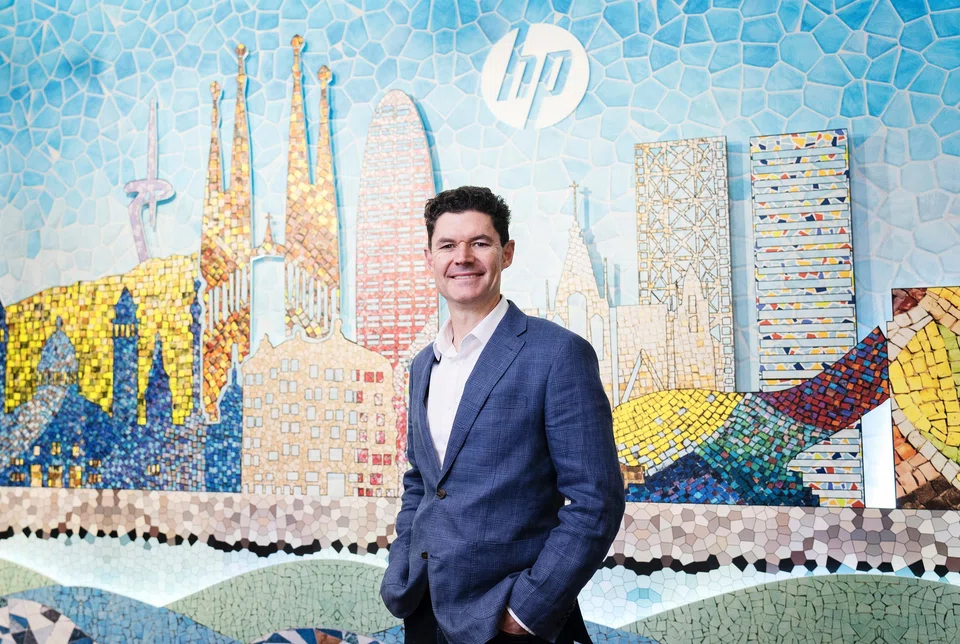
    • Boyle says: “If we look at the relationship between cloud and the edge, HP is very much positioning ourselves to be not only at the compute level but also the orchestration around the edge and reducing that friction.” PHOTO: VICENS GIMENEZ

    [SINGAPORE] HP, probably best known for its personal computers and printers, has been investing heavily in services-led growth and artificial intelligence-enabled work solutions in a bid to raise profitability and its share of recurring revenue. 

    “If we look at the relationship between cloud and the edge, HP is very much positioning ourselves to be not only at the compute level but also the orchestration around the edge and reducing that friction,” Michael Boyle, senior vice-president and managing director for HP Greater Asia, told The Business Times. 

    HP split into HP Inc and HP Enterprise (HPE) in 2015. The split, at that time, allowed both businesses to focus on their respective customers, with HP Inc taking care of the consumer-facing hardware and HPE focusing on the enterprise business. 

    Since the split, HP Inc has also been trying to grow its share of services revenue. For example, it modernised its managed print services and also started to offer device-as-a-service plans in 2016.

    HP Inc has since ramped up its strategic emphasis on its solutions and services business as the company sharpens investments around higher-growth areas tied to AI and the future of work. 

    Boyle said: “We see HP supporting, being in the background, to allow people to produce more of... the output they’re looking for.”

    Boyle, who has been with HP for more than a decade, moved to Singapore earlier this year to help HP grow its services business in this region and find new AI solutions.

    He oversees markets in South-east Asia, Australia, New Zealand, South Korea and Japan.

    HP has long had a presence in Singapore. It first opened a regional sales office in 1969 and then set up its first manufacturing plant a year later.

    Today, the Singapore operation serves as a hub for its print manufacturing, as well as R&D.

    Boyle’s role, as he describes it, is to coordinate the teams in Singapore to bring HP Inc’s products and services to customers in the region. 

    One of his key messages as a leader is to “set a clear direction” and to “keep things simple” as he leads the American tech firm’s regional headquarters towards a destination that includes more offerings beyond hardware. 

    “I think it’s really important to work out priorities, and then actually keep consistency in priorities,” he said. 

    One of those directions that is being set is leveraging AI to reduce friction and augment capabilities in the day-to-day work. That incudes using AI solutions for everything from sales to resource management.

    “It’s not only about what they (AI solutions) bring, it’s also how a company with the legacy of more than 85 years of technology actually incorporates that into our day-to-day operations,” Boyle said. 

    HP is also trying to market these solutions that it is using in-house to its clients through its workforce experience platform. 

    In its most recent quarter, the three months ending Apr 30, 2026, HP Inc reported revenue of US$14.4 billion, up 9 per cent from the same period the year before.

    The company said the increase was driven by unit placements. Workforce solutions and consumer subscriptions were listed as two of six key growth areas for HP Inc. 

    Another AI-related endeavour that Boyle is overseeing is Garage 2.0, HP’s incubator platform for startups. 

    The name of the incubator platform is a play on HP’s history.

    The American tech firm traces its roots back to a garage in Palo Alto, California, that the founders Bill Hewlett and David Packard worked out of. 

    Boyle’s and HP Inc’s view of Garage 2.0 is clear: assess startups involved with AI on their potential to scale their offerings, and then back these startups through support from HP Inc’s network to allow these startups to scale.

    For HP Inc, the programme allows it to tap back into its heritage of invention and entrepreneurship, and for the startups, the programme offers HP’s engineering expertise, business insights and go-to market support. 

    Boyle said: “It’s win-win. We’re learning from the cohorts (of startups) and they’re learning from us in terms of the global scale of HP, and importantly using the brand of HP at a global scale.”

    Three questions with Michael Boyle, senior vice-president and managing director, Greater Asia, HP

    Q: Was there a pivotal moment in your career or personal life that changed your approach to leadership?

    Earlier in my career, I thought leadership meant staying close to everything and trying to have all the answers. Over time, I realised that can actually slow a team down. If people are looking to you for every decision, you do not build ownership or momentum.

    The shift for me was stepping back and focusing more on clarity than control. It is about making sure people understand what matters, what good looks like and where we are trying to go. I have found that organisations work best when there is leadership at all levels, regardless of job title.

    Q: What is one piece of “unconventional wisdom” you swear by that most business schools would tell you is wrong?

    I think a lot of people still confuse being busy with being effective. In reality, more activity often creates more fragmentation, more noise and less impact.

    For me, one of the most important disciplines in leadership is focus. Being clear on what matters most, and equally clear on what does not. In a fast-moving environment, the ability to simplify and concentrate effort is often far more valuable than simply doing more.

    Q: When you feel burnout creeping in, what’s your non-business-related “panic button” activity or routine that reliably resets your focus?

    For me, it is music or going for a run. Either activity gives me a way to step back from the day-to-day and reset mentally. It is less about switching off completely, and more about creating a bit of space to think differently, regain perspective and come back with more clarity.

    If it’s music, my usual go-to instruments are the electric guitar or “neighbour-friendly” electronic drums.