Killing ‘zombie’ projects: Philippines bets big on offshore wind
The Department of Energy is planning to bid out up to 25 GW of capacities in the next decade
WHEN the Philippine government finalised its first green energy auction programme (Geap) in 2022, officials called it a success for its climate policy.
The programme called for public developers to bid the lowest price they could offer to build renewable energy (RE) projects such as solar and wind farms. In turn, the government ensured the projects would be utilised.
By the end of the first auction, 2 gigawatts (GW) were taken up – the entire capacity offered by the government. The projects were expected to be completed by 2025.
But four years after that auction, the full capacities were never realised.
In January 2025, the Philippines’ Department of Energy (DOE) fined Leandro Leviste, formerly the CEO of Solar Philippines and currently a member of the country’s House of Representatives, 24 billion pesos (S$510.4 million) or US$400.8 million.
His firm failed to establish committed projects, under various government contracts, including the ones under the first auction. In 2022, Solar Philippines won 93 per cent of the total awarded projects for solar energy developers in the first auction, which is about 1.2 GW.
Leviste blamed various government agencies for the delay of his firm’s projects, as he found securing permits too difficult. Other energy players lamented that Solar Philippines’ bids for the first auction were simply too low, and the projects became unsustainable to build.
Ultimately, Leviste sold the business in 2023.
Despite the fiasco, the Geap continues: The DOE announced in February that it is holding five more auctions in the coming years, with installation of projects expected until 2035.
Like many of its peers in South-east Asia, the Philippines still relies on fossil fuels as the main source of its energy. These auctions are part of the country’s efforts to source more energy from RE, going from the current level of 25 per cent of its total supply to 35 per cent by 2030.
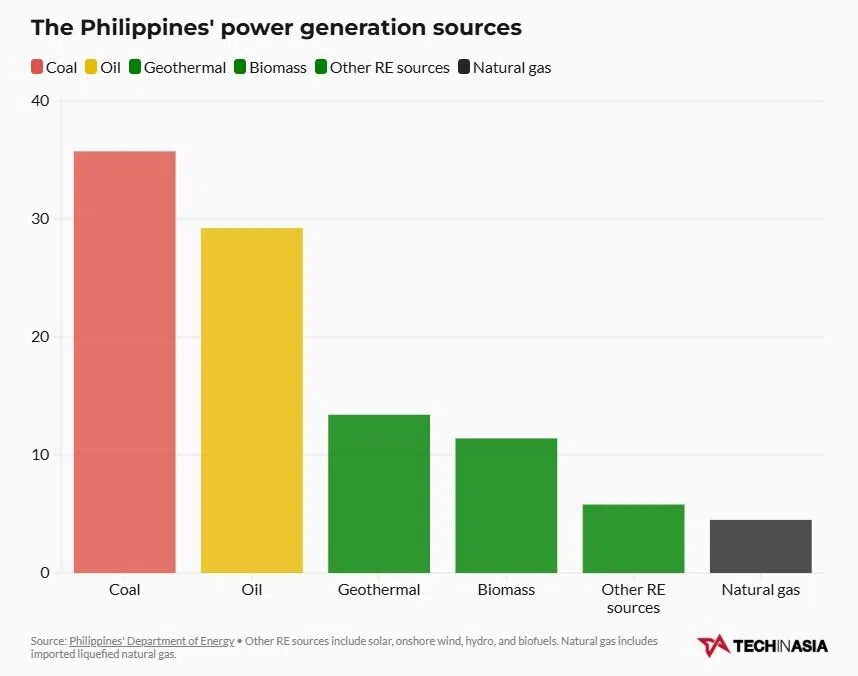
“Especially with our current situation wherein we face rising fuel prices, renewable energy is our bet against it,” says Ruby de Guzman, assistant director at the DOE’s Renewable Energy Management Bureau, tells Tech in Asia. “It will help us secure our power supply.”
Experts and stakeholders believe that the auction process has improved from the initial rounds, with the DOE setting up various measures to prevent cancelled projects and to attract investor interest.
Skin in the game
To be sure, Leviste wasn’t the sole RE developer whose projects had stalled. DOE Secretary Sharon Garin told local media that 163 service contracts were cancelled due to non-performance, which she tagged as “zombie projects”. These would have amounted to 17.9 GW of energy capacity.
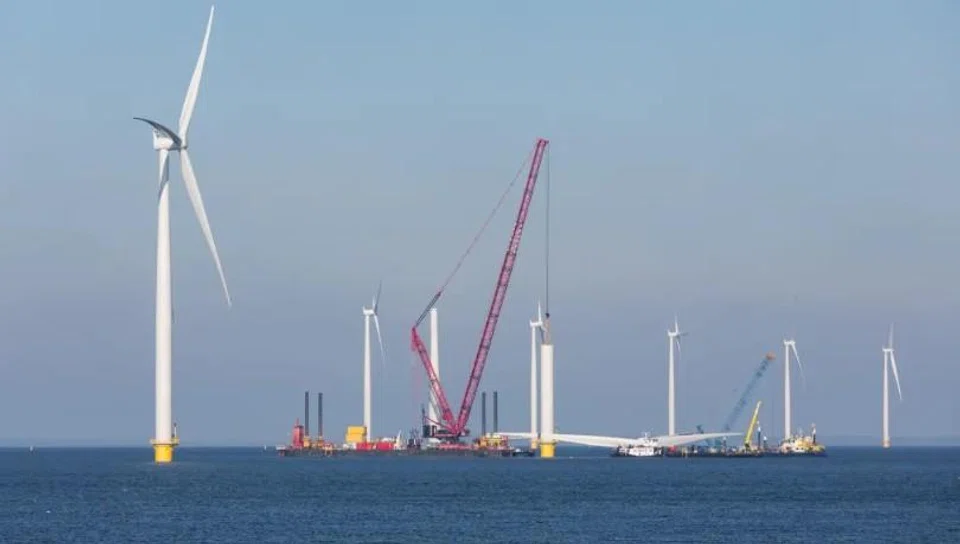
The DOE, however, is keen to continue pursuing new RE capacities. Its fifth green energy auction, which began this March, focuses on offshore wind projects that require wind turbines to be installed on the ocean floor.
A 2022 World Bank study estimated that the Philippines has the potential to produce 178 GW of energy from offshore wind farms alone. That’s six times more than the country’s total installed power capacity, which was at 30 GW as at 2025.
For this auction, the DOE is only seeking 3.3 GW of capacity from offshore wind projects. To participate, bidding firms must have done predevelopment work and grid connection studies, which includes consultations with authorities to determine if their prospective project could have a transmission line to the electrical grid.
In layman’s terms, you can’t bid if you have no skin in the game.
If a bidder’s project gets approved, they would be required to submit a yearly project report about their accomplishments and milestones to the DOE. If developers expect their projects to be delayed, they would have to explain why in detail. Otherwise, corresponding fines may be imposed.
In the first energy auction, such provisions were nonexistent.
The requirements for the latest auction were designed to ensure that participating bidders had “clear and realistic plans” as well as “to promote timely project delivery and reinforce accountability throughout the project cycle,” De Guzman says.
These measures aim to attract “mature” investors or those that have experience building projects in the Philippines, says Jephraim Manansala, chief data scientist at the Institute for Climate and Sustainable Cities.
“Is that good or not? I’m not sure. While it is good that it can ensure that a project is connected to the grid, those that bid may not always be the ones that could provide the least cost for consumers,” he adds.
Ann Margret Francisco, Philippine country manager of the Global Wind Energy Council (GWEC), a trade organisation representing wind developers, points out that the DOE is striking a balance between the sentiments of “smaller” players and ensuring that bid projects can be fully realised.
The agency is “looking for guarantees that (whoever) they say won the bids could deliver these projects,” she says. “They are the ones that commit to the public.”
To be sure, stricter requirements are warranted as this would be the first time that offshore wind projects will be built in the Philippines.
“It’s a pioneering project for the country. And unlike other auctions focused on more mature technologies like solar or onshore wind, this one has unique supply chain constraints,” said Manansala.
For instance, wind turbines need large ports for their transport and installation – a requirement not necessary for solar farm development.
The complex and costly requirements of offshore wind development have led to a few industry leaders.
At present, China is ahead with 41.6 GW of installed offshore wind capacity. That represents half of the world’s total, data from GWEC shows. Taiwan and Vietnam are the two other markets in Asia that have installed offshore wind projects at 3 GW and 1 GW, respectively. The Philippines’ goal of securing 3.3 MW looks paltry in comparison.
Is there investor interest?
GWEC estimates that at least 60 project developers could be in the running for the offshore wind auction. These firms hold service contracts from the DOE, or the right to explore or develop sites for offshore wind development.
Stakeholders interviewed by Tech in Asia believe that many bidders would likely have foreign partners, as offshore wind technology is new to the Philippines.
Heiner Strauss, a veteran wind energy project manager, expects that the 3.3 MW up for bidding will be fully auctioned. His firm, Reprocon, is currently working with two prospective bidders.
The DOE actively engaged with the private sector to craft the mechanics for the latest auction to ensure the “bankability” of the projects, Francisco of GWEC says.
Financing for energy projects in the Philippines have mostly been led by local or regional banks. But for smaller, independent RE project developers in the country, financing is a particularly tricky issue.
They have a harder time securing loans without programmes such as Geap, as banks still find RE projects riskier to finance than bigger facilities like coal power plants.
For example, large energy developers usually sign an agreement with a distribution utility firm to ensure that whatever power they produce would be utilised. In contrast, smaller independent RE developers would have to look for enterprises such as factories or retail malls that would avail of their services.
There should be more financing options for energy projects in the Philippines other than local and regional banks, said Francisco. “We need more capital stack. That could help lower the risk for developers and other financiers, too,” she observes.
The DOE is optimistic that the next round of auctions will still draw investors. The agency is planning to bid out up to 25 GW of capacities in the next decade. TECH IN ASIA