LAC Med set to list on Bursa with an AI healthcare play across Malaysia and Indonesia
Group’s proposed listing will serve as a springboard to accelerate regional expansion, with Indonesia as the sole overseas focus for now


[KUALA LUMPUR] As hospitals across Malaysia ramp up spending on advanced imaging, digital health and artificial intelligence (AI)-enabled diagnostics, LAC Med is preparing to list to capture the next wave of demand at home and in Indonesia.
Formerly known as LAC Medical, the medical devices and integrated healthcare technology group will mark its debut on Bursa Malaysia on Wednesday (Dec 10) following a nearly 13 times oversubscription of its public tranche.
Priced at 75 sen per share, the initial public offering will raise about RM78 million (S$24.6 million), comprising RM55.7 million in new funds for the group and RM22.5 million in proceeds for existing shareholders.
In an interview with The Business Times, LAC Med chief executive officer Liew Yoon Poh said the group’s proposed listing will serve as a springboard to accelerate regional expansion while deepening its push into higher-margin services and digital healthcare solutions.
“We have crossed the difficult incubation phase in Malaysia. Now, we are using the listing to shorten that same incubation period when we enter new markets such as Indonesia,” he added.
LAC Med supplies and integrates large-scale medical equipment including MRI, and ultrasound equipment, consumables and software solutions.
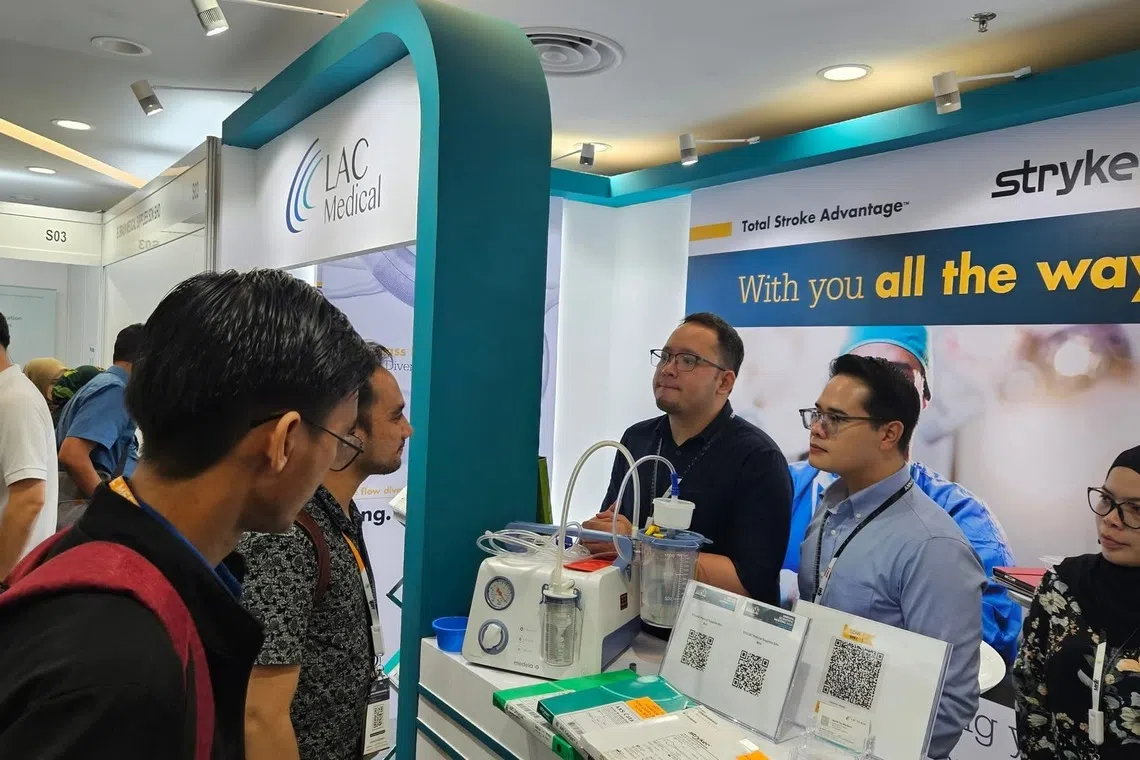
It is an authorised distributor for 11 global brands, including long-standing partners Samsung and Philips, alongside newer principals such as Stryker, LG, Abbott and Bayer.
The company is now expanding into AI-driven solutions, Equipment-as-a-Service (EaaS) and asset management to diversify revenue streams and extend its market reach.
According to the prospectus, over half of the funds raised will be allocated for expansion, specifically to finance a new head office and warehouse, the development of new business segments, including EaaS, and the expansion into Indonesia.
Indonesia – core overseas growth engine
Indonesia is LAC Med’s sole overseas focus for now, selected for its large population, expanding middle class and growing private healthcare sector, supported by the national health insurance scheme.
The group incorporated PT Fairmed in December 2024 as a 95 per cent-owned subsidiary, with operations based in Jakarta. The unit has begun recording revenue since the third quarter of 2025.
LAC Med plans to invest RM8 million between 2026 and 2027 to establish branches in Sumatra, Surabaya and Kalimantan, expanding in phases as commercial milestones are achieved.
It has secured 10 clients in Indonesia to date and has taken over servicing for more than 800 existing installations linked to brands it represents.
“Indonesia is compelling simply by sheer size, supported by its national health insurance scheme,” Liew said, adding that there are 3,000 hospitals in Indonesia, which is way more than what we have in Malaysia, and they are still growing rapidly.
“That creates sustained demand across both public and private hospitals, which is very different from a smaller, mature market like Malaysia,” he added.
Tradeview Research said that while Indonesia’s contribution will be small for now since PT Fairmed only has one licence, the company is likely to gain more approvals, such as for distributing medical devices, and broaden its product range.
In a report on Nov 24, the firm estimates LAC Med’s Indonesia operations could reach RM12.6 million and make up 3.9 per cent of total revenue by 2027, driven by the country’s large population and ageing demographic.
AI adoption
AI is emerging as a key growth driver for LAC Med as hospitals pursue efficiency gains amid global healthcare worker shortages, said Liew.
For example, one AI solution deployed by LAC Med analyses chest X‑ray images for 124 anomalies, automatically flagging abnormal results for doctor review. This helps reduce information overload, accelerate diagnoses and allow staff to prioritise critical cases.
In MRI procedures, AI software has shortened scan times by up to 30 per cent, improving patient comfort and enabling hospitals to handle more cases.
“The future isn’t AI versus doctors; it’s doctors with AI versus doctors without AI. Demand for these solutions will increase as it improves productivity, reduces waiting times and helps prevent doctor burnout,” Liew said
The IPO
The company has set a dividend policy to distribute at least 30 per cent of its annual audited net profit.
Based on a pro forma net profit of RM20.4 million for financial year 2024, LAC Med is listed at a price-to-earnings (P/E) ratio of 14.7 times, implying an estimated market capitalisation of about RM300 million.
TA Securities has set a target price of RM0.83 per share for LAC Med, up from the IPO price of RM0.75, based on an assigned 14 times target price-to-earnings (P/E) multiple on 2026 earnings.
“This valuation reflects the group’s market leadership and strong medium-to-long-term earnings growth, driven by rising demand for diagnostic and digital imaging due to an ageing population and the increasing prevalence of non-communicable diseases,” TA Securities said in a Nov 21 note.
The research house pointed out that the multiple is slightly below Bursa-listed industry peer Umedic Group as it takes into account LAC Med’s lower-margin, distribution-focused business model.
Umedic, a medical device manufacturer and distributor, has a market capitalisation of nearly RM135 million and earnings multiples of 15.8 times. The counter has fallen by about 46 per cent year-to-date, weighed down by the ringgit’s recent strengthening, which negatively impacts the manufacturing division and subdued orders from government hospitals.
Meanwhile, Malacca Securities values LAC Med at RM1.02 per share, applying a P/E ratio of 15 times to the company’s projected earnings per share of 6.78 sen for mid-2026.
The valuation multiple is broadly in line with regional peers, as comparable medical equipment distributors trade at 14.8 to 16.3 times earnings on both trailing and forward bases, said Malacca Securities.
Founded in 2003, LAC Med has built deep customer trust in a capital-intensive, highly regulated market where equipment can cost millions of ringgit and hospitals demand long-term service assurance.
Today, LAC Med serves over 300 clients nationwide and has installed more than 2,500 medical devices across Malaysia.
According to a Vital Factor Consulting report, LAC is one of the largest local medical equipment distributors in Malaysia by revenue. For instance, as of 2023, LAC Med covered 58 per cent of Malaysia’s 373 hospitals, according to its prospectus.
Key financial metrics
LAC Med has recorded steady revenue and profit growth over the years. In 2024, revenue rose 22 per cent to RM183.2 million, although net profit edged down 1.4 per cent to RM20.4 million, weighed by higher administrative expenses and an effective tax rate of 24.6 per cent.
For the first six months of 2025, the group generated nearly RM95 million in revenue and profit after tax of RM10 million.
By segment, the largest revenue contributor was integrated solutions (RM72.2 million), followed by medical equipment (RM14.3 million) and related products and services (RM8.4 million).
The company’s outstanding order book stands at RM184.6 million (as at October). TA Securities expects this to support sales growth of 7.9 per cent in 2025, with net profit projected to rise 1.3 per cent.
Looking ahead, TA Securities forecasts a stronger earnings trajectory, estimating net profit to grow 15 per cent to RM23.8 million in 2026 and a further 12 per cent to RM26.6 million in 2027, supported by steady sales growth and margin improvement.
According to the prospectus, LAC Med’s gross profit margin stood at about 24.8 per cent in 2024 and is projected to increase to 29.4 per cent in 2025.
Nevertheless, Liew noted that segment margins may fluctuate with hospital budget cycles and revenue mix, but the company has maintained a consistent blended profit margin of about 24 to 25 per cent over the past three years.
Managed services
LAC Med’s EaaS model is a departure from traditional leasing practices. Under this arrangement, the company supplies, maintains and upgrades equipment under multi‑year contracts while sharing performance risks with hospitals.
“If the equipment goes down and the hospital loses revenue, we lose revenue too,” Liew said.
This approach converts large capital expenses into manageable operating costs and ensures hospitals operate with current technology.
LAC Med has already secured EaaS contracts with private healthcare groups and the Ministry of Health, a model analysts say will support steady, recurring earnings growth.
Malacca Securities noted that Eaas will be a win-win for LAC Med and its clients, offering the company greater earnings stability instead of just one-off projects while giving clients capital flexibility when exercising this arrangement.