



Malaysia builds a new ‘Silicon Island’ to house its AI ambitions
The project may contribute RM1.1 trillion to Malaysia’s economic output through 2050
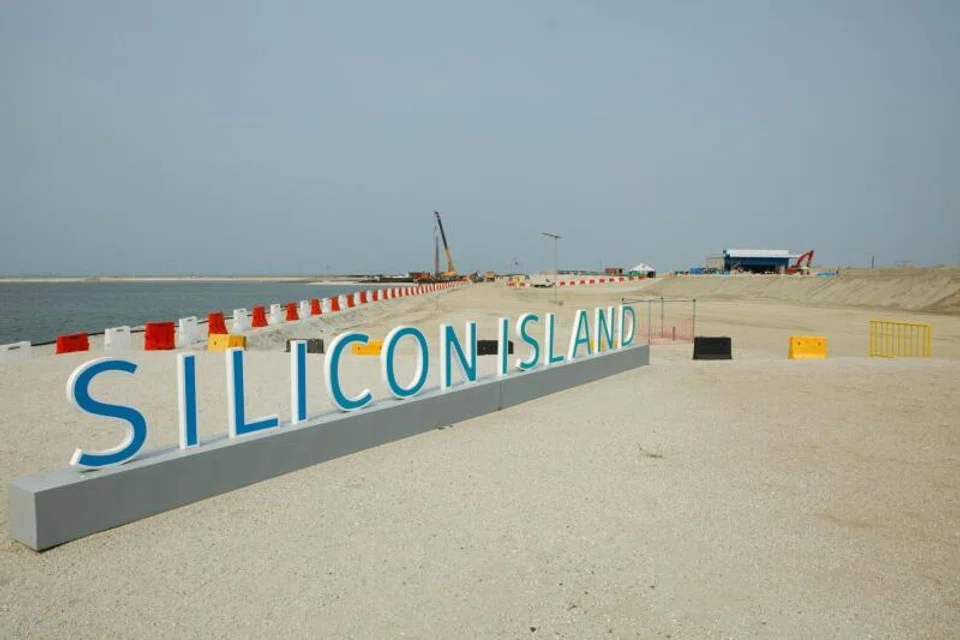
JUST south of Penang, the historic trading island off Malaysia’s north-west coast, excavators are turning a stretch of blue-green sea into a new, man-made island.
Dump trucks criss cross freshly reclaimed sand as orange pipes snake across the emerging land mass, carrying fill pumped from dredgers offshore.
Once complete, this 930-hectare (ha) area, called Silicon Island, is expected to entrench Malaysia’s role in the global semiconductor industry, adding hundreds of billions of dollars to its economy and creating some 220,000 jobs by 2050.
Almost three times the size of New York’s Central Park, it is envisaged the island will also be home to office towers, hotels and waterfront apartments.
The project is an ambitious answer to a problem created in part by Penang’s own success.
After more than five decades building one of South-east Asia’s leading electronics and semiconductor hubs, one of Malaysia’s smallest states is running short of land.
Intel, Advanced Micro Devices and ASE Technology Holding are among technology heavyweights that have expanded operations in recent years around Bayan Lepas, a sprawling cluster of factories near Penang’s airport that forms the heart of Malaysia’s semiconductor industry.
Silicon Island would give the sector room to grow while supporting Malaysia’s push beyond its traditional strengths of chip assembly and testing – the final stages of semiconductor production – into higher-value activities, such as design and advanced packaging.
It is also a bet the artificial intelligence boom will supercharge the race to expand and diversify global chip production, sending more investment towards South-east Asia.
SEE ALSO


Space for further growth in Penang is “increasingly constrained”, the state’s Chief Minister Chow Kon Yeow said in an interview with Bloomberg News.
“Silicon Island represents an important opportunity to build on Penang’s existing industrial strengths while positioning the state for the next phase of the global technology cycle.”
The potential payoff is substantial.
Silicon Island could contribute a cumulative RM1.1 trillion (US$269 billion) to Malaysia’s economic output through 2050 and attract about RM75 billion in investments, according to a Deloitte study cited by its developers, Silicon Island Development, a venture controlled by Malaysian infrastructure giant Gamuda and backed by the Penang state government.
Demand from AI build-out
Penang already accounts for about 5 per cent of the world’s semiconductor exports, according to the state government.
Its electronics industry meanwhile dates back to the early 1970s, when Penang, a centuries-old trading port that prospered on spices, tin and rubber, began courting foreign manufacturers to create jobs and diversify its economy.
Now, the rapid build-out of AI infrastructure is providing another source of demand.
Malaysia Semiconductor Industry Association president Wong Siew Hai recently raised his forecast for the nation’s electrical and electronics exports by about 13 per cent to more than RM900 billion.
Semiconductors account for almost three quarters of those shipments, with Malaysia ranking as the world’s sixth-largest exporter.
The rush to build AI infrastructure is driving growth across the supply chain, leaving some manufacturers at capacity and searching for space to expand – demand that could draw companies to Silicon Island, said Wong, who previously spent 27 years at Intel.
Penang has also benefited as US-China tensions prompt companies to spread production across more countries.
Manufacturers seeking to reduce their reliance on Asia’s biggest economy have been adding capacity elsewhere, and Penang offers an established base of factories, engineers and suppliers.
Silicon Island has already drawn interest from local and international firms, with “particularly encouraging interest” from Taiwan and Japan, Chief Minister Chow said.
One prospective Japanese investor visited the site three times in just two months, with increasingly senior executives making the trip, from the company’s Malaysia chief executive to its Japan-based CEO and finally the chairman, said Tan Jun Jing, deputy project director at Silicon Island Development, a Gamuda executive who has helped deliver large-scale rail networks and townships across Malaysia.
When Tan asked them about the state of the sector, their answer underscored the urgency behind the search for more capacity.
Demand from customers including Intel and Nvidia is so strong that cost has become less of a concern versus how quickly suppliers can ramp up production, she said.
“The current commitment these companies are asking for is ‘how much and how fast can you produce?’” Tan said.
“That’s why a lot of them are really exploring expansion to meet customer demand.”
Facing competition
Still, turning land wrested from the sea into another Bayan Lepas will take time.
The island could take another three to four years just to fully reclaim and as long as 15 years to build out, Tan said, with the first industrial operations expected to start by early 2029.
Competition is also intensifying. Singapore is pushing deeper into advanced manufacturing while Vietnam is vying for a bigger share of projects. India is spending heavily to build a semiconductor industry, too.
Within Malaysia, states including Kedah and Selangor are also courting chipmakers. Higher land prices could further narrow Silicon Island’s pool of potential tenants.
The cost of transforming sand into solid ground is likely to put the expense of being based there beyond the reach of some lower-margin manufacturers, making high-value technology companies its most likely occupants, Wong said.
For companies spending billions of dollars on a new facility, however, land represents a relatively small portion of the overall investment, he said.
Tan sees Silicon Island playing the same role for Penang’s next half-century that the Bayan Lepas Free Industrial Zone has played over the past 50 years.
Intel, one of the early overseas manufacturers that helped establish Penang as a tech hub, is also part of the state’s effort to move beyond traditional assembly and testing.
CEO Tan Lip-Bu met Chow for an update on the US chipmaker’s RM12 billion advanced-packaging facility in the state.
At Silicon Island’s centre will be a roughly 283 ha Green Tech Park targeting industries including semiconductor design, advanced packaging and automated testing.
The first phase is planned to run entirely on renewable energy, according to Silicon Island Development, and there will eventually be a 380 m bridge connecting the development to the main island.
Its location helps define the companies Penang is targeting.
Businesses considering Silicon Island are likely to rely primarily on air freight to bring in materials and send out finished products, taking advantage of its proximity to Penang International Airport, Tan said.
Heavy manufacturers dependent on seaborne cargo would be better suited to the mainland, with easier access to the port, she said.
Gamuda, which has a 70 per cent stake in Silicon Island Development, is financing the project’s RM14 billion in reclamation and infrastructure costs through a syndicated loan, Tan said.
The project expects to break even within eight years, with the first sale of industrial land planned for early 2027, she added.
As shareholder of the rest of the venture, Penang’s government is entitled to a 30 per cent cut of the profits.
A place people call home
According to Chow, the state will also fully own the reclaimed land and determine how it is ultimately allocated and developed. One day, Silicon Island is also intended to be a place people call home.
The plans call for about 20,000 houses on 145 ha, including condominiums and affordable dwellings, alongside shops, amenities and restaurants. Almost one-fifth of the island will be green space, including parks, beaches and mangrove wetlands.
Silicon Island will also serve as a starting point for Penang’s first light-rail system. The 29.5 km Mutiara Line will connect the development with Bayan Lepas, Penang’s airport and the state’s capital, George Town. A later extension will provide a link to the Malaysian mainland. Operations are scheduled to begin by the end of 2031.
A Gamuda-led consortium won a RM7.93 billion contract for the first civil works package.
The sheer scale of the development invites comparisons with Forest City, the US$100 billion megaproject built on reclaimed land in southern Malaysia by Chinese property giant Country Garden and a local partner.
Conceived as a futuristic city for as many as 700,000 people, it relied heavily on overseas property buyers, particularly from China.
Demand faltered after Beijing imposed capital controls, while Malaysian political opposition, the pandemic and Country Garden’s subsequent financial troubles compounded its problems.
Today, only a fraction of the project, originally planned as four artificial islands, has been built and occupancy remains low.
But Silicon Island’s developers are betting on a different anchor: an industry that already exists on its doorstep.
Here, the thinking is that factories and investment will come first, and the city will follow.
“A lot of people compare us to Forest City, but today when you look at it, it’s a pure residential and commercial play,” Tan said. “Our main catalyst will be industrial.” BLOOMBERG
Decoding Asia newsletter: your guide to navigating Asia in a new global order. Sign up here to get Decoding Asia newsletter. Delivered to your inbox. Free.
Share with us your feedback on BT's products and services
TRENDING NOW

DBS, OCBC, UOB rout lops billions from STI as inflation, rate concerns spook investors

OCBC sheds S$8 billion in value as shares close nearly 6% down; analysts cautious on banks

IOI Properties and CapitaLand Investment closer to acquiring One Raffles Place in joint bid

Grab CEO’s wife Chloe Tong on life with Anthony Tan and finding her purpose

