Malaysia PM Anwar set to boost budget spending as election speculation grows
He will likely prioritise cash handouts to middle income groups when he presents 2027’s spending plan
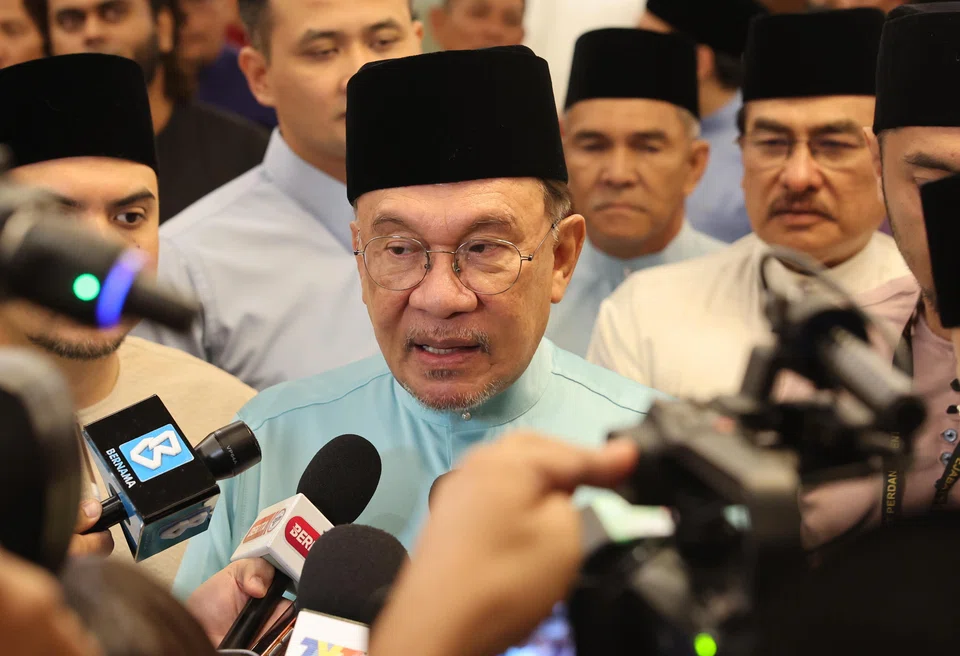
[KUALA LUMPUR] Malaysian Prime Minister Anwar Ibrahim is expected to tackle rising living costs in potentially his government’s last budget before he calls national elections.
Anwar, who is also finance minister, is likely to prioritise cash handouts to middle-income groups when he presents the 2027 spending plan to parliament on Friday (Oct 9).
He will also likely provide more support for the semiconductor and renewable energy sectors, and aim to boost existing revenue streams instead of unveiling new taxes, economists said.
The 79-year-old premier, whose Pakatan Harapan coalition has suffered setbacks in a succession of state elections, is trying to court voters and is said to be considering calling nationwide polls in the second half of 2027, ahead of the February 2028 deadline.
That “raises the stakes for every measure inside the 2027 budget”, Kenanga Investment Bank economists said in a report that noted a pledge to protect people from the global energy crisis while laying the foundations for a higher-value economy.
“The main aim is to ease cost-of-living pressure on households.”
On Aug 30, Anwar restored subsidised fuel quotas in a move that could benefit 16 million people even as it adds to deficit pressures, and eased a burdensome invoicing regulation for small and medium-sized enterprises.
He has also signalled a possible hike in the private sector’s monthly minimum wage from 1,700 ringgit (US$416), with the economy minister identifying higher wages as a key priority.
“Rising political noise ahead of the Budget 2027 announcement, taken together with persistent external volatility and elevated oil prices, suggests that fiscal consolidation may prove challenging,” Lavanya Venkateswaran, economist at OCBC, said in a report.



Budget may see cash handouts, tax reliefs
Spending on subsidies and social assistance could push the government’s 2026 fiscal deficit to 3.6 per cent of gross domestic product, compared with its 3.5 per cent target, she said.
While state spending on fuel subsidies could climb to 40 billion ringgit in 2026, more than double the 15 billion ringgit allocated in 2026’s budget, tax revenue should also be strong.
That is thanks to an economy that expanded a faster-than-expected 6 per cent in the second quarter from a year earlier.
For 2027, the government will likely project a narrower fiscal deficit of 3.4 per cent of GDP, according to a Bloomberg survey of economists.
“We expect a mildly expansionary yet fiscally measured budget, balancing growth priorities with fiscal discipline,” UOB Kay Hian economists said in a report.
It may include “increased cash handouts and increased tax reliefs for the middle income group.”
Malaysia’s tech-exporting economy has benefited from the artificial intelligence boom, and UOB Kay Hian says the sector could get further support through tax incentives, grants, preferential financing as well as measures to promote research and talent development.
It also forecasts green incentives to help Malaysia reach net-zero carbon emissions by 2050.
The central bank expects the economy to expand about 5 per cent in 2026, at the upper end of its 4 to 5 per cent forecast range.
Bank Negara Malaysia expects inflation to remain manageable and within its 1.5 to 2.5 per cent outlook in 2026, with consumer prices rising 1.9 per cent in August from a year ago.
Economists surveyed by Bloomberg see next year’s GDP growth at 4.8 per cent, with headline inflation at 2.1 per cent in 2027.
Impact of populist measures uncertain
Even as growth remains resilient, Anwar has acknowledged that strong economic performance has yet to translate into an improved sense of economic well-being for many Malaysians.
It is unclear if populist measures will help revive his government’s prospects.
The nation has limited room for additional spending as it seeks to narrow its budget deficit, with fiscal discipline important for maintaining investor confidence, according to Azizul Amiludin, a senior fellow at the Malaysian Institute of Economic Research.
“Many of the challenges associated with the cost of living are structural in nature, and policy interventions typically take time to translate into tangible outcomes,” Azizul said.
“Addressing these challenges therefore requires sustained and longer-term policy measures rather than one-off budgetary support.” BLOOMBERG
Decoding Asia newsletter: your guide to navigating Asia in a new global order. Sign up here to get Decoding Asia newsletter. Delivered to your inbox. Free.
Share with us your feedback on BT's products and services