Malaysia shifts EV push from consumers to factories
New import rules aim to spur local EV investment, but affordability and consumer choice remain key concerns

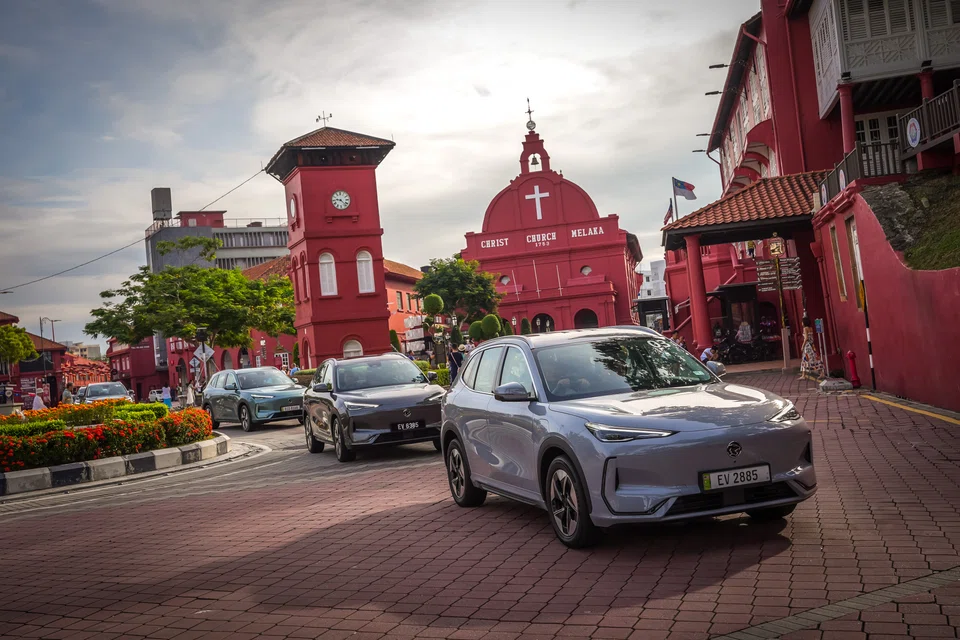
[KUALA LUMPUR] As sales of electric vehicles surge, Malaysia is tightening import rules and localisation requirements as it aims to shift gears from building consumer demand to forcing automakers to invest and put factories and supply chains on the ground.
The strategic pivot comes after four years of tax incentives boosted EV sales that jumped 85.1 per cent year on year to 31,738 units in the first half of 2026, or about 7.8 per cent of total vehicle sales, according to data from Malaysia’s Road Transport Department.
From Jul 1, newly approved, fully imported completely built up EVs must meet a minimum cost, insurance and freight value of RM200,000 (US$48,863) and a minimum motor output of 180 kilowatts following the expiry of temporary tax incentives for imported EVs.
New entrants seeking to assemble vehicles locally also face stricter production and localisation requirements, signalling that future growth will increasingly depend on long-term industrial investment.
One example is Chinese automaker BYD’s proposed RM1.3 billion completely knocked down assembly plant in Tanjung Malim, Perak, which has stalled amid negotiations with the Ministry of Investment, Trade and Industry (Miti) over proposed manufacturing conditions.
These include an 80 per cent export requirement and a cap of 10,000 units for domestic sales annually.
Miti has denied the measures are protectionist, saying in a Mar 31 statement that they are intended to ensure “local assembly focuses on higher-value segments, preserving market space for national players like Proton and Perodua while still offering affordable EV solutions”.
Proton, while regarded as a national carmaker, is itself partly Chinese-owned. Malaysian conglomerate DRB-Hicom holds 50.1 per cent of Proton, while China’s Zhejiang Geely owns the remaining 49.9 per cent under a strategic partnership formed in 2017.
Proton’s eMAS emerged as the bestselling EV brand in the first half of 2026, with 13,530 units sold, well ahead of BYD’s 5,675. This marked a reversal from the same period in 2025, when BYD led with 5,434 units against Proton’s 4,034.
Proton launched its first EV, the eMAS 7, in late 2024 with sales and deliveries beginning in January 2025. Other brands in the top five in the first half of 2026 were China’s Chery and Zeekr, and US automaker Tesla.
By country of origin, Chinese automakers accounted for 45.2 per cent of total EV sales, narrowly ahead of Malaysian brands Proton, Perodua and CAM, which together held a 43.3 per cent share. US automakers ranked third with 6.2 per cent.
From consumer market to industry
Deputy Investment, Trade and Industry Minister Sim Tze Tzin has framed Malaysia’s recent move as the next stage of the country’s EV road map.
“Malaysia should not merely become a consumer market but should also develop its own industrial capabilities,” he told Parliament recently, describing the strategy as a transition from encouraging EV adoption towards local assembly before eventually increasing localisation so domestic vendors benefit from the industry’s expansion.
Analysts broadly agreed that the policy reflects a natural evolution of Malaysia’s EV ambitions.
“The policy mix sends a clear signal that Malaysia is moving from the first phase of EV development, which focused on market creation and consumer adoption, into a second phase focused on industrial development and localisation,” said Jigar Shah, CEO of Maybank Investment Bank India and head of sustainability research at Maybank Investment Banking Group.
However, he cautioned that policymakers would need to strike a careful balance. “The key challenge will be balancing industrial development objectives with EV adoption goals,” Shah said. He warned that consumers may face higher prices and fewer options in the sub-RM200,000 segment during the transition.
Not every automaker expects an immediate impact. Hyundai Motor Malaysia said the new rules would have little effect on its current business because its EV portfolio comprises the premium Ioniq 5 N and Ioniq 6 N, both of which already sit above the new threshold.
Changing landscape
Sean Soon, deals strategy and operations director at PwC Malaysia, told The Business Times: “The overall effect is not a reduction in consumer choice so much as a shift in where competition takes place, from imported vehicles to who can localise production the fastest.”
Several manufacturers have already moved in that direction. MG, XPeng, GWM and Zeekr have either established or announced local assembly plans, allowing them to continue benefiting from tax incentives for locally assembled EVs until the end of 2027.
Soon said the policy would likely distinguish manufacturers making long-term commitments from those relying primarily on imports. “Rather than competing purely on volume, Malaysia is well-placed to carve out a role in selected parts of the EV value chain where technical capability, infrastructure readiness and supply chain reliability matter most,” he said.
Malaysia already has around 750 automotive companies supporting some 700,000 jobs, while Proton achieved 76 per cent local content last year, providing a solid foundation for deeper localisation.
Challenges: Productivity and policy implementation
Whether the strategy succeeds ultimately depends on implementation.
“The central issue is one of sequencing rather than direction,” said Lim Kheng Swe, co-founder and director of research at Seaiea Consulting.
He said Malaysia’s ambition to move from importing EVs to assembling them domestically mirrors a broader regional trend. The challenge is ensuring local production expands quickly enough before tighter import rules begin limiting consumer choice.
“The impact on consumers will depend less on the import restriction itself than on whether local assembly can expand quickly enough to maintain competition and choice,” Lim said.
He also questioned whether some localisation requirements are commercially viable. Requiring BYD to export 80 per cent of its Malaysian output, for example, would make it one of the country’s largest vehicle exporters almost immediately.
“The objective is not in question; it is the calibration and sequencing of the policy that will determine whether it attracts the investment needed to achieve it,” he said.
As South-east Asian nations shift focus from vehicle imports to manufacturing investments, distinct regional strategies are emerging. Thailand dominates the automotive production scale, while Indonesia leverages its nickel reserves for battery manufacturing.
Malaysia also sets itself apart through strategic integration. Lim noted that unlike Vietnam – where VinFast competes directly with Chinese automakers – Malaysia absorbs Chinese tech via joint ventures such as Proton and Geely.