



Malaysia’s economy: Five takeaways from GDP, trade and inflation figures
Robust exports and low inflation provide a boost, but external risks delay interest rate hikes

[KUALA LUMPUR] Malaysia’s economy maintained solid growth in the third quarter as manufacturing strengthened and exports surged, although weaker mining output and slower services expansion tempered the gains.
With September inflation easing, economists see room for continued expansion. But resilient activity and Budget 2027 support measures are also sharpening the debate over whether Bank Negara Malaysia could raise interest rates as early as November.
Here are five takeaways from the latest data and economists’ assessments.
1. Growth stays solid, but Q4 faces headwinds
Malaysia’s economy expanded 5.3 per cent year on year in Q3, easing from 6 per cent in Q2, according to advance estimates from the Department of Statistics Malaysia (DOSM).
For the first nine months of the year, gross domestic product growth reached 5.5 per cent, up from 4.8 per cent in the same period last year.
The figures are based on available data for July and August, alongside estimates for September.
Lavanya Venkateswaran, senior Asean economist at OCBC, noted that the Q3 figure aligns with the bank’s full-year growth forecast of 5.2 per cent, while Bank Negara Malaysia projects full-year growth between 4.5 and 5.5 per cent.
However, UOB expects growth to moderate further in Q4, citing a higher comparison base alongside haze and lingering El Nino-related disruptions that have affected economic activities since October.
These domestic challenges are compounded by external headwinds, including the Middle East conflict and global market volatility.
SEE ALSO






According to Marc Ratings chief economist Dr Ray Choy, the prolonged transboundary haze could cost Malaysia up to RM1 billion (US$245 million) in GDP every month.
2. Manufacturing strengthens as mining activity declines
Manufacturing growth increased to 7.5 per cent from 7.3 per cent in Q2, supported by electrical and electronic (E&E) as well as optical products, alongside petroleum, chemical, rubber and plastic products.
Services growth slowed to 5.4 per cent from 5.9 per cent, while mining and quarrying contracted 4.9 per cent, reversing the preceding quarter’s 9.2 per cent expansion as crude oil and condensate production declined.
Construction growth moderated to 6 per cent from 6.5 per cent. Agriculture rebounded to 1.3 per cent growth from a 3.7 per cent contraction.
MBSB Research noted that the advance GDP estimate provides only a production-side assessment. Detailed expenditure figures, including contributions from net exports and private consumption, are not yet available.
Bank Negara Malaysia will release third-quarter GDP data on Nov 18.
3. Electronics drive an export boom
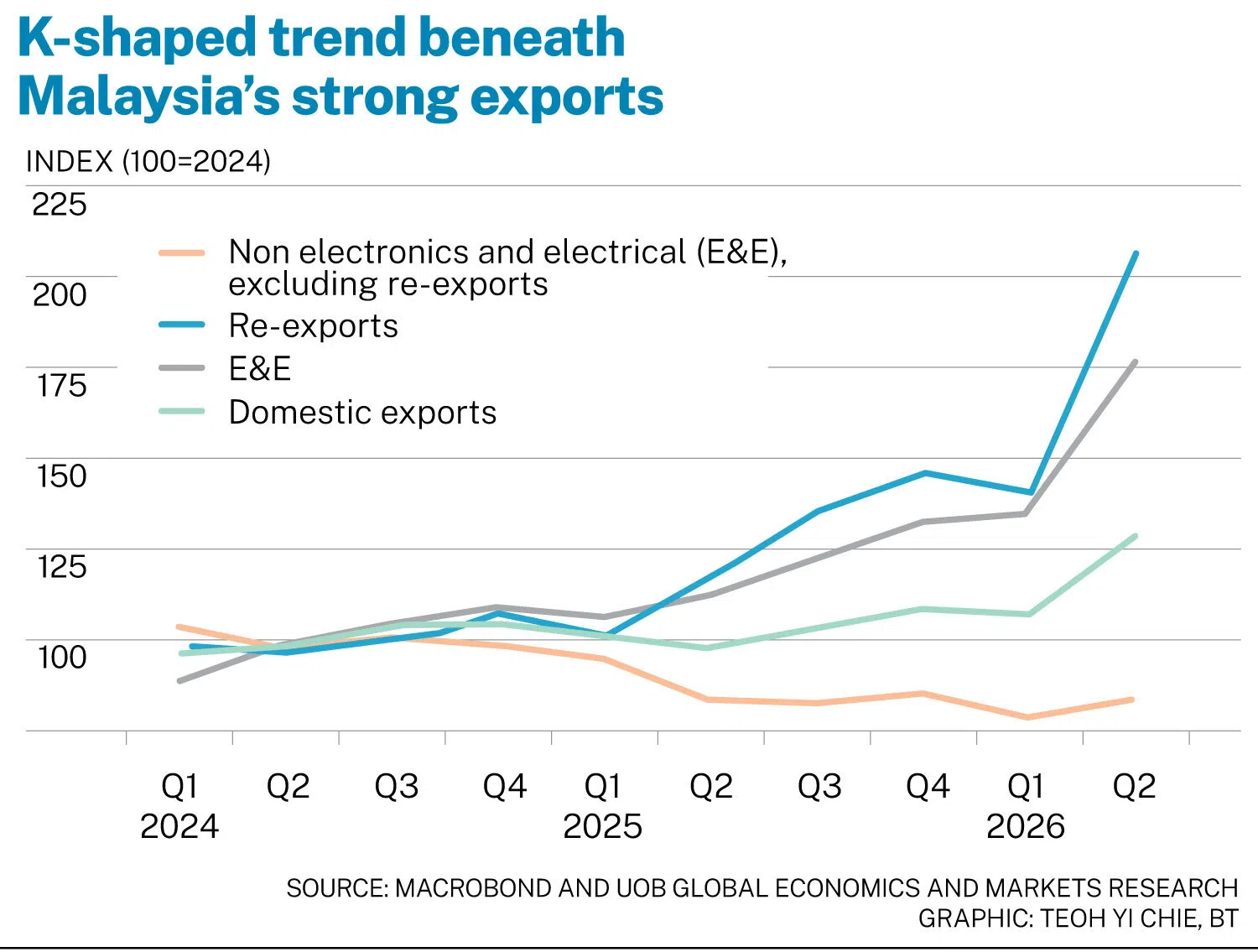
September exports jumped 54.5 per cent to RM215.1 billion, marking the fastest pace of growth in more than five years, with manufactured shipments reaching a record RM191.6 billion.
E&E products contributed RM45.1 billion to the overall export increase. Both E&E products and optical and scientific equipment recorded their highest monthly export values.
Domestic exports rose 54.7 per cent to RM162 billion, accounting for three-quarters of total shipments, showing that the surge extended beyond re-exports.
MBSB said sustained growth in E&E and optical exports suggested demand for related output remained an important driver, amid continued investment in artificial intelligence technologies and advanced electronics.
Strong E&E demand should sustain export growth, it said, adding that better-than-expected external trade performance presented upside to its growth projection.
However, MBSB flagged prolonged geopolitical tensions, tighter trade policies and elevated energy-related inflation as downside risks.
4. Imports show strong demand for production inputs
Imports climbed 52.7 per cent to RM181.4 billion in September, driven partly by goods used in production.
Intermediate goods imports rose 69.6 per cent to RM92.1 billion, accounting for just over half of total imports. Capital goods imports increased 20.9 per cent to RM22.3 billion, while consumption goods imports grew 18.2 per cent to RM10.9 billion.
These figures suggest demand for production inputs and equipment, although nominal import values alone do not establish how much reflects higher quantities or prices.
The trade surplus widened 64.9 per cent to RM33.7 billion.
For Q3 overall, exports increased 46 per cent year on year, but nominal merchandise trade growth is not directly comparable with real GDP growth.
5. Softer inflation leaves a close call on rates
Headline inflation eased to 1.8 per cent in September from 1.9 per cent in August, while core inflation held at 1.7 per cent.
Food inflation nevertheless accelerated to 1.8 per cent from 1.4 per cent, while transport inflation rose to 2.5 per cent from 2 per cent.
OCBC lowered its full-year headline inflation forecast to 1.9 per cent from 2 per cent.
UOB senior economist Julia Goh and economist Loke Siew Ting said stronger-than-expected Q3 growth and Budget 2027 measures – including higher minimum wages, larger cash transfers and tax reductions – pointed to resilient domestic demand heading into 2027.
UOB expects Bank Negara to raise its overnight policy rate by 25 basis points to 3 per cent on Nov 5. The rate has stood at 2.75 per cent since July 2025’s cut.
OCBC’s Venkateswaran shared a similar view, noting that for the central bank, the choice between normalising its policy rate by 25 basis points on Nov 5 or at its meeting in early January is becoming a closer call.
On one hand, the solid growth outlook allows for a more immediate rate hike, while on the other, contained price pressures afford Bank Negara a longer runway, she added.
Decoding Asia newsletter: your guide to navigating Asia in a new global order. Sign up here to get Decoding Asia newsletter. Delivered to your inbox. Free.
Copyright SPH Media. All rights reserved.
TRENDING NOW

GCash parent Mynt rises in market debut after S-E Asia’s top 2026 IPO

In the age of AI, what is a university education for?

Singapore to use ‘every legal and regulatory lever’ against companies linked to haze: Shanmugam

‘IPOs are not the only vehicle’: KKR heads for record exits even as firms stay private for longer

