



Malaysia’s Genting posts Q2 net loss despite 14% rise in revenue
External headwinds, rising costs and a stronger ringgit drag conglomerate into the red in Q2

[KUALA LUMPUR] Malaysia’s Genting Berhad swung into the red in the second quarter despite double-digit revenue growth, as the conglomerate grappled with rising costs and a stronger ringgit, even as its casino businesses showed signs of improvement in their key markets.
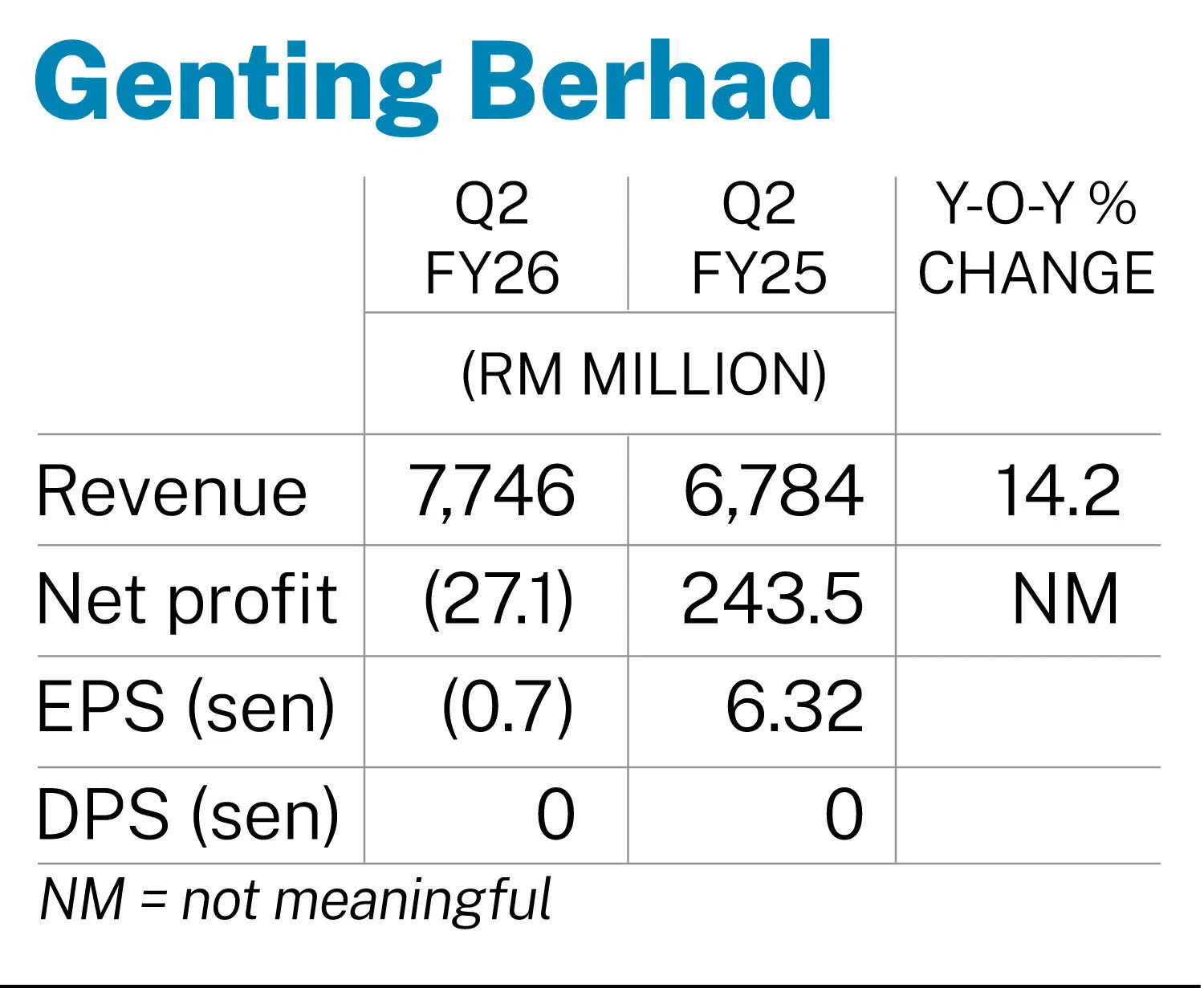
The group posted a net loss of RM27.1 million (US$6.7 million) for the three months ended June, reversing a net profit of RM243.5 million in the year before.
Its revenue rose 14.2 per cent to RM7.7 billion from RM6.8 billion.
For the first six months, revenue grew 9 per cent year on year to RM14.4 billion, and net profit fell 70 per cent to RM74 million.
Genting attributed the higher quarterly revenue to its plantation business, driven by higher production and improved downstream manufacturing sales, as well as its leisure and hospitality operations in Singapore and Malaysia.
The stronger ringgit, however, weighed on its overseas businesses. Genting said that the currency’s appreciation against the Singapore dollar, British pound and US dollar reduced the translated revenue and adjusted earnings before interest, tax, depreciation and amortisation (Ebitda) contributions from foreign operations during the quarter.
Genting Malaysia (GENM), the subsidiary that manages the group’s casino businesses in Malaysia, the UK and the US, similarly recorded stronger revenue but sharply weaker earnings.
Its Q2 revenue jumped 31.9 per cent to RM3.8 billion, but its net profit plunged 88.6 per cent to RM47.4 million.
For the first six months, GENM’s revenue rose 22 per cent to RM6.7 billion, while its net profit dropped 91 per cent to RM43.6 million.
SEE ALSO





Genting and GENM did not declare an interim dividend, saying that it would balance its business requirements and ongoing investments with efforts to pare down existing debt.
Tradeview Capital portfolio manager Neoh Jia Man was pessimistic about the near-term earnings outlook for both Genting and GENM, pointing to geopolitical tensions, higher travel costs and the ongoing expansion of Resorts World New York City (RWNYC).
He told The Business Times: “The Middle East conflict could weigh on casino visitor numbers through flight disruptions and travel-cost inflation, while startup costs at RWNYC are likely to remain elevated for another one to two quarters.”
Nevertheless, New York is emerging as a bright spot for Genting’s casino business.
Genting’s US and Bahamas leisure and hospitality operations, excluding Resorts World Las Vegas, recorded higher revenue and Ebitda, primarily following the start of full commercial casino operations at RWNYC on Apr 28.
The property launched with 242 table games and 2,500 slot machines, with another 1,400 slots subsequently added. GENM broke ground in July on the next phase of development to transform RWNYC into a full-scale integrated resort for gaming, entertainment and hospitality.
Early operating data suggests the table-game roll-out is gaining traction.
In a recent report, Maybank Investment Bank Research said that weekly gross gaming revenue (GGR) from table games has climbed to US$11.1 million, from US$4.9 million in the opening week.
Average daily GGR per table reached US$6,539, above Maybank’s US$5,500 forecast. Despite 12 per cent cannibalisation of slot GGR, Maybank noted that the shift towards table games, taxed at 30 per cent versus 56 per cent for slots, is positive.
It estimates the lower slot tax could add US$120 million to annual Ebitda, with US operations contributing 36 per cent of GENM’s Ebitda by 2027.
Analysts warned the expansion of RWNYC carries sizeable near-term costs. CGS International estimates GENM’s 2026 capital expenditure at about US$1 billion for New York licence fee and pre-operating costs. Interest on the facility used to fund the licence is being expensed rather than capitalised, which CGS said would continue weigh on near-term earnings.
Elsewhere, Genting’s casino operations showed signs of improvement.
Resorts World Sentosa (RWS) recorded higher revenue and Ebitda in Singapore-dollar terms, but a stronger ringgit erased the gains, with ringgit revenue falling and Ebitda remaining flat year on year.
Neoh said that Genting’s broad geographical exposure gives it a more balanced portfolio, but also leaves the group exposed to foreign-exchange translation risk.
Its overseas casinos also face greater competitive pressure than Resorts World Genting, which holds Malaysia’s sole casino licence.
Resorts World Las Vegas benefited from stronger convention attendance and improved high-end play. Hotel occupancy rose to 88 per cent from 80.2 per cent the year before, while its average daily rate rose to US$274 from US$265.
Genting expects convention attendance in Las Vegas to reach a record high in 2026 following the completed expansion of the Las Vegas Convention Center, which increased its capacity by 30 per cent.
The group remains cautious about the outlook, warning that geopolitical tensions and macroeconomic risks continue to cloud global growth; in Malaysia, higher airfares and travel-related fuel costs could weigh on regional and domestic tourism.
Decoding Asia newsletter: your guide to navigating Asia in a new global order. Sign up here to get Decoding Asia newsletter. Delivered to your inbox. Free.
Copyright SPH Media. All rights reserved.
TRENDING NOW

Grab CEO’s wife Chloe Tong on life with Anthony Tan and finding her purpose

Hwa Seng Builder, two China companies win S$1.2 billion Tuas Road Viaduct phase two contracts

Deal between tycoon friends sparks scrutiny of Philippine power sector

Canada is upping oil flows to Asia, but South-east Asia’s refineries aren’t ready to handle them yet

