Malaysia’s government-linked funds to invest in firms under MY Value Up programme
State pension funds and investment managers will back firms prioritising governance and value

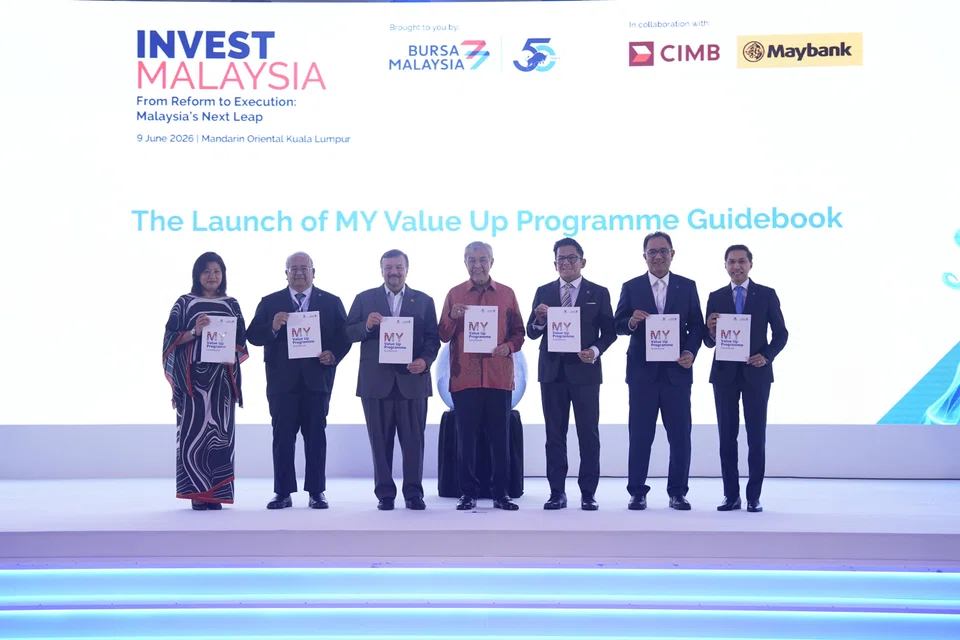
[KUALA LUMPUR] Malaysia’s government-linked funds will channel capital towards companies that demonstrate stronger governance and value creation under the MY Value Up initiative, said Deputy Prime Minister Ahmad Zahid Hamidi.
Speaking at the launch of the MY Value Up programme guidebook at Invest Malaysia 2026 on Tuesday (Jun 9), he said this is a move aimed at raising corporate standards and improving the quality of the country’s capital market.
Participating government-link firms are the state-owned investment management company Permodalan Nasional and the state-backed pension funds – Employees Provident Fund and Retirement Fund.
The My Value Up programme, launched in March, aims to strengthen the value-creation narratives of the country’s top 88 listed companies, which collectively account for about 80 per cent of Bursa Malaysia’s total market capitalisation.
Anchored as part of the Capital Market Masterplan 2026 to 2030, the programme is intended to nudge public-listed companies into articulating and delivering their value-creation agenda in the medium to long term, in order to attract domestic and foreign investors.
“This (initiative) will ensure that companies embracing stronger governance (and) better capital allocation, and higher standards of transparency are recognised not only by the market, but also by the nation’s largest institutional investors,” Zahid said.
However, specific allocation targets and mechanisms have yet to be disclosed. Details will be announced by the respective institutions.
Beefing up Malaysia’s capital market
He described the move as an important signal that Malaysia wants a capital market that is “not only larger, but better”, one that rewards discipline, accountability and sustainable value creation.
The announcement comes as policymakers seek to deepen the role of the capital market in supporting Malaysia’s next phase of economic growth amid a rapidly changing global investment landscape.

While investment inflows remain important, Zahid said future growth would depend increasingly on how effectively capital is mobilised and channelled into productive sectors.
“Our capital market is no longer simply a financing platform. It is the national growth engine,” he said, noting that Malaysia’s capital market has become one of the country’s key economic strengths, reaching RM4.3 trillion (S$1.4 trillion) in size in 2025. The funds raised last year totalled RM187.7 billion, and 60 companies debuted through initial public offerings.
Securities Commission executive chairman Mohammad Faiz Azmi said Malaysia was not a bad market, but noted that only about 200 out of the 1,100 listed companies generated a return on equity (ROE) of above 8 per cent.
“Over the past decade, market capitalisation increased from roughly RM2 billion to RM4.3 trillion (in 2025), while gross domestic product expanded much more significantly. When we studied the issue, we found some surprising gaps,” he told the audience at a separate panel discussion.
He said that among the top 88 listed companies reviewed, six did not have investor-relations functions, and four had no analyst coverage at all.
“That suggests the issue is not only performance. Companies also need to communicate their value proposition better,” he said.
In his opening speech, Bursa Malaysia CEO Fad’l Mohamed said the initiative comes at a time when Malaysia is seeking to better communicate its investment strengths amid shifting global trade, technology and capital flows.
He said that while Malaysia is often viewed as a defensive market supported by domestic consumption, banking and healthcare sectors, the country also offers exposure to fast-growing industries such as semiconductors, advanced manufacturing and digital infrastructure.
“Malaysia offers both stability and upside within a single investment destination,” he said.
He noted that electrical and electronics products accounted for RM711.6 billion or 44 per cent of Malaysia’s exports in 2025, and that integrated circuit exports grew 24 per cent year on year, underscoring the country’s growing role in global technology supply chains.
Fad’l said stronger corporate performance alone may not be enough to attract investor interest, and that listed companies should articulate their value creation strategies more clearly.
“Malaysia is not starting from a position of deep undervaluation. Yet, fair market recognition requires more than financial performance alone,” he said.
Decoding Asia newsletter: your guide to navigating Asia in a new global order. Sign up here to get Decoding Asia newsletter. Delivered to your inbox. Free.
Copyright SPH Media. All rights reserved.