



Malaysia economy expands 5.4% in Q1 as Bank Negara warns of tougher outlook
The country is entering a tougher global environment from a ‘position of strength’, says the central bank


[KUALA LUMPUR] Malaysia’s economy expanded 5.4 per cent in the first quarter of 2026, marginally exceeding forecasts despite mounting headwinds.
Bank Negara cautioned that the country is entering a more challenging global environment “from a position of strength”.
The final figure was slightly higher than the 5.3 per cent growth forecast in a recent Reuters poll, though it represented a slowdown from the 6.2 per cent expansion recorded in Q4 2025.
Speaking at a media briefing on Friday (May 15), Bank Negara Malaysia governor Abdul Rasheed Ghaffour stressed that higher energy prices, supply chain disruptions and heightened uncertainty were expected to weigh on the external environment.
Nevertheless, he expects the country’s economy to remain resilient this year, with growth projected to come in within the range of 4 to 5 per cent, supported by steady domestic demand and continued export expansion.
Exports rebound
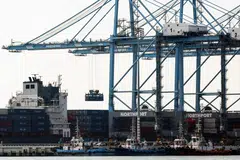
Malaysia’s net exports rebounded by 13.5 per cent in Q1, after a decline of 32.9 per cent in the previous quarter, the Department of Statistics Malaysia (DOSM) said.
This was driven by a 5.2 per cent rise in exports alongside a moderation in imports to 4.6 per cent.
Export growth was mainly driven by continued expansion in electrical and electronics shipments.
Gross import growth, meanwhile, moderated amid slower growth in imports of capital, intermediate and consumer goods.
SEE ALSO








The latest data echoed the World Bank’s recent assessment of Malaysia’s economic resilience.
Zafer Mustafaoglu, division director for the Philippines, Malaysia and Brunei at the World Bank, said on Thursday that Malaysia’s economy is expected to grow 4.4 per cent this year, driven primarily by robust domestic demand.
He said the country consistently exceeded expectations in the second half of 2025, despite a “profoundly uncertain” global environment.
OCBC economist Lavanya Venkateswaran noted that while the public sector’s contribution dropped to 0.7 percentage point, private-sector support was resilient at 4.3 percentage points, nearly matching the previous quarter’s 4.5 percentage points.
OCBC expects GDP growth to slow in the coming quarters, averaging 4.4 per cent for 2026.
UOB senior economist Julia Goh and economist Loke Siew Ting noted that despite a resilient Q1, intensifying Middle East tensions and the Strait of Hormuz’s closure have heightened downside risks.
While maintaining a 2026 GDP growth forecast of 4.5 per cent, they noted that potential supply shocks and resurgent inflation could dampen demand in the second half of 2026.
Ringgit supported by strong fundamentals
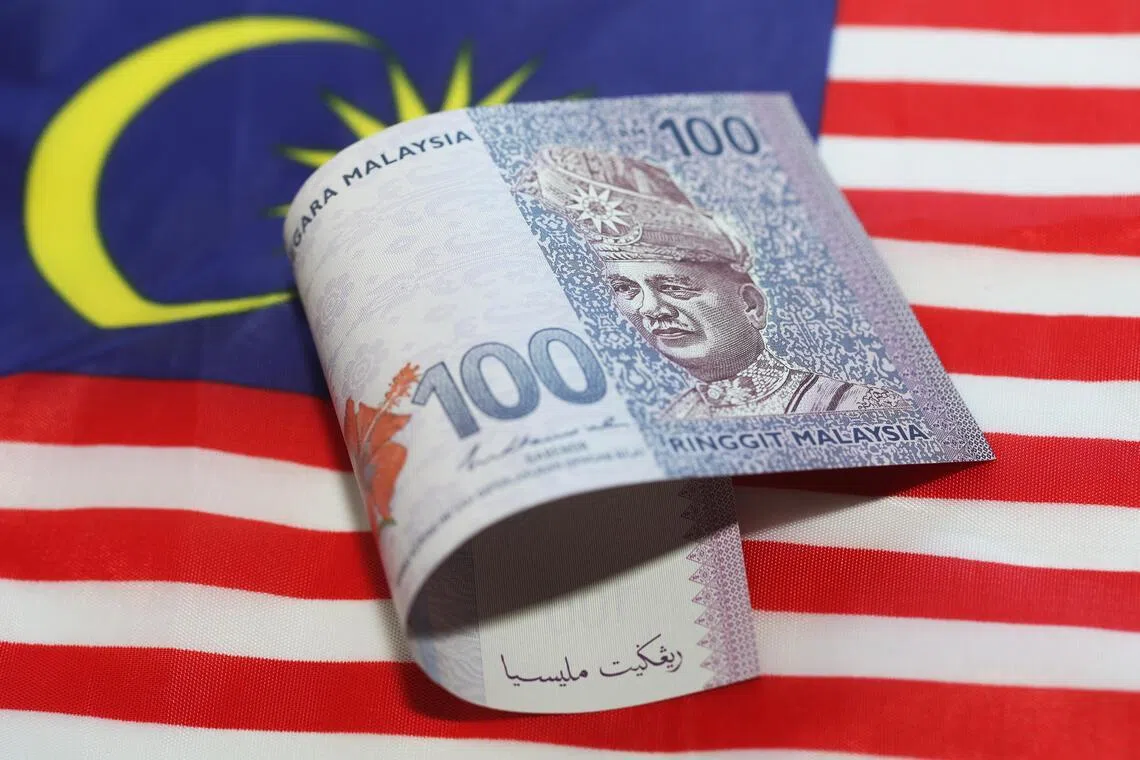
The ringgit remained broadly stable in Q1, with a 1.4 per cent gain in the nominal effective exchange rate against key trading partners.
The local currency also appreciated by 0.5 per cent against the US dollar during the quarter, despite the dollar strengthening following the onset of the Middle East conflict amid risk-off sentiment.
“The appreciation was supported by Malaysia’s strong domestic fundamentals and growth momentum, alongside continued non-resident inflows into domestic markets,” said Abdul Rasheed.
The ringgit’s seven-day winning streak against the US dollar ended on May 8 as investors adopted a “wait-and-see” approach prior to the Q1 GDP announcement.
Despite this recent dip, the currency has maintained a strong performance since the beginning of the year.
As at 5 pm on Friday, the ringgit stood at 3.9508 against the greenback, marking a nearly 2.7 per cent gain from its level of 4.0585 on Jan 1.
Against the Singapore dollar, the ringgit strengthened to 3.0867, a 2.2 per cent appreciation from the Jan 1 rate of 3.157.
Kenanga Investment Bank noted that the ringgit maintained a tight range of 3.92 to 3.93 against the greenback last week, largely unfazed by geopolitical developments.
In a Friday report, Kenanga said that although a strong US dollar and elevated energy costs are weighing on global sentiment, the ringgit is projected to consolidate between 3.93 and 3.96 against the greenback, supported by stable domestic inflation.
Services and manufacturing remain key drivers
Malaysia’s economic growth in Q1 was underpinned by resilient household spending, aided by festive spending and government cash assistance, as well as continued investment activities.
However, several sectors showed signs of cooling following a particularly strong previous quarter.
Mohd Uzir Mahidin, chief statistician at DOSM, said major economic sectors remained expansionary, although growth momentum eased.
The services sector – the primary driver of growth – expanded 5.6 per cent in Q1, compared with 6.2 per cent in the previous quarter.
Similarly, the manufacturing sector grew 5.9 per cent, slightly below the 6 per cent recorded in Q4 2025.
The construction sector’s growth normalised to 7.7 per cent following a period of double-digit expansion, while the agriculture sector grew 2.6 per cent, from 5.7 per cent previously.
In contrast, the mining and quarrying sector contracted 2.1 per cent – down from a 1.4 per cent expansion in the prior quarter – due to reduced production levels.
“Overall, economic activity remained underpinned by domestic events and policy measures that bolstered demand and sectoral performance,” said Mohd Uzir.
Last week, Bank Negara kept the overnight policy rate steady at 2.75 per cent, citing the nation’s fundamental resilience amid the Iran war.
Inflation expected to edge higher
Headline inflation rose to 1.6 per cent in Q1 from 1.3 per cent in the previous quarter, while core inflation moderated to 2.1 per cent from 2.3 per cent.
Bank Negara said the rise in headline inflation reflected some initial cost pass-through of higher global cost pressures, partly due to the conflict in the Middle East.
Headline inflation is projected to average 1.5 to 2.5 per cent in 2026.
Abdul Rasheed said that inflation is expected to edge higher following escalations in the Middle East, due to elevated global energy and commodity prices, broadly in line with expectations.
However, he said that existing policy measures, including targeted fuel subsidies and other mitigation efforts, are expected to help contain broader inflationary spillovers in the near term.
“The extent and pace of pass-through to domestic prices from the ongoing conflict will also depend on firms’ pricing behaviour and demand conditions,” he added.
Transport Minister Anthony Loke said earlier this week that the current mechanism for the RON95 petrol subsidy would remain unchanged for now amid concerns over a planned subsidy review.
Lavanya noted that with energy-reliant sectors generating roughly 27 per cent of total output, Malaysia’s economy remains highly vulnerable to global oil price shocks and supply volume constraints.
OCBC expects the country’s headline inflation to average 2 per cent this year, cautioning that there may be potential adjustments to the fuel subsidy mechanism, considering the rising subsidy bill.
“We expect Bank Negara Malaysia to maintain the policy rate at its July meeting and throughout the remainder of 2026,” Lavanya said. “However, a normalisation to 3 per cent remains a possibility should inflationary pressures become more pervasive and persistent.”
Decoding Asia newsletter: your guide to navigating Asia in a new global order. Sign up here to get Decoding Asia newsletter. Delivered to your inbox. Free.
Copyright SPH Media. All rights reserved.
TRENDING NOW

DBS, OCBC, UOB rout lops billions off STI as inflation, rate concerns spook investors

Grab CEO’s wife Chloe Tong on life with Anthony Tan and finding her purpose

OCBC sheds S$8 billion in value as shares close nearly 6% down; analysts cautious on banks

Deal between tycoon friends sparks scrutiny of Philippine power sector

