



Malaysia’s stock market faces bleak outlook as foreign outflows hammer sentiment
Global trade tensions, delayed IPOs and investor unease over Trump’s second term have soured the mood and upended early-year optimism

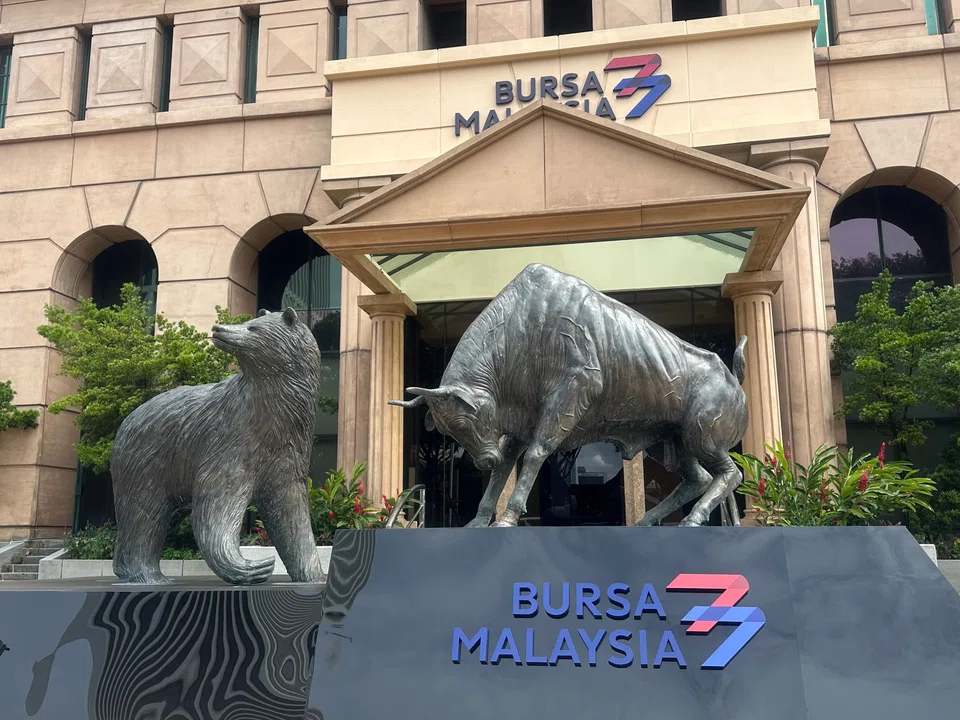
[KUALA LUMPUR] Mounting uncertainty over United States’ trade policy – particularly the risk of sweeping new tariffs under a second Trump administration – is shaking investor confidence in Malaysia, triggering sharp equity outflows and weighing on the country’s economic outlook.
Foreign investors pulled more than RM10 billion (S$3 billion) from the market over the three-month period, marking the biggest quarterly outflow since the landmark 2018 general election.
The FBM KLCI tumbled 7.3 per cent over the period, making it one of the worst performers in South-east Asia and effectively wiping out the gains of last year’s rally.
“The risk of transactional tariffs leaves investor sentiment on edge,” said Alexander Chia, head of regional equity research at RHB.
Apex Securities head of research Kenneth Leong expects market volatility to remain elevated in coming months, largely driven by the unresolved questions surrounding US trade policy.
“Volatility is expected to persist until greater clarity emerges regarding tariff negotiations before the 90-day reciprocal tariff pause ends,” he told The Business Times.
From sunny to gloomy

“The optimism that propelled last year’s rally, particularly from the data centre boom in Johor, has waned,” said Neoh Jia Man, portfolio manager at Tradeview Capital.
He noted that the technology sector has lost momentum, especially after Washington introduced the Artificial Intelligence Diffusion Rule, which dampened investor appetite for tech-related counters.
Fourth-quarter earnings in 2024 broadly missed expectations, said Neoh, adding that companies grappled with rising operating costs, higher taxes and an uneven demand recovery.
“Investors are also nervous about the risk of retaliatory tariffs from the US, adding further strain to emerging-market sentiment,” he told BT.
Market outlook weakens
The benchmark index ended March at 1,513.65, falling from its 2024 closing high of 1,642.33 – its strongest level since 2017. The earlier rally, propelled by tech sector optimism, anticipated US rate cuts, and foreign inflows, has lost momentum due to growing geopolitical uncertainties and worsening macro conditions.
This fragility is evident in the continuous net selling by foreign funds for 26 weeks since November, which has pulled the index down to its current level. As a result, the index recorded a 7.3 per cent decline in the first quarter, underperforming the average 4 per cent drop of the Asean-5.
RHB slashed its year-end KLCI forecast to 1,650 from 1,750, while recommending a defensive tilt with increased cash holdings and selective exposure to high-quality domestic stocks.
MIDF Research highlighted resilience in real estate investment trusts and financials, buoyed by attractive dividend yields. It also favours ringgit-centric stocks with minimal foreign revenue exposure.
Macquarie echoed that view, noting that Malaysian, Indonesian and Philippine equities are trading at steep discounts to historical price to earnings levels, suggesting bottom-up stock picking over index-focused strategies.
IPO pipeline stalls
The chill has also hit Malaysia’s IPO pipeline, which was the biggest star last year by deal count among regional exchanges. The exchange drew 55 listings, raising RM7.4 billion in 2024.
At least two listings – Cuckoo International and SPB Development – have been postponed, citing unstable market conditions.
Bloomberg reported that advisers for South Korea’s OCI Holdings have paused work on the IPO of its Malaysian polysilicon unit due to global market volatility.
Despite these listing delays, Bursa Malaysia chairman Abdul Wahid Omar in an event in early April affirmed the bourse’s target of 60 IPOs for the year, aiming for a combined market capitalisation of RM40.2 billion.
That may sound a tad ambitious in today’s climate – especially after 2024’s glittering run, in which Bursa chalked up the highest number of new listings in two decades. That included the notable debut of 99 Speed Mart Retail, Malaysia’s largest IPO in eight years and the biggest retail float in South-east Asia since 2020.
As at Apr 15, Bursa Malaysia recorded 16 IPOs for the year. More than half closed above their offer price on debut – though most of the strong performers hit the market before February, which signals a slowdown in investor appetite since.
All IPOs listed since March have experienced a marked decline in share prices on their maiden day of trading, with the notable exception of public bus services provider HI Mobility – which not only traded higher on its debut but has continued to outperform other recent IPOs.
Earnings crunch
The first-quarter corporate reporting season, beginning in May, could be a crucial inflection point. Investors will be closely watching for signs of resilience or further weakness as global uncertainty looms over markets.
Tradeview’s Neoh warned that volatility is likely to remain elevated in the months ahead as the persistent uncertainty surrounding US trade policy will continue to drive capital flows.
“Coming closer, investors will be paying close attention to corporate earnings releases next month, but more critically, to the forward-looking guidance offered by corporations given the prevailing circumstances,” said Apex’s Leong.
He noted that beyond corporate earnings announcements, the tabling of the 13th Malaysia Plan in July will also be closely watched.
The 13th Malaysia Plan (2026-2030) is expected to outline strategies emphasising talent development and innovation to propel Malaysia towards a high-income nation status.
Fiscal cushion

Energy remains a potential bright spot – not for exports but domestic stability.
Lower oil prices could help alleviate inflationary pressures in Malaysia, where energy costs ripple across transportation, manufacturing and food supply chains.
Macquarie projects Brent crude to average between US$60 and US$68 per barrel till 2026, a level that could ease the fiscal pressure of Malaysia’s fuel subsidy regime.
Despite being a net oil and gas exporter, Malaysia spends heavily to shield consumers from rising fuel costs, with Ron95 petrol capped at RM2.05 per litre – the lowest in South-east Asia.
Analysts expect the Malaysian government to delay adjustments to the Ron95 petrol price, citing the country’s resource surplus and the narrowing gap between market and subsidised prices.
“We think it likely Malaysia will now defer any reform on Ron95 prices, given the narrowing gap between the market and subsidised price, and given a less predictable economic backdrop,” said analysts from Macquarie in an Apr 14 report.
Still, downside risks loom. OCBC warned that if US tariffs extend to Malaysian semiconductor exports, which make up nearly a third of shipments to the US, Bank Negara Malaysia may be forced to cut rates sooner than anticipated.
GDP downgrades, ringgit outlook
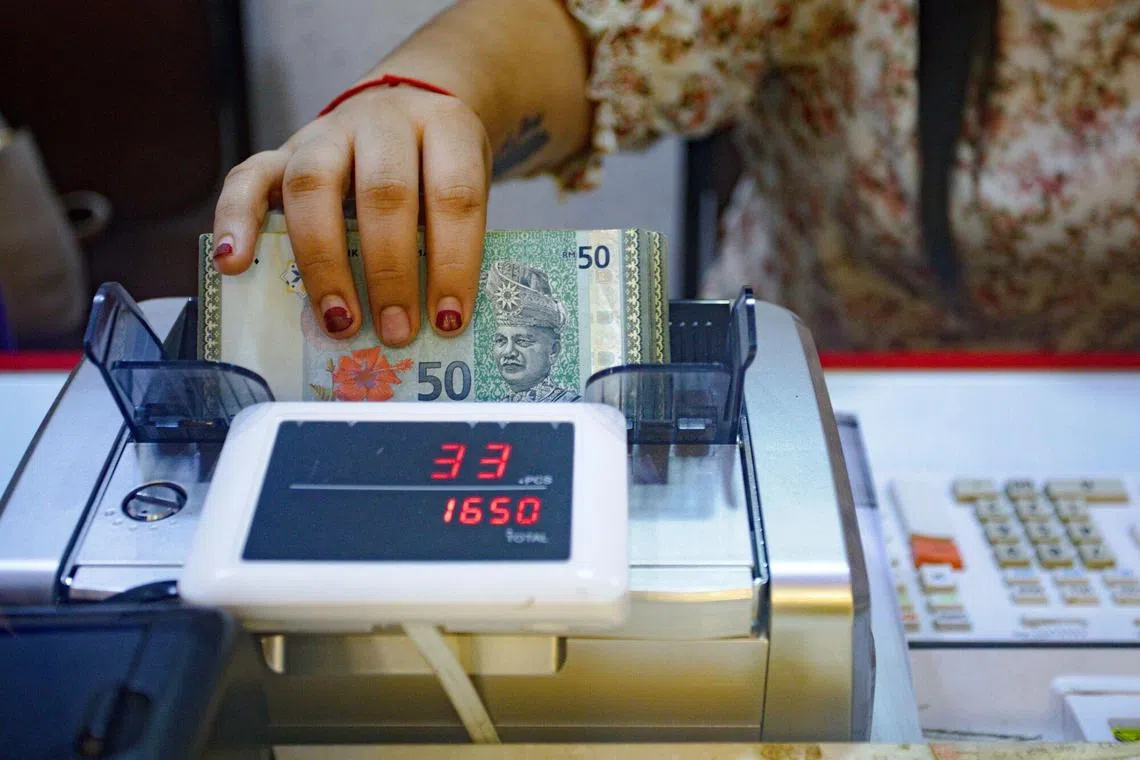
Weaker external demand is prompting economists to lower Malaysia’s 2025 growth outlook. OCBC now expects gross domestic product to expand 4.3 per cent, down from 4.5 per cent, while RHB cut its forecast to 4.5 per cent from 5 per cent.
Citing broader downward revisions in regional forecasts, the International Monetary Fund on Apr 23 lowered its real GDP growth outlook for Malaysia this year to 4.1 per cent, down from the 4.7 per cent it predicted in January.
MIDF and Kenanga Research remain more upbeat on the country’s economic growth, with forecasts of 4.6 per cent and 4.8 per cent, respectively, pointing to resilient consumer spending and investment.
Official data released on Apr 18 showed that the economy expanded 4.4 per cent year-on-year in the first quarter – slower than the 5 per cent pace in the previous quarter and below the Bloomberg median estimate of 4.8 per cent.
The Department of Statistics Malaysia said the growth was underpinned by solid domestic activity and a healthy labour market.
The Overnight Policy Rate is expected to remain at 3 per cent for now, though some analysts expect rate cuts could be on the table if downside risks materialise.
The ringgit has shown modest strength, trading at RM4.4348 per US dollar as at Mar 31, up 0.8 per cent from RM4.4715 at the start of the year.
MIDF forecasts the currency will strengthen further to 4.23 by year-end, though capital flow volatility tied to US policy remains a key risk.
TRENDING NOW

Britain’s mansion tax shows the difficulty of targeting wealth

Once staunchly pro-China, Malaysian Chinese businesses are now distancing themselves from Beijing

The only common thing in S-E Asia is that we all eat rice: Cisco’s Asean president

Singapore data centre operator DayOne opts for US IPO at likely US$20 billion valuation

