



Manila taps India’s GMR for US$11 billion airport – but does it need another?
By courting India’s private capital, the Philippines is shifting away from its reliance on development aid


[MANILA] A multibillion-dollar megaproject rising on a former US naval facility south of Manila is at the centre of the Philippines’ campaign to attract Indian investments to upgrade its ageing aviation network and boost India-Asean connectivity.
The US$11 billion Sangley Point International Airport (SPIA) development is a flagship of President Ferdinand Marcos Jr’s “Build Better More” infrastructure campaign.
In a recent meeting with business leaders during his visit to New Delhi for the Brics Summit, Marcos doubled down on the “aero-city” project, which he said will deepen capital commitments in infrastructure, aviation and digital services.
“Our goal is to build a world-class aviation hub that will help decongest the Ninoy Aquino International Airport (NAIA) and support the continued growth of our economy,” Marcos shared on social media.
To fund Luzon’s latest international gateway, the government is looking to India’s infrastructure giant GMR Group.
Analysts said that by courting India’s private capital, Manila is shifting away from its reliance on development aid, such as loans from the Japan International Cooperation Agency (JICA), to build its aviation infrastructure.
Other international gateways such as Thailand’s Suvarnabhumi and Vietnam’s Noi Bai and Tan Son Nhat have leaned on JICA loans to bankroll their airport expansions.
The Sangley development is set to test whether a private operator and commercial lenders are willing to accept domestic traffic, regulatory, land and financing risks, said an analyst.
Turning blue-sky projections into bankable assets would hinge on a few non-negotiables: steady passenger volumes, firm airline commitments, high-yield commercial revenues, and a stress-tested financing model capable of weathering economic shock.


Andrew Kinloch, managing director at Logie Group specialising in infrastructure finance, said: “The robustness of the public-private partnership structure depends on how much traffic risk investors such as GMR – and their banks – are prepared to take.”
If GMR and the government proceed with Sangley, then the state may need to provide support to limit the risk borne by private investors, “most likely (through) viability gap funding or, better, minimum revenue guarantees”, he added.
The capital structure would also need to manage foreign-currency exposure. Airport revenues would primarily be collected in Philippine pesos, while imported equipment, capital expenditure and potential debt obligations could be denominated in US dollars or Indian rupees.
Kinloch added: “There is no easy way to hedge these exposures over the long term.”
One too many airports?
An airport’s cash flow rises and falls on foot traffic.
Aeronautical revenue is shaped by landing, passenger and other regulated charges, while retail, duty-free, parking and other commercial income depend on passenger volumes and spending.
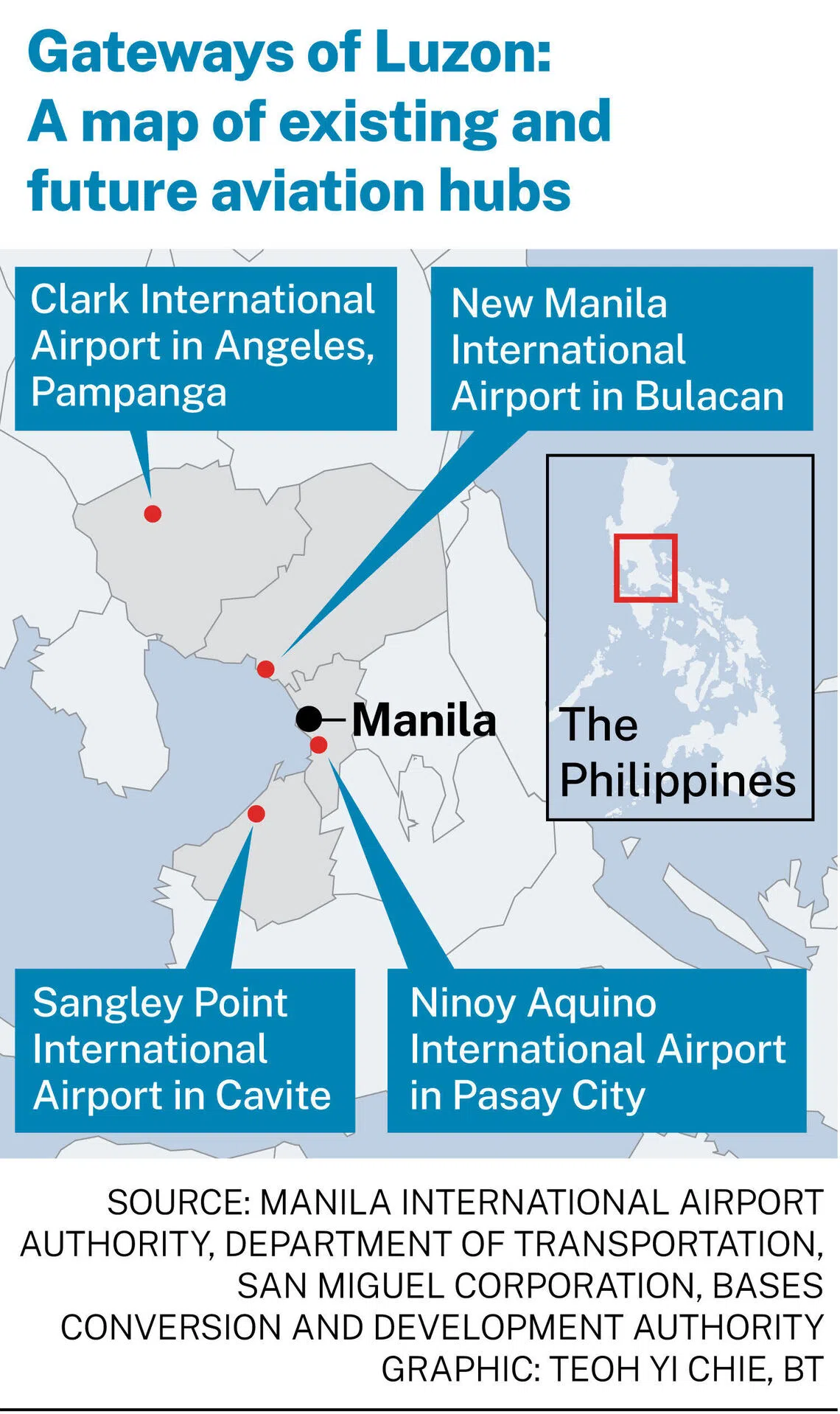
Kinloch questions whether Manila can absorb another international gateway alongside NAIA and two other hubs in nearby Central Luzon – San Miguel’s New Manila International Airport in Bulacan and GMR’s upgraded Clark International Airport in Pampanga.
“Manila does not need four airports,” Kinloch noted. “It is not clear to me that Sangley Point is needed.”

Public-private partnership
GMR’s listed aviation division GMR Airports boasts a market capitalisation of one trillion Indian rupees (US$10.4 billion) on the National Stock Exchange of India.
It affirmed its commitment to the project in 2025 and is expected to join the SPIA Development Consortium in partnership with the government of Cavite – a province 35 km south of Manila, where the airport will be built.
The SPIA consortium is led by infrastructure investor Cavitex Holdings and House of Investments – the investment holding company of the prominent Yuchengco family. It is one of the oldest and most diversified business dynasties in the Philippines and also won the contract for the Sangley airport in 2022.
GMR’s funding commitment for Sangley has not been announced, but the group said it is optimistic about its prospects following initial visits to the site.
“As a private investor, we’ll be more than happy to look at good opportunities, including Sangley and other regional airports, which will be a win-win for both of us – India and the Philippines,” Srinivas Bommidala, GMR’s chairman for energy and international airports, told local media in August.
GMR has invested more than 36 billion pesos (US$573 million) in Philippine aviation infrastructure since 2014, with projects such as the Mactan-Cebu and Clark International airports.
In June, Marcos ordered agencies to fast-track the Sangley project, assigning a technical working group to manage clearances and address reclamation and airspace concerns.
Role in the larger Luzon Economic Corridor
The concept behind aero-cities, such as Sangley, anchors the airport as the centre of urban activity, surrounded by a web of business, residential and transit nodes built for high-speed commerce.
The SPIA consortium said phase-one development is expected to cost about US$4.3 billion.
The state estimates Sangley can generate up to US$500 million in direct government revenue and create 15,000 new jobs, as it reaches its target capacity of 75 million passengers annually once it is fully built.
By contrast, NAIA – the country’s heavily congested main aviation hub – posted a direct government revenue of 21.8 billion pesos in 2025. It handled more than 52 million passengers, its highest annual traffic on record, nearly 50 per cent above its original design capacity of 35 million.
But capacity is not the same as demand. Sangley’s traffic and revenue targets may be reached only after several construction phases and years of demand growth.
The strongest case for Sangley may not be passenger traffic alone, but its role in the larger Luzon Economic Corridor – a strategic, multi-country economic belt backed by the US, Japan and other global partners. It aims to build infrastructure, secure critical supply chains and boost regional connectivity.
With logistics, industrial and commercial development helping to generate demand, the aero-city model for Sangley and other provincial hubs is achievable.
Joey Roi Bondoc, research director at Colliers International Philippines, said: “But only if stakeholders avoid viewing it as an airport-driven story and instead treat it as an economic corridor-driven story.”
In Northern and Central Luzon, early demand is more likely to come from industrial occupiers, logistics firms, export-oriented manufacturers and maintenance, repair and overhaul facilities than from passenger traffic.
Bondoc said that the first phase of any aero-city development should prioritise cargo, logistics, industrial parks and employment-generating uses.
“Residential communities, offices, hotels and retail centres tend to follow once critical economic mass has been achieved. This is precisely how successful master-planned communities and economic zones mature over time,” he added.
Investing in India-Asean connectivity
The Sangley project offers GMR the opportunity to expand its Asean presence.
In Indonesia, GMR Airports holds a 49 per cent stake in a joint venture with state-owned airport operator Angkasa Pura II for the development and operation of Medan’s Kualanamu International Airport.
In Vietnam, it inked a memorandum of understanding with infrastructure conglomerate Sun Group to strengthen cooperation in aviation and tourism.
Meanwhile, its latest megaproject, the US$587-million Vizag Airport in Andhra Pradesh, has been hailed by Indian officials as the country’s “gateway to South-east Asia”.
Kinloch said that GMR was “doing the right thing” by planning new routes to the region, including one to the Philippines.
Decoding Asia newsletter: your guide to navigating Asia in a new global order. Sign up here to get Decoding Asia newsletter. Delivered to your inbox. Free.
Share with us your feedback on BT's products and services
TRENDING NOW

DBS, OCBC, UOB rout lops billions off STI as inflation, rate concerns spook investors

Grab CEO’s wife Chloe Tong on life with Anthony Tan and finding her purpose

OCBC sheds S$8 billion in value as shares close nearly 6% down; analysts cautious on banks

Deal between tycoon friends sparks scrutiny of Philippine power sector

