More Asean corporates expect geopolitical pressure impact, with no region being ‘a safe hedge’: StanChart
By 2031, digital acceleration could add US$2.8 trillion to international trade each year, the bank says


[SINGAPORE] Asean can no longer expect to benefit from businesses’ relocation to avoid geo-economic impact, as it could increasingly be exposed to geopolitical pressure.
Corporates increasingly shifted production, sourcing and investments into Asean to reduce their exposure to geopolitical tensions elsewhere, but those operating in the region now increasingly expect geo-economic actions to affect their markets, supply chains and trading relationships, said a Standard Chartered report.
“No region is offering a safe hedge,” said the 2026 edition of the bank’s Future of Trade report, based on a survey of 2,100 senior corporate decision-makers across 27 markets.
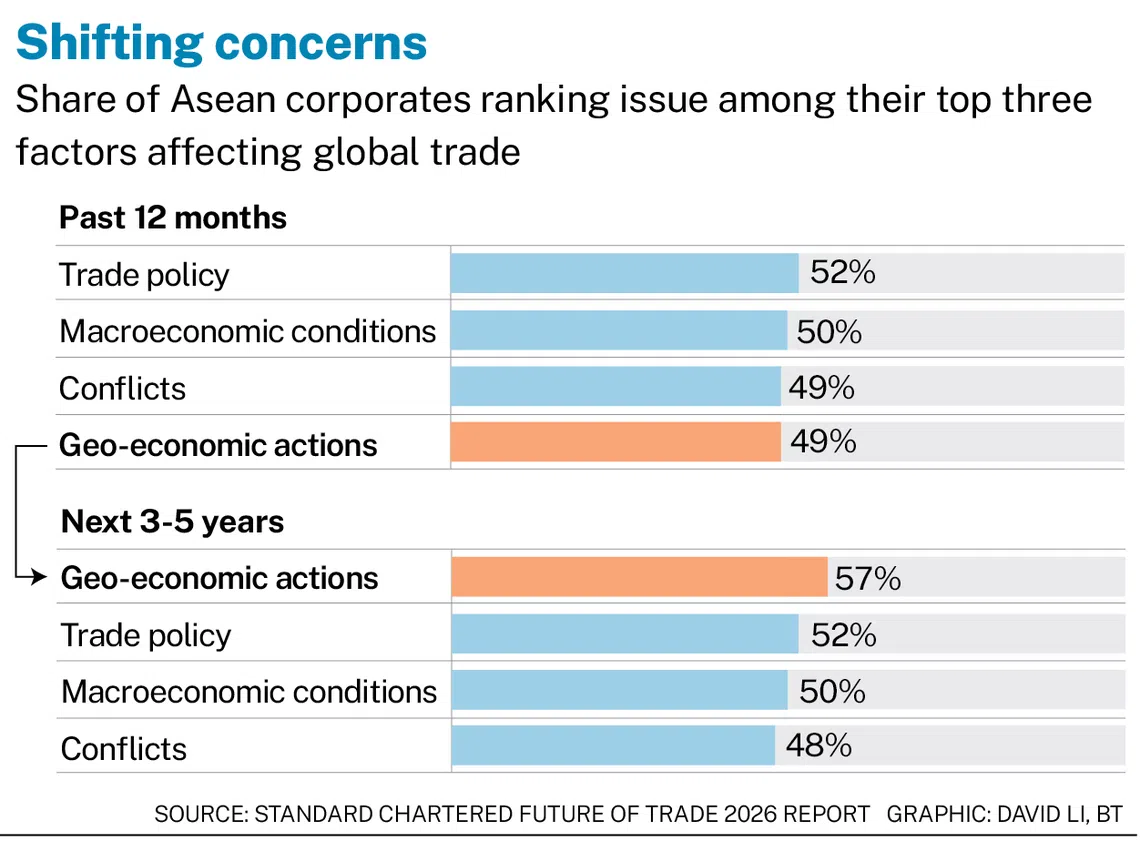
Geo-economic actions was cited by 49 per cent of Asean corporates as a top three factor affecting global trade over the past 12 months – but this share has risen to 57 per cent over the next three to five years.
It was the factor cited by the largest proportion of Asean respondents for the upcoming period.
This worry was experienced across markets, with the same shift observed in other regions: geo-economic concern rose 4.7 percentage points in the Middle East and Africa.
Overall, 51 per cent of corporates ranked the issue among their top three factors expected to affect global trade in 2026, ticking up from 50 per cent in 2025.
“Geo-economic measures are reaching further across markets,” the report said. “Governments are increasingly deploying unilateral measures that can affect corporates across markets and supply chains.”
It added: “Relocating activity does not necessarily remove geopolitical pressure.”

Supply chains, resilience
Rather than where they operate, resilience must now be built on how quickly businesses can detect and respond to change, the report said. It highlighted the importance of “capabilities, relationships and financial structures to make new networks work”.
The report identified cost as the leading constraint to supply chain reconfiguration, at 32 per cent.
But capability is also a limiting factor, with “almost as many” respondents citing insight into optimal treasury management (29 per cent), inadequate analytical capabilities (28 per cent), shortages of internal expertise and talent (28 per cent), and trade-policy uncertainty (27 per cent) as constraints.
For corporates, geographic reconfiguration is losing momentum, and the focus is shifting towards deepening supplier relationships and capabilities.
Most are adjusting activities within markets, fine-tuning them by reallocating suppliers, investment and production as risks and commercial priorities evolve, rather than redrawing footprints, the report said.
Overall, supplier-focused strategies are now seeing a notable increase in priority from the past 12 months to the next three to five years, at 4.3 percentage points.
This includes multisourcing, deeper partnerships with existing suppliers, and building the internal capabilities and technical solutions needed to support more complex supply networks.
For Asean, the share of corporates ranking this action as their top strategy grew by 4.4 points.
Inventory management priorities are also rising for corporates overall (+2.9 points), with the rise being sharpest in Asean (+8.4 points).
These point to a focus on investments in “the capabilities needed to make existing networks perform”, the report said.
The power of digitalisation
Investments in digital capabilities are becoming a critical source of competitive advantage, said Roberto Hoornweg, CEO for corporate and investment banking at StanChart.
Faster digitalisation – lower trade frictions, stronger technology investment and faster adoption of artificial intelligence – could add US$2.8 trillion to international trade each year by 2031, 6.9 per cent above baseline levels, going by an illustrative scenario developed by StanChart and Oxford Economics.
As companies refine supply chains and build resilience, they are expected to create greater demand for digital tools, AI and integrated financial infrastructure.
Capabilities in digitalisation “are no longer viewed primarily as efficiency levers”.
Four in five corporates report benefiting from investments in at least one digital capability, while 83 per cent say digital tools help them respond more quickly to supply chain disruption.
Services trade would benefit particularly strongly from digital acceleration, “as digitalisation widens markets for remotely deliverable and digitally connected services”, the report said. Such services, which include computer, cloud, cybersecurity, professional and other services, are expanding rapidly.
These exports grew 136 per cent between 2016 and 2025, compared with a 70 per cent growth in total goods and services exports; they accounted for 14.7 per cent of global exports in 2025, up from 10.6 per cent in 2016, StanChart found.
Under the digital acceleration scenario, services trade could rise 11.4 per cent above baseline by 2031, as better data flows, digital payments, interoperable systems and streamlined compliance reduce cross-border friction, the report said.
This is almost double the projected 5.8 per cent increase for goods.
The report said that unlocking the US$2.8 trillion trade opportunity from digitalisation will require corporates to tackle internal barriers.
These include a lack of internal enterprise capabilities, difficulty upgrading legacy systems, high costs or uncertain returns on investment, and fragmented data across functions.
But progress will also depend on partners and policy, it added.
Cloud technology ranks highest overall for its potential to advance trade digitalisation, with 70 per cent of corporates describing it as highly relevant or transformational.
But AI is also emerging as a key enabler of this shift, with 56 per cent of corporates rating it highly relevant or transformational. Expectations are highest in technology, media and telecommunications, and energy.
Decoding Asia newsletter: your guide to navigating Asia in a new global order. Sign up here to get Decoding Asia newsletter. Delivered to your inbox. Free.
Copyright SPH Media. All rights reserved.