



Najib house arrest adds drama to Malaysia’s royal situationship
The expansion of palace influence is testing the limits of Malaysia’s system of constitutional monarchy

A NATION’S Constitution is supreme. Except when it is not.
In Malaysia, where nine of the 13 states have hereditary rulers, an expanding royal footprint has not only bred legal confusion, but also drawn the palaces into the very political machinations that constitutional monarchs are supposed to stand above.
The nine sovereigns – who rotate five-year terms as Malaysia’s King, or Agong – have roles, powers and tenures defined according to the constitutions of their respective states and the federation of Malaysia.
But these legal provisions have proven to be less than clear-cut, either because they have never been, or because an increasingly contested political space has blurred the lines.
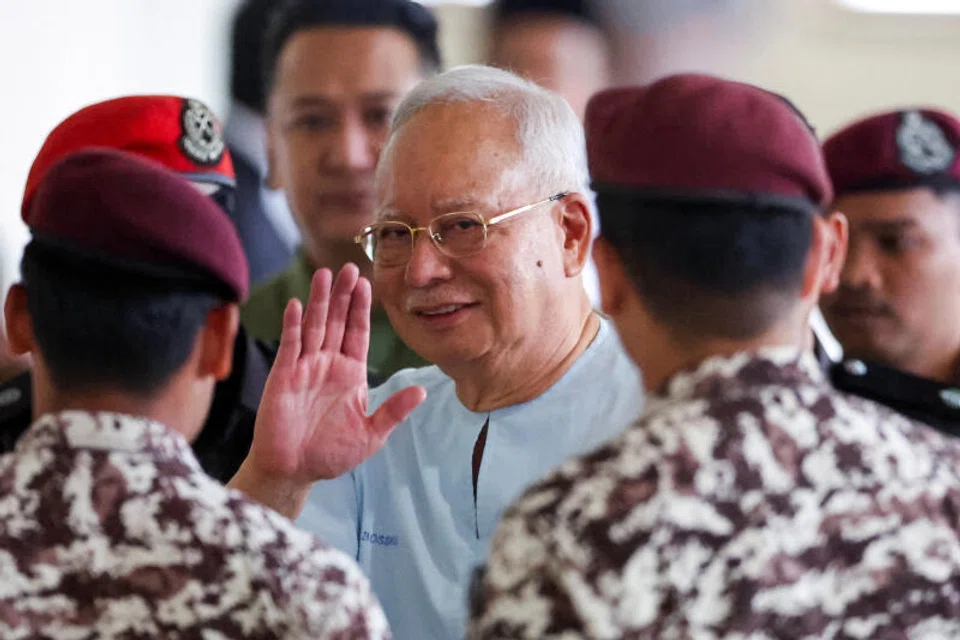
The most recent exercise of royal influence, thanks to a conditional pardon ordered by the King, Sultan Ibrahim Iskandar of Johor, has resulted in former prime minister Najib Razak now sitting the remaining two years of an 1MDB-linked graft sentence in the comfort of his palatial mansion in Kuala Lumpur, surrounded by family.
But a vaguely phrased Nov 6 discharge granted by the court after Najib seemed to have raised most of an RM50 million (S$15.6 million) fine overnight led to a delay, as the Attorney-General disputed whether it meant the entire sentence was voided.

This would have just meant that Najib remained in jail to begin serving another 15-year sentence on a more serious RM2.3 billion graft conviction – one the ex-Umno chief has appealed against.
The impasse broke on Nov 7, when the King declared that any outcome other than Najib going home was tantamount to defying a royal decree.
Backed unsurprising by Umno – where Najib remains an influential figure – the warning led the Attorney-General to rush to court the next working day to obtain a specific order to formalise the house arrest.


Legally, however, clemency rests with the Pardons Board, chaired by the Agong. Any new precedence, such as a house arrest, can withstand legal scrutiny if due process is exercised and cases avoid being fast-tracked because of political pressure.
Instead, that tension is now up to the courts to resolve.
The Malaysian Bar – which represents the legal profession across Peninsular Malaysia – filed a challenge raising several questions including over the constitutionality of Najib’s house arrest given the absence of specific statutory provisions, whether the case falls under the Pardons Board’s powers to grant a pardon, reprieve or respite and whether the board can grant house arrest after already halving the sentence from 12 to six years in 2024 under the previous king, Sultan Abdullah Ahmad Shah of Pahang.
Those questions are now more pertinent after minutes of the Pardons Board meetings were leaked on Nov 18, showing the King had decided against the advice of both the Attorney-General and Federal Territories Minister Hannah Yeoh.
Whatever the courts decide, the episode raises a larger issue: to what extent can royalty override executive counsel to grant clemency? Does this logic extend further to other areas of royal prerogative?
Negeri Sembilan’s customs versus Constitution
A parallel tug-of-war is playing out in the long-drawn-out saga in Negeri Sembilan.
In the seven months since the four territorial chieftains, known as the Undang, claimed that the throne was vacant in April, the state has seen snap polls in August that returned Umno to power, followed by a full-blown crisis of governance after the party backed the chieftains’ bid to depose the ruler.
Two have laid claim to the throne owing to murky rules governing how the Yang di-Pertuan Besar (or Yamtuan) is appointed or removed, under Adat Perpatih, an anachronistic matrilineal customary law, recognised alongside the state Constitution.
The state Constitution requires a formal inquiry into the fitness of the Yamtuan to reign before a replacement can be sought. No such proceeding took place before the Dewan Keadilan dan Undang, the state’s highest authority on matters of custom and royalty.
The Undang insisted they conduct their own and quickly came to a conclusion that the incumbent ruler Muhriz Munawir should be deposed.
The episode raises more questions over due process. The original and authoritative Malay text, in fact, uses stronger language more akin to an “investigation”, a member of the royal household told The Straits Times.
Those supporting the Undang and the challenger Nadzaruddin Ja’afar, Muhriz’s cousin, ignore this provision and claim the Adat Perpatih gave the Undang ultimate discretion over the throne.
This camp included political opponents of Prime Minister Anwar Ibrahim’s Pakatan Harapan (PH) coalition that had governed Negeri Sembilan for two terms until Umno accused then Chief Minister Aminuddin Harun of interfering in royal affairs by refusing to affirm the Undang’s proclamation removing Muhriz from the throne.
Subsequently, faced with the practical need to pass a 2027 state budget to avert a government shutdown, Umno made a U-turn.
On Nov 10, current Chief Minister Ismail Lasim and his state Cabinet retracted their Sep 17 letter to the Conference of Rulers declaring Nadzaruddin as Yamtuan and formally acknowledged Muhriz as the rightful ruler.
In both instances, Attorney-General Dusuki Mokhtar has been caught in the crossfire of interpreting constitutional boundaries for the bureaucracy.
In the case of Negeri Sembilan, he had argued that the Yang di-Pertuan Besar could sack the entire state Cabinet save the chief minister, given that they serve at his pleasure.
Yet the Attorney-General himself technically serves at the pleasure of the Agong. Does this also mean that the Agong, who now sees the challenge to his ruling on Najib’s house arrest as an affront to royal prerogative, can remove the Attorney-General?
Top legal officers are certainly in a tenuous position when palace and executive priorities collide.
Expansive interpretations, wider implications
Acting on the advice of the democratically elected executive is the bedrock of a constitutional monarchy. In Malaysia, rulers are bound to do so, with exceptions concerning the appointment of a prime minister or chief minister and withholding consent to dissolve the legislature.
Over the years, however, there have been more expansive interpretations of royal prerogatives.
In early 2026, pig farming was banned in Selangor following a royal decree by Sultan Sharafuddin Idris Shah after a months-long tussle with the PH-led state government.
The episode generated enough unease that the Sultan felt compelled to stress on several occasions that he understood his role as a constitutional monarch and was not seeking absolute rule.
Earlier, during the Covid-19 pandemic in October 2020, Sultan Abdullah initially rejected then Prime Minister Muhyiddin Yassin’s request for a nationwide state of emergency before assenting to a second request months later – a discretionary call that remains subject to legal challenge.
In both cases, opposition parties swiftly capitalised on the rulers’ interventions to pile pressure on the sitting government.
For decades, these grey areas barely mattered because the ruling Barisan Nasional’s aura of invincibility, and more precisely, Umno’s political hegemony, kept the system firmly anchored in the executive.
But the lack of any dominant party in recent years due to a fragmented electorate has turned the palaces into separate power centres and, at times, decisive power brokers.
King Abdullah effectively steered the 2022 post-election impasse after Malaysia’s first-ever hung Parliament towards a multi-coalition unity government rather than a race to the simple majority of 112 MPs – an outcome that favoured Anwar, as Muhyiddin’s tally lacked full backing from Umno president Ahmad Zahid Hamidi.
At the state level, rulers have been overriding party choices for chief minister at least since 2008, when the Umno-led Barisan Nasional lost its two-thirds parliamentary supermajority and five state governments.
Party leaders have largely chosen accommodation over confrontation rather than risk alienating Malay-Muslim voters who view the monarchy as the ultimate guardian of their race and religion.
Faced with such consequences, political leaders are increasingly making “pragmatic” choices when dealing with royals.
Umno’s incumbent chief minister Hasni Mohammad won the 2022 Johor polls with a commanding two-thirds supermajority but the Palace insisted, successfully, on Onn Hafiz Ghazi, who had then served only a single term in the state assembly.
Yet, it was not always this way. During Mahathir Mohamad’s 22-year rule, he twice clipped the wings of the royals, most notably in the 1990s, when repeated assaults linked to the Johor royal household prompted Parliament to strip rulers of legal immunity.
The political balance between the executive and the palaces may also be shaped by a force of personality rather than parliamentary dominance.
Mahathir again stood firm when he returned to power in 2018 at the head of PH with a razor-thin 113-seat majority. A day after the May 9, 2018, election, visibly irked by delays in his swearing-in, he told a press conference after receiving applause: “The King is not required to clap, he is required to sign.”
“I don’t know about (the King) not liking me. I have the support of the majority. That is what the provision of the Constitution says. It doesn’t say ‘I like you, I don’t like you, I love you’.”
Mahathir also pushed through the appointment of Tommy Thomas as the first non-Malay Attorney-General since Malaysia’s independence in 1963, despite a two-week royal hold-up, and in 2019 refused to compensate Sultan Ibrahim for land needed for the Johor Bahru-Singapore Rapid Transit System Link if the ruler had not originally paid for the plot.
Mahathir’s confrontational stance arguably eroded PH’s Malay support and contributed to the coalition’s collapse via defections in 2020.
But as seen from how some Malaysians have been reviving the King’s repeated claim – first made in a 2023 ST interview – that he will “hunt all the corrupt people” on social media after he ordered Najib’s house arrest, public deference to the royalty is no longer absolute.
Once taboo, criticism of the royal houses is increasingly visible online, with some accusing certain palaces of political bias.
In 2024, when Sultan Sharafuddin, as chair of the National Council for Islamic Religious Affairs, rebuked Parti Islam SeMalaysia president Abdul Hadi Awang for claiming rulers were “colonised” and failing to safeguard Islam, social media sentiment swung overwhelmingly behind the Islamist leader.
Moments when monarchs find themselves on the back foot remain rare. Still, even when pushing back carries heavy political risk, elected leaders retain a choice.
It is in the nature of power – royal or otherwise – to test its boundaries. It is the duty of elected representatives to hold the line. If politicians are willing to surrender constitutional norms merely to entrench themselves in office, they can hardly expect voters’ trust in return. THE STRAITS TIMES
Decoding Asia newsletter: your guide to navigating Asia in a new global order. Sign up here to get Decoding Asia newsletter. Delivered to your inbox. Free.
Copyright SPH Media. All rights reserved.
TRENDING NOW

StarHub-M1 deal could add to Keppel’s special dividends but analysts flag potential wait

Could Jensen Huang work for Elon Musk? It would be ‘a titanic ego death match’, says biographer
Why Singapore, Johor and Riau Islands should build a cross-border ecosystem for AI

Alice Huang-linked firms listed US$270 million in AI servers in China, records show

