



New canals could reshape South-east Asian trade and test Vietnam’s edge
China’s Pinglu Canal and Cambodia’s Funan Techo project set to open new routes to the region’s ports
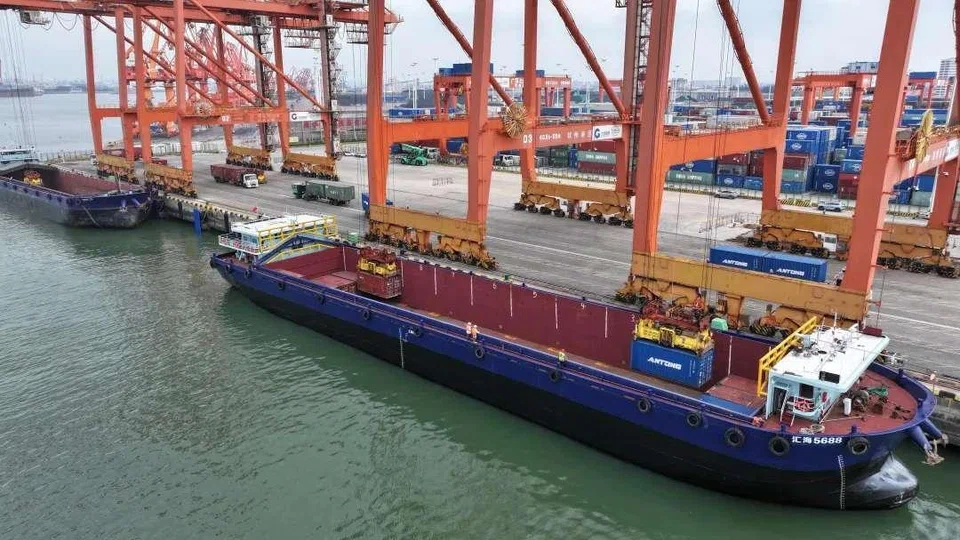
TWO ambitious canal projects in China and Cambodia are poised to redraw South-east Asia’s trade map, reshaping the economics of regional shipping and testing Vietnam’s position in increasingly interconnected manufacturing supply chains.
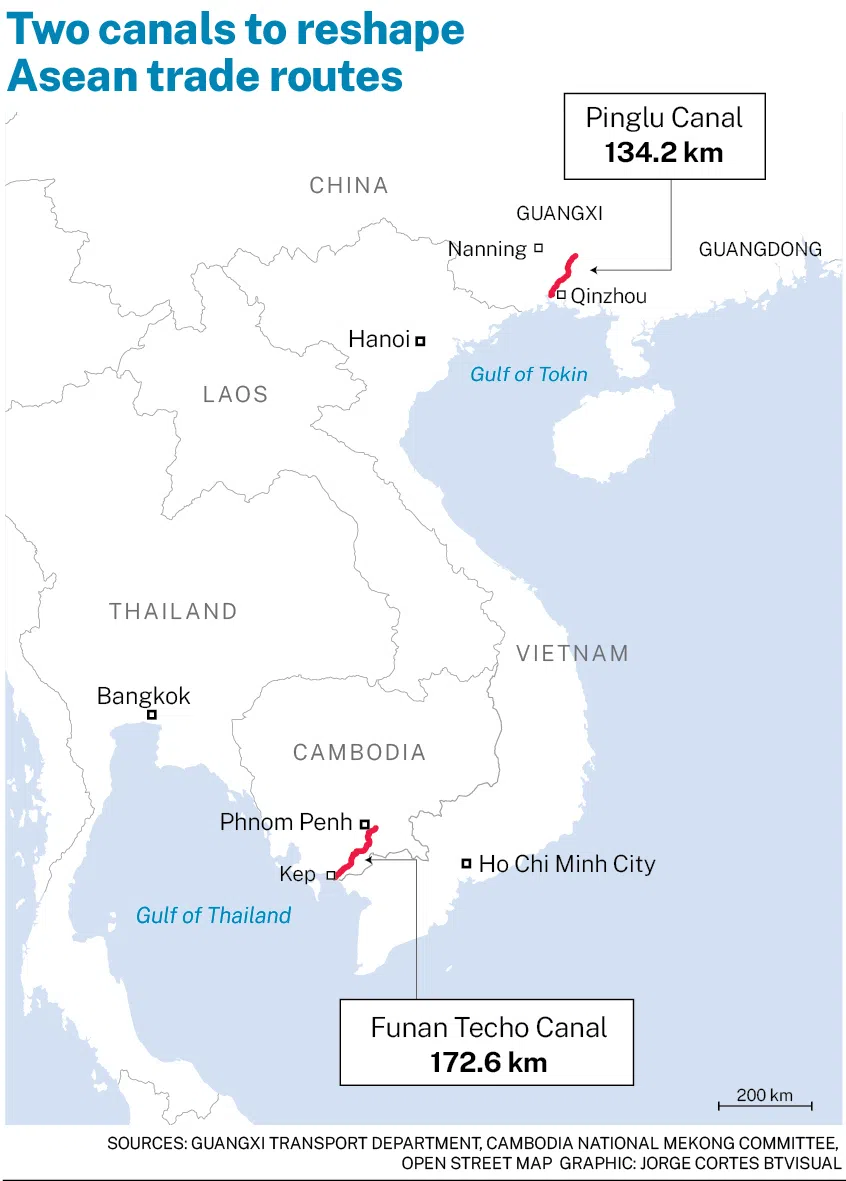
After four years of construction, China’s US$10.75 billion Pinglu Canal officially opened in September, handling more than one million tonnes of cargo in its first month.
The 134.2-kilometre waterway connects China’s Guangxi region to the Gulf of Tonkin and offers manufacturers in the region’s western hinterland a shorter route to South-east Asian markets.
Its growing regional significance was underscored in Beijing on Saturday (Nov 21), when Singapore Prime Minister Lawrence Wong and Chinese Premier Li Qiang discussed potential synergies between the canal and the existing International Land-Sea Trade Corridor, a network of rail, road and maritime routes connecting western China with Asean markets.
Further south, Cambodia is pressing ahead with its 172.6-kilometre Funan Techo Canal, developed by a joint venture with 49 per cent Chinese ownership.
Construction of the canal’s second section began in April, followed by a nearly US$1 billion financing agreement with China Exim Bank in September. The project aims to give Cambodia direct access to the Gulf of Thailand and reduce its reliance on Vietnamese ports.

“The more important change is that the region is moving towards a genuinely multi-modal production network,” said Mickael Driol, CEO of Mekong Partners, a cross-border business advisory and outsourcing firm operating across China and Vietnam.
“Rails, inland waterways, ports and cross-border roads are beginning to connect industrial clusters that were previously evaluated much more independently,” he added.
A new route from China
Vietnam is seen as a major beneficiary of the Pinglu Canal, given its proximity to China, its extensive trade ties with Beijing, and manufacturers’ heavy reliance on Chinese components, machinery and industrial materials.


The first container ship travelling directly from China’s Nanning through the Pinglu Canal arrived at Can Tho Port in southern Vietnam on Sep 24, carrying 252 twenty-foot equivalent units of cargo, including wood panels, chemicals and automotive parts.
The new shipping service is expected to operate twice a month, with a transit time of about seven days. The service opens another trade corridor between south-western China and Vietnam’s Mekong Delta.
Beijing estimates that the Pinglu Canal could reduce logistics costs by up to 30 per cent by providing a shorter shipping route through Guangdong province, while operator Pinglu Canal Group expects annual cargo to exceed 100 million tonnes by 2035.
Driol said that lower-cost access to Chinese suppliers through the Pinglu Canal could shorten replenishment cycles for Vietnamese factories, reduce the need for buffer inventory and improve factory efficiency.
However, the canal’s benefits will depend on more than the distance saved, he added.
A shorter corridor only creates value if it has sufficient cargo density, reliable vessel frequency, competitive handling charges, efficient customs clearance and sufficient backhaul.
Some freight forwarders interviewed by Lianhe Zaobao earlier this year continued to favour established gateways such as Shanghai and Guangzhou, citing constraints on inland transport and limited direct shipping services from Guangxi’s ports.
The canal’s capacity also limits its ability to compete with established maritime routes. Its 5,000-tonne vessels are better suited to shorter regional journeys, while cargo bound for more distant markets would generally need to be transferred to larger ships at ports, according to shipping experts.
“The broader result is a more flexible modal structure across the subregion,” Driol said, noting that companies would increasingly use waterways for heavy or less time-sensitive cargo, rail for higher-value components and roads for shorter or urgent deliveries.
Cambodia’s bid to bypass Vietnam
Cambodia’s Funan Techo Canal presents a more complicated calculation.
Cambodian Deputy Prime Minister Sun Chanthol has estimated that the waterway could save between US$155 and US$181 per container on shipments from the capital to Cambodian coastal ports compared with existing routes through Vietnam.
Phnom Penh also aims to reduce the share of its international cargo passing through Vietnamese ports from about one-third to 10 per cent, while promoting industrial parks, logistics hubs and agricultural processing facilities along the canal.
The commercial impact on Vietnam, however, may be modest
Huynh Trung Dung, a senior fellow at Singapore’s ISEAS-Yusof Ishak Institute, estimated that Cambodian transit cargo accounts for only about 3 to 4 per cent of relevant transhipment activity in Vietnam. This suggests that diverting this cargo would have a limited impact on Vietnam’s wider logistics industry.
“It’s more economically significant for Cambodia than for Vietnam,” he said.
Even then, the canal’s commercial viability remains uncertain. Dung warned that its relatively shallow depth and limited vessel capacity could require additional cargo handling or transhipment before goods reach major international markets.
“It might have some values in terms of strategic autonomy,” he added. “But in terms of the economic cost-benefit analysis, I would be very cautious about that.”
Driol similarly argued that the eventual diversion of cargo would depend less on political ambition than on the competitiveness of the new route.
“Port depth, terminal productivity, inland connections, and customs performance will determine how much freight actually shifts,” he said.
For Vietnam, however, the more consequential risks may lie outside trade.
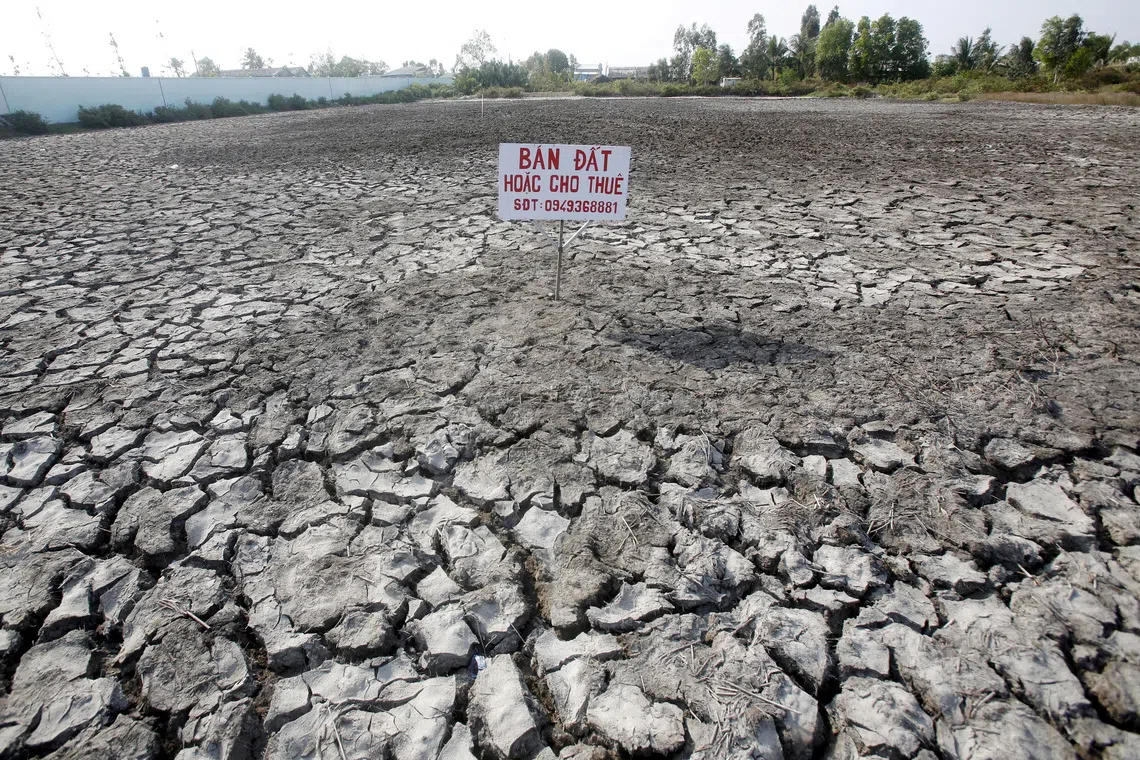
ISEAS’ Dung warned that the Cambodian project could affect water flows, sediment transport and underground water systems in Vietnam’s Mekong Delta, a major agricultural region already under pressure from upstream dams and climate change.
“Environmental impacts are the most important concern for Vietnam,” he said. “The issue is not whether Cambodia proceeds with the project, but whether there is sufficient transparency for Vietnam to monitor its impacts.”
Shifting strategic dynamics in South-east Asia
Robert Yap, chairman of Singapore-based logistics group YCH, told The Business Times that expanding regional transport infrastructure – including waterways, roads, railways, air links and maritime routes – could unlock economic activity in areas historically disadvantaged by poor connectivity.
Such links could help less-developed economies participate more fully in international supply chains, creating what he described as greater “inclusivity of growth”.
“Connectivity is key to unlocking potential and levelling the playing field,” he said. “Once they can be freed (from geographical constraints), they can be plugged into the global value chain and slowly move up the prosperity (ladder).”
However, the expansion of Chinese-financed infrastructure across South-east Asia, much of it linked to the Belt and Road Initiative, could also have geopolitical implications for Beijing.
ISEAS’ Dung said various projects funded by China in South-east Asia, including Cambodia’s Funan Techo Canal and rail link developments in Vietnam, Laos, Thailand and Indonesia, could deepen regional dependence on Beijing.
“Those projects provide China with the strategic benefits rather than trade benefits,” Dung said. “In other words, it will have a more dominant voice in regional issues.”
Decoding Asia newsletter: your guide to navigating Asia in a new global order. Sign up here to get Decoding Asia newsletter. Delivered to your inbox. Free.
Share with us your feedback on BT's products and services






