No sea, no sweat: Dry ports turn landlocked Laos into land corridor, eye trade to Middle East, Europe
The dry ports are beefing up partnerships with regional peers in the likes of Singapore’s PSA International and Malaysia’s Penang Port

[VIENTIANE/SINGAPORE] South-east Asia sits at a nexus of key shipping lanes, in a world where more than 80 per cent of global trade is carried by sea. At the heart of it lies Laos: one of its smallest economies, and its only landlocked country.
Cut off from any direct access to maritime routes, the nation is banking on its dry ports, which are hoping to elevate the predominantly mountainous state bordered by five countries into an alternative, quicker gateway for trade with the Middle East, Central Asia and Europe.
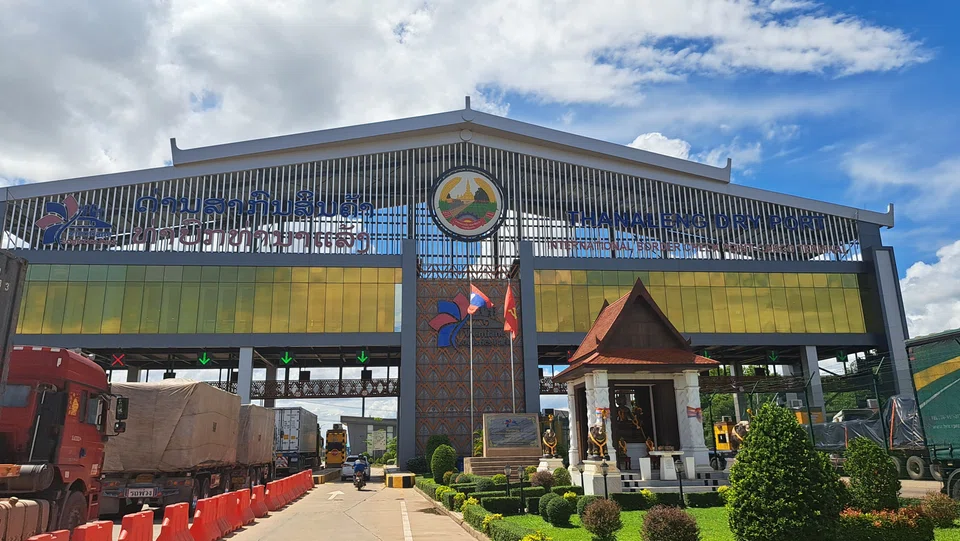
In an interview with The Business Times, Thanaleng Dry Port’s managing director, Sakhone Philangam, said it aims to establish regular services from Laos to Europe by the end of the year.
Though there have been several one-off trials, such as one involving a train from Thailand that passed the dry port on the way to Italy in February 2024, Sakhone intends to bring in a proper operator and launch commercial operations.
The autonomous dry port, located in the Laotian capital of Vientiane and a kilometre away from the First Thai-Lao Friendship Bridge over the Mekong River, facilitates transitions between road, rail, sea and air transport.
In 2024, Thanaleng Dry Port handled about 253,840 20-foot equivalent units (TEUs).
Operating as a public-private partnership under a 50-year concession agreement with the government, it has been designated a Class One dry port of Laos and one of international importance by the United Nations.
Thanaleng Dry Port was developed and is owned by Sitthi Logistics Lao, a subsidiary of PTL Holding Company, which is part of local diversified conglomerate Phongsavanh Group.
Officially opened in December 2021, the dry port was financed by Sitthi Group and the World Bank’s International Finance Corporation (IFC), which provided some US$20.1 million for the project, BT reported previously.
Other sources in the IFC-led financing package include the International Development Association and a quasi-equity loan.
The port is also a key component of the country’s integrated Vientiane Logistics Park, a flagship project that aims to transform Laos into a land-linked nation of the Greater Mekong sub-region.
Cross-border cooperation
To achieve its goal of reaching the coasts of Europe, Thanaleng Dry Port is beefing up its regional partnerships.
In July, it sealed a deal with China’s Anning Dry Port International to boost logistics efficiency between both countries by streamlining customs processes, sharing warehouse resources and standardising documentation.
In May, Thanaleng Dry Port signed a deal with Malaysia’s Penang Port to enhance cross-border trade via a rail-sea route. This built on an earlier agreement with Mutiara Perlis, a joint venture between private firm Mutiara Infra and the Perlis state government. The Malaysia company is the developer of Perlis Sanglang Port and Perlis Inland Port.
Earlier in April this year, the port’s developer, Sitthi Logistics Lao, inked an agreement with Singapore end-to-end supply chain solutions partner YCH Group, to further cooperation in the cross-border transportation of agricultural products between South-east Asia and China.
In March, PTL Holding Company, which owns Sitthi Logistics Lao, signed a strategic partnership agreement with PSA International to advance digital logistics services at the international cargo border checkpoint at the port.
On future regional partnerships, Sakhone told BT: “We have to try to build partnerships and bring in international operators... Naturally, after you have all these dry and seaport network links to this location, you leverage connectivity... We are recognised internationally, but we have yet to make it happen through commercial partners.”
In the longer term, Sakhone is eyeing partnerships with ports along the Middle Corridor – a trade route that stretches from South-east Asia to China, Central Asia and Europe.
Strengthening intra-Asia links
Meanwhile, Savannakhet Dry Port is beefing up its intra-Asian links to reach destinations such as the Middle East.
Operated by logistics giant DP World through Savan Logistics, the dry port is situated in Laos’ largest province of Savannakhet and the country’s first special economic zone.
Glen Hilton, chief executive and managing director for Asia-Pacific at DP World, told BT that Savannakhet sits at the heart of three major trade corridors, which allows it to act as a vital cross-border node.
It connects inland South-east Asia to deep seaports such as Thailand’s Laem Chabang and Vietnam’s Vung Ang, as well as markets in China including Kunming and Chongqing, and Asean member nations in the likes of Malaysia and Singapore, he said.
Hilton noted that the team sees opportunities to deepen connections with Southern China – particularly in Kunming, Nanning, Chongqing and Guangzhou – as well as Western China.
Through the Xi’an-Europe rail route and aligned with the Regional Comprehensive Economic Partnership and China’s Belt and Road trade flows, Laos can further be linked to Central Asia, he said.
Hilton added that Savannakhet Dry Port is also eyeing markets in South Asia and the Middle East, via established links through Malaysia and Singapore.
Currently, the port handles a monthly volume of 11,000 TEUs of goods moving across the Laos-Thailand border and other key crossings.
It is playing a growing role in transit trade between Thailand, Vietnam and China, said Hilton.
“We’re seeing notable flows from Thailand to Vietnam and China via Laos; Vietnam to Thailand, using Laos as a land bridge; and China-bound exports transiting through Laos.”
Beyond these countries, the port also handles shipments originating in or destined for regional hubs – such as Singapore, Malaysia and Cambodia – with its bonded warehouses and customs branches across South-east Asia.
Savannakhet Dry Port spans 140,456 sq m, including 23,000 sq m of warehousing with 11,000 sq m of bonded warehouse space.
It also handles customs clearance for imports and exports, and offers value-added services such as fumigation, mobile X-ray, electronic seal systems and container depot storage, said Hilton.
“We continue to see growing demand for multimodal and cross-border transport, particularly as businesses look to diversify supply chains and boost agility,” he added.
“Looking ahead, we expect volumes to continue rising, supported by intra-Asian trade growth, the increased adoption of China+1 strategies, and the accelerated adoption of rail freight and digitalised logistics solutions.”
TRENDING NOW
Three ex-employees of Envy group join Ng Yu Zhi in bankruptcy
He built the Vingroup empire. Now South-east Asia’s richest man is handing some key roles to his sons
Grab CEO’s wife Chloe Tong on life with Anthony Tan and finding her purpose
Incidence of civil servants buying property near unannounced MRT stations ‘a concern’, but may not establish misconduct: PSD