



Oil shocks triggered by Middle East war ripple through South-east Asia
Oil-fuelled inflation is showing up in higher transport and food costs, electricity prices, fuel prices and bigger fuel subsidy bills for governments
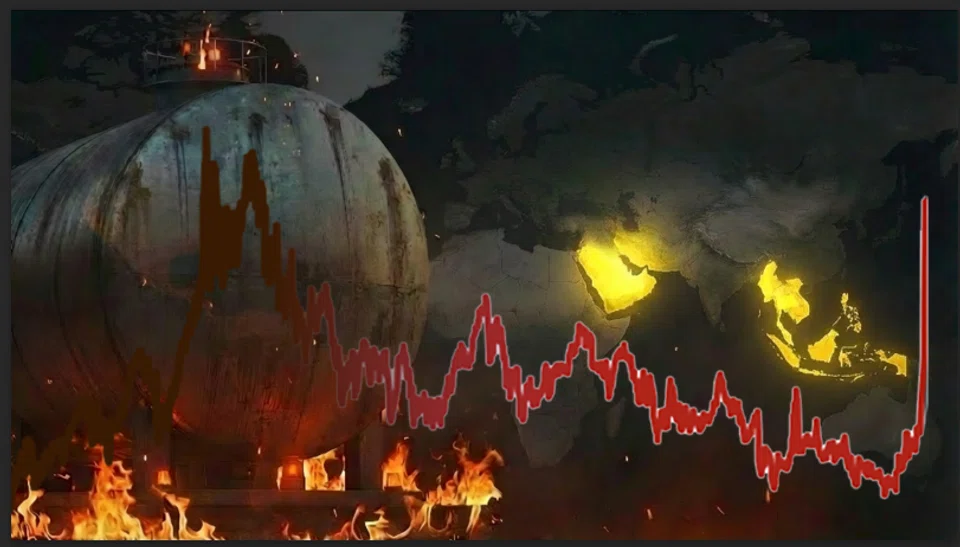
[SINGAPORE, JAKARTA, KUALA LUMPUR, HO CHI MINH CITY] A surge in oil prices past US$100 a barrel, with analysts warning it could move towards US$150, is exposing South-east Asia’s heavy reliance on imported energy from the Middle East.
Shockwaves are already rippling through the region: It has raised transport and food production costs in the Philippines, threatened electricity prices in Thailand, swelled subsidy bills in Malaysia and Indonesia, and pushed pump prices in Singapore towards levels last seen during the 2022 energy crisis.
Nomura analysts warn that the region faces stagflationary shock, the severity of which would depend on the duration of the disruption. “If it sustains, then firms could face margin pressure and production cuts, and consumers could face higher food prices,” Nomura said.
The impact is unlikely to be uniform across South-east Asia. Chua Jen-Ai, equity research analyst for Asia at Julius Baer, said economies such as the Philippines, Thailand, and Singapore are more vulnerable due to inflationary cost pass-throughs.
On the other hand, she said commodity-exporting economies like Malaysia and Indonesia could benefit from the higher coal and oil prices, “providing some buffer against the shock”.
The tensions have shown little sign of easing since the joint US and Israeli strikes on Iran more than a week ago disrupted oil shipments through the Strait of Hormuz, now a critical chokepoint for global energy supplies.
The resulting squeeze on crude markets and shipping routes has pushed prices sharply higher, reviving fears of another inflation shock.
Markets are increasingly bracing themselves for a prolonged conflict, raising the risk that oil prices remain elevated; some analysts have warned that crude could surge towards US$150 a barrel if tensions escalate.
The jump in oil prices fuelled the sell-off in regional markets on Monday, with equity benchmarks in Singapore, Kuala Lumpur, Jakarta and Bangkok falling as investors braced themselves for the inflationary impact of higher energy prices.
Analysts have warned that increasingly frequent strikes on oil infrastructure have created supply-chain disruptions that outpace standard reserves, raising the pressure for a swift resolution.
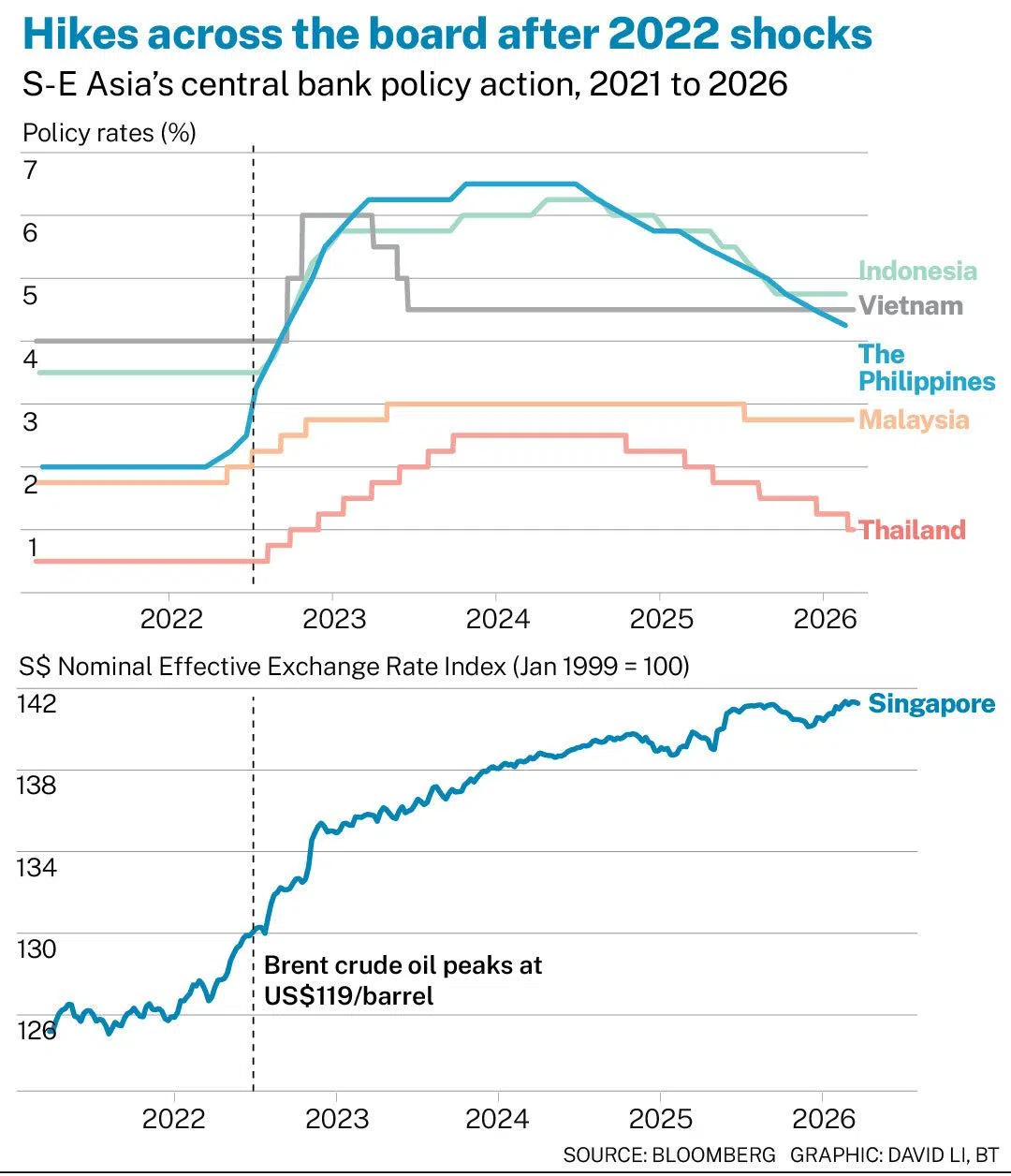
If oil prices remain elevated, governments will face tougher choices, and central banks may need to adjust policy accordingly, said Tan Altundag, investment manager for emerging equities at Pictet Asset Management.
He added: “Sustained high oil prices could halt interest rate cuts – or even prompt tightening – depending on the duration and magnitude of the shock.”
Thailand: Disproportionately high energy imports
Thailand sources about 60 per cent of its crude oil from the Middle East. Imports account for roughly 6 per cent of gross domestic product, making the country particularly vulnerable to supply disruptions.
Kaushal Ladha, head of Thailand research at Macquarie Capital, warned that if oil prices rise to US$110 per barrel, energy costs could climb to as much as 8 per cent of GDP, sending shockwaves through the country’s trucking, agriculture and airline industries.
Higher oil prices could also feed inflation. Maybank analysts Erica Tay and Chua Hak Bin noted that energy accounts for 11.8 per cent of Thailand consumer price index basket, the highest share in South-east Asia.
In response to the crisis, the Thai government ordered oil producers to suspend crude and petroleum exports on Mar 1, and announced that existing reserves and incoming supply could meet domestic needs for 95 days.
The authorities also capped domestic diesel prices for 15 days from Mar 3 to cushion customers against higher prices. But such measures come with fiscal costs.
Maybank’s Tay said the price cap would likely require subsidies from Thailand’s Oil Fuel Fund, which supports fuel prices. The fund returned to surplus only in February, with a balance of 2.5 billion baht (S$99.8 million).
It was the first time it had had a surplus in four years, after having been in deficits of as much as 133 billion baht during the Russia-Ukraine energy shock.
Still, analysts said Thailand’s external position may help buffer financial markets. Lloyd Chan, senior currency analyst at MUFG, said the baht could be supported by the country’s current account surplus, projected at around 3 per cent of GDP in 2025.
“This is not a repeat of 2022,” he said, noting that Thailand now enters the latest oil shock with a stronger external position. BY EVAN SEE
Singapore: Trading hub still hostage to energy shocks
Singapore remains heavily exposed to global energy shocks despite its role as one of Asia’s largest oil refining and trading hubs.
Fitch Solutions unit BMI said the city-state’s direct oil intensity is relatively low, but it remains vulnerable to higher energy prices through transport costs, utilities and weaker regional demand, which could modestly slow economic growth.
Fuel prices are already climbing. Pump prices in Singapore crossed S$3 a litre last week and are expected to approach S$4 for the premium 98-octane grade, a level last reached in June 2022.
The country is also highly reliant on imported natural gas for electricity generation. Around 95 per cent of Singapore’s power is produced using natural gas, most of which is sourced from abroad.
Analysts expect the concurrent rise in oil and liquefied natural gas (LNG) prices to quickly hit consumers and businesses, triggering inflation. They added that supply chains would take several months to regain stability.
Singapore’s gas supply is diversified, but still exposed to global shipping routes. In 2025, about 43 per cent of its gas imports came through pipelines from Malaysia and Indonesia; the remaining 57 per cent were shipments from global suppliers.
Research firm Rystad Energy estimates that around 42.5 per cent of Singapore’s LNG imports last year came from Qatar, with shipments passing through the Strait of Hormuz.
Despite these vulnerabilities, Singapore’s markets could benefit from global uncertainty. Julius Baer’s Chua said the bank expects Singapore equities to attract safe-haven inflows, and higher energy prices could also tilt the Monetary Authority of Singapore’s inflation outlook upward, increasing the likelihood of an earlier steepening of the Singapore dollar policy band in April. BY BENICIA TAN
Indonesia: Rising subsidy burden
As if rupiah volatility, bruised investor confidence from MSCI’s warning and a ratings downgrade by Fitch were not enough, the Indonesian economy is also having to deal with surging oil prices through a higher subsidy bill, which already stands at around 1.5 per cent of GDP – the highest in South-east Asia.
Nomura estimates that a 10 per cent rise in oil prices could widen Indonesia’s fiscal deficit by about 0.2 per cent of GDP, largely due to higher subsidy spending.
Finance minister Purbaya Yudhi Sadewa has also warned that if oil averages US$92 a barrel in 2026, the energy subsidy bill could push the deficit to around 3.6 per cent of GDP.
The rupiah weakened past 17,000 to a US dollar on Monday, as surging oil prices spurred investor caution and drove capital toward safe-haven assets.
South-east Asia’s largest economy sources roughly a quarter of its crude and about 30 per cent of LNG imports from the Middle East. Officials have so far said that the country has fuel supply buffers to last up to 25 days, and there are no immediate plans to adjust subsidised fuel prices.
There is a silver lining: as a net commodity exporter, the country could offset potential trade shocks if prices of metals and minerals markets remain strong. BY ELISA VALENTA
Malaysia: Whither subsidy reforms?
Malaysia’s exposure to global oil shocks is complicated by its trade structure. Although it is an oil producer, the country has been a net importer of crude and petroleum products since 2014 as domestic demand has outpaced declining output from ageing fields.
The rising tensions in the Middle East is creating a mixed outlook for Malaysia’s economy, with analysts warning of growing pressure on fuel subsidies and inflation.
Prime Minister Anwar Ibrahim said the government could keep the subsidised price of RON95 petrol at RM1.99 a litre for only a month or two if global oil prices continue climbing, underscoring the fiscal strain higher energy prices could place on the government.
The subsidy benefits more than 16 million Malaysians, shielding consumers from global price swings, but becomes increasingly expensive when crude prices rise.
Nazmi Idrus, chief economist at CGS International Securities Malaysia, said that if Brent crude averages US$84 a barrel this year, Malaysia’s fiscal deficit could widen by about 0.2 per cent of GDP.
This reflects an estimated RM10.9 billion (S$3.5 billion) increase in fuel subsidies, which would outweigh roughly RM5.7 billion in additional oil-related revenue.
Malaysia primarily sources its crude oil from Saudi Arabia, the UAE and Oman; its refined petroleum products are largely imported from Singapore and South Korea, and its LNG imports, mainly from Australia.
Higher energy prices could squeeze corporate earnings, particularly for logistics firms, while upstream oil producers may benefit from stronger crude prices.
Peter Kong, head of research at Kenanga Investment Bank, said the traditional link between oil prices and the ringgit has weakened; he warned that the currency could fall 6 to 9 per cent if Brent rises above US$100 a barrel. BY TAN AI LENG
The Philippines: Stagflation fears loom
The Philippines, which imports 95 per cent of its crude oil from the Middle East, has limited alternatives to these shipments bypassing the Strait of Hormuz.
Michael Wan, senior currency analyst at MUFG, highlights that the indirect effects of prolonged supply disruptions could create a stagflationary environment.
“Manufacturing, transportation, travel and food production are particularly vulnerable to higher energy costs, which could slow activity in energy-intensive sectors,” he wrote in a note.
The country’s petroleum reserves, estimated to last about two months, will be crucial in mitigating potential shortages.
MUFG projected that if oil prices hold at US$100 a barrel, GDP growth could slip to 3.7 per cent in 2026 and 5.7 per cent in 2027 from current forecasts of 4 per cent and 6 per cent, respectively.
A spike to US$130 a barrel may depress growth even further, MUFG noted. By ELISA VALENTA
Vietnam: Ambitious growth target under threat
Vietnam’s push for double-digit growth is facing fresh risks as surging oil prices expose the country’s heavy reliance on imported energy.
Economists warn that sustained oil prices will weigh on growth. Analysts at Ho Chi Minh City Securities estimate that a sharp rise in Brent crude prices could widen Vietnam’s oil trade deficit and add to inflationary pressures.
They forecast that a 30.6 per cent rise in Brent oil prices this year to US$80 a barrel could raise Vietnam’s crude oil trade deficit by 20 per cent to US$7.6 billion this year; this would be equivalent to a 0.24 percentage point drag on GDP growth, and an additional 1.2 percentage points to headline inflation.
Analysts at Vietnam Investors Service caution that prolonged global energy disruptions, higher costs, softer external demand and tighter financial conditions could weaken the macroeconomic outlook and complicate delivery of achieving 10 per cent GDP growth by 2026.
The economy had grown by about 8 per cent in 2025.
The country relies heavily on imported crude for domestic refining, which meets up to 70 per cent of local demand, with Kuwait as its main supplier.
The remaining demand is met through refined petroleum imports from Singapore, South Korea and Malaysia, entering at zero tariffs under free-trade agreements.
Vietnam’s imports of petroleum products and crude oil last year totalled US$14.5 billion.
To help businesses proactively diversify their supply sources, the government has cut the most-favoured-nation import tax on some petroleum products and raw materials to zero per cent from Mar 9 until end-April. BY JAMILLE TRAN






