



Penang looks beyond chips with a bigger medtech push
The Malaysian state is scaling up its high-margin play in the sector to lock in long-term investment

[KUALA LUMPUR] While Penang is riding a fresh semiconductor boom fuelled by artificial intelligence, its decades-old medical technology cluster is stepping out of the shadow of the much larger chip sector, as the state seeks to diversify its manufacturing base.
Malaysia’s northern island state is looking to its established medtech ecosystem, home to global manufacturers including B Braun, Abbott, Boston Scientific, Smith & Nephew and Dexcom, to draw more long-term, high-value investments.
To do that, it is tapping many of the same engineering skills, precision-manufacturing capabilities and supplier networks that helped establish it as a semiconductor hub and earn it the moniker “Silicon Valley of the East”, said Loo Lee Lian, CEO of the state’s investment promotion agency InvestPenang.
“What Intel did for semiconductors, B Braun did for the medical device industry,” she told The Business Times.
Since establishing its Malaysian presence in 1972, B Braun has invested nearly RM5 billion (US$1.2 billion) in the country.
The company operates five massive manufacturing plants spanning 180,000 square metres in Penang, making the island one of its largest production sites outside Europe.
Penang’s push comes as Malaysia more broadly seeks to build its position in the global medical device industry. The country, home to nearly 300 medtech firms, has seen many industry players establish regional bases and commercial offices there.
According to InvestPenang, the state has the highest concentration of medtech companies in Malaysia.
Tapping similar strengths
The reason companies choose Penang for medtech is similar to why they have chosen it for semiconductors, said Loo.
“Clustering is very important. We already have the ecosystem and the talent that understands this industry. That’s something we’re very proud of.”
She noted that medtech manufacturing tends to be clustered in a relatively small number of established locations, including Minneapolis and Boston in the US, Ireland and Costa Rica.
“Penang has actually been known as a medtech hub for the last 30 years,” she said, adding that the industry has often been overshadowed by the state’s much larger semiconductor sector.
Medtech also provides Penang with an avenue to diversify its industrial base while leveraging capabilities already developed for advanced manufacturing. Both medical devices and semiconductors require precision engineering, stringent quality standards and highly skilled workers.
Loo noted that medtech offers a key advantage, as manufacturers tend to make long-term commitments due to strict regulatory requirements surrounding medical devices and production facilities.
“Medtech is a very attractive industry because margins are high, and companies tend to stay for the long term,” she said. “Once they invest in a facility and obtain regulatory approvals, they usually continue operating there for many years. It’s a very sustainable industry.”
That makes diversification increasingly important as Penang seeks to capture new advanced manufacturing investments without becoming overly reliant on the semiconductor cycle.
While AI-related investments remain a priority, Loo emphasised that the state is actively pursuing opportunities in life sciences and medtech, too.
“AI is certainly an important future technology, but we also want diversification,” she said.
“We recently announced a life sciences laboratory project and will soon announce another medtech project. We don’t want to focus only on semiconductors.”
Malaysia’s medtech play
Penang’s medtech sector drew a cumulative RM3.6 billion in approved investments between 2020 and the first half of 2025, according to the state’s Chief Minister Chow Kon Yeow.
Its importance is also reflected in the state’s broader precision-manufacturing exports.
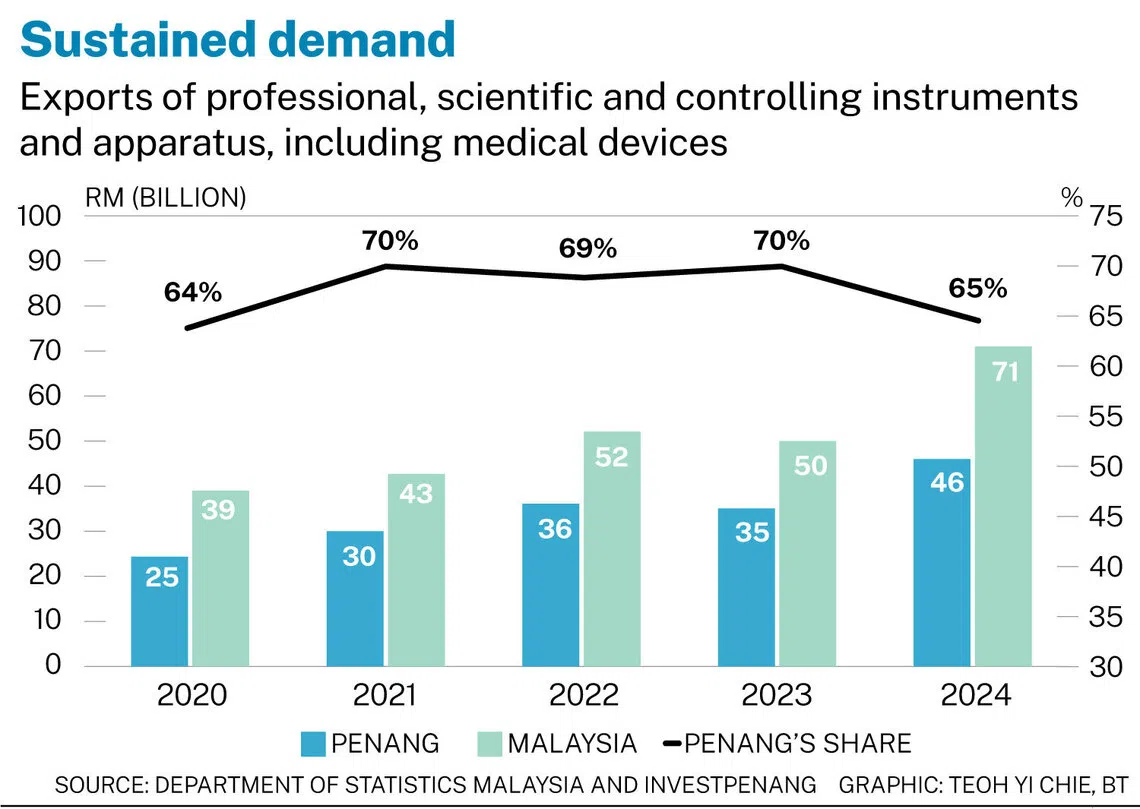
Penang accounted for an average 65 per cent of Malaysia’s exports of professional, scientific and controlling instruments in 2024, a category that includes medical devices, data from Department of Statistics Malaysia showed.
Nationally, Malaysia exported more than US$12.5 billion of optical, technical and medical equipment in 2025, placing it among major exporters such as the US, China, Ireland and Costa Rica.
The medical device industry also attracted RM4 billion in approved investments across 46 projects that year, according to the Malaysian Investment Development Authority’s 2025 performance report.
Access to advanced healthcare technology
Beyond investments and job creation, Loo believes expanding local manufacturing will also improve access to advanced healthcare technology for all Malaysians.
She cited Dexcom’s continuous glucose monitoring system as an example.
When the company first established operations in Penang, the product was available primarily in the US. As production expanded into Asia, Malaysia became one of the first countries in the region where the device was introduced.
The wearable monitor allows diabetes patients to track glucose levels continuously without repeated finger-prick tests, while enabling caregivers to monitor readings remotely through a mobile application.
“By attracting all these companies here, we also hope they can reduce the cost and make their products more affordable to people in general,” she added.
TRENDING NOW

Once staunchly pro-China, Malaysian Chinese businesses are now distancing themselves from Beijing

Looking beyond looming CEO succession, should UOB potentially pursue a transformative merger?

Could stablecoins be the future of money?

Grab CEO’s wife Chloe Tong on life with Anthony Tan and finding her purpose

