Philippine sovereign wealth fund targeting investments this year despite Middle East conflict, economic languor
Maharlika looking at projects that build national resilience, says CEO Rafael Consing Jr

[SINGAPORE] Maharlika Investment Corporation, the Philippines’ sovereign wealth fund, is doubling down on its strategy and focusing on national resilience in response to external shocks such as the Middle East conflict.
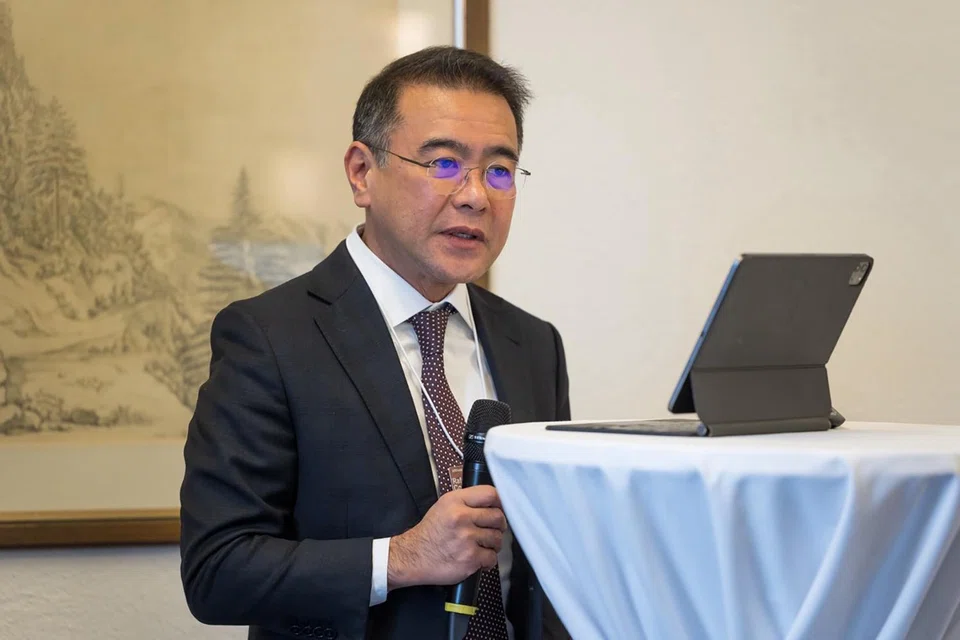
Rafael Consing Jr, CEO and president of Maharlika, told The Business Times that the war is validating the fund’s strategy to act as a growth catalyst and that it is focusing on three core sectors: energy, agriculture and mining.
“This war validates our choices of sectors. We are focused on social and developmental impact, which in turn responds to a third element: national resilience,” Consing said.
The Philippines has been one of the most exposed economies in South-east Asia to the current war with Iran led by the US and Israel.
Fuel price hikes stemming from the conflict led to President Ferdinand Marcos Jr declaring a national energy emergency in late March. The country imports almost 90 per cent of its fuel needs from the Middle East. Higher fuel costs feed directly into transport and household expenses, which in turn could slow consumer spending and affect the Philippines’ consumption-led economy.
The country’s growth outlook has already been cut by organisations such as the World Bank, and the ratings firm S&P Global has also lowered its outlook to “stable” from “positive” in response to the country’s vulnerability from the conflict in the Middle East.
The fund was established in mid-2023 and Consing joined in November that year. He got the approval to start building out his team only in July 2024.
Maharlika’s first publicly announced investment was a 20 per cent stake in Synergy Grid and Development Philippines for 19.7 billion Philippine pesos (S$417.6 million) in January 2025.
Its second was a US$76.4 million loan facility to Makilala Mining Company the following month, to initiate a feasibility study and early development works for a project in Kalinga province on Luzon island.
The third major publicly announced investment was in December last year, when Maharlika acquired a minority stake in Asian Terminals, a logistics company.
Consing explained the strategy is to invest in projects that can “catalyse growth”, particularly because of the smaller amount of capital Maharlika has.
The fund currently has about 68 billion pesos to deploy. It started with an initial 75 billion pesos, which was provided by state-run banks Land Bank of the Philippines and the Development Bank of the Philippines.
An example is Maharlika’s planned investment in the Small Power Utilities Group (Spug), a unit of the National Power Corporation that provides electricity to remote islands. As Spug is not connected to the grid, electricity comes from generators that are powered predominantly by fossil fuels, which can become extremely expensive when crude oil prices rise.
Maharlika plans to upgrade assets from Spug to modernise distribution to remote islands, move away from expensive fuel-dependent generators and enable 24-hour power provision. Upgrading these assets will also enable other power generation companies to be able to build facilities in that area, Consing said.
This would then have a multiplier effect as it would allow for business planning and other infrastructure to be built.
Besides the investments in energy, Consing said there are also long-term plans to invest in sustainable mining projects and refining capacity, and thus increase the share of the mining sector’s contribution to the Philippine economy. For agriculture, he said the strategy was to invest in products and brands with strong export potential.
Upcoming deals and scrutiny
Consing said that people can expect the fund to show more investment activity and results for the rest of this year and going into 2027.
The fund is undertaking due diligence on three deals simultaneously and Consing said he is confident that there will be two significant announcements within the next four months.
The two deals he is confident about both involve publicly listed companies. One of them is expected to involve an agriculture firm.
Consing acknowledges that Maharlika is operating in an environment where there is still a lot of public scepticism of the sovereign wealth fund, especially among the general Philippine population over fears of corruption.
Then, there is also the capital structure. The capital for Maharlika has come from two state banks instead of government surpluses, which are usually where sovereign wealth funds get their capital from.
Jayant Menon, visiting senior fellow at Iseas-Yusof Ishak Institute, noted: “There is a real risk that the financial performance of these banks might be affected if the fund becomes politicised. This could be disastrous for these banks and the overall stability of the Philippine banking system.”
And then there are also concerns that the political landscape in the country could impede Maharlika’s agenda as well.
Nona Pepito, an assistant professor of economics at Singapore Management University, said: “A fund like this only works if markets believe it is professionally run. Credibility is what brings in good deals and helps you resist political interference. The Philippines does not score well on transparency and rule-of-law benchmarks.”
Consing argues that Maharlika adheres to the Santiago Principles, a globally accepted standard designed to promote good governance, transparency and accountability for sovereign wealth funds.
Apart from these principles, he argues that the fund is also prudent in abiding by local laws governing government-owned and controlled corporations regarding transparency, audits and disclosures.
The fund’s small capital, in comparison to other sovereign wealth funds, also raises doubts on whether it has the firepower to invest in companies that could eventually become home-grown champions.
But Consing is hopeful long-term results will help change the narrative. He emphasises that Maharlika aims to be more of a catalyst and hopes its investments can also lead other medium-sized companies and above to join in as well.
“I am confident that all the processes that we have put in place, all the transactions that we have announced and about to announce, will be a very strong landmark policy of the Philippines for the years to come,” he said.
TRENDING NOW
Grab CEO’s wife Chloe Tong on life with Anthony Tan and finding her purpose
HDB reviewing ‘jumbo’ flat scheme after Telok Blangah unit listed for sale at S$2.18m
He built the Vingroup empire. Now South-east Asia’s richest man is handing some key roles to his sons
Singapore judge raises doubts iron ore trader Radiant World is owed US$1 billion