


Asean Business logo
SPONSORED BYUOB logo

As Prabowo marks one year in office, economy sputters, diplomacy gains

Analysts argue he is stamping Indonesia’s place on the global stage despite several domestic concerns

Summarise
Elisa Valenta
Published Fri, Oct 17, 2025 · 12:00 PM
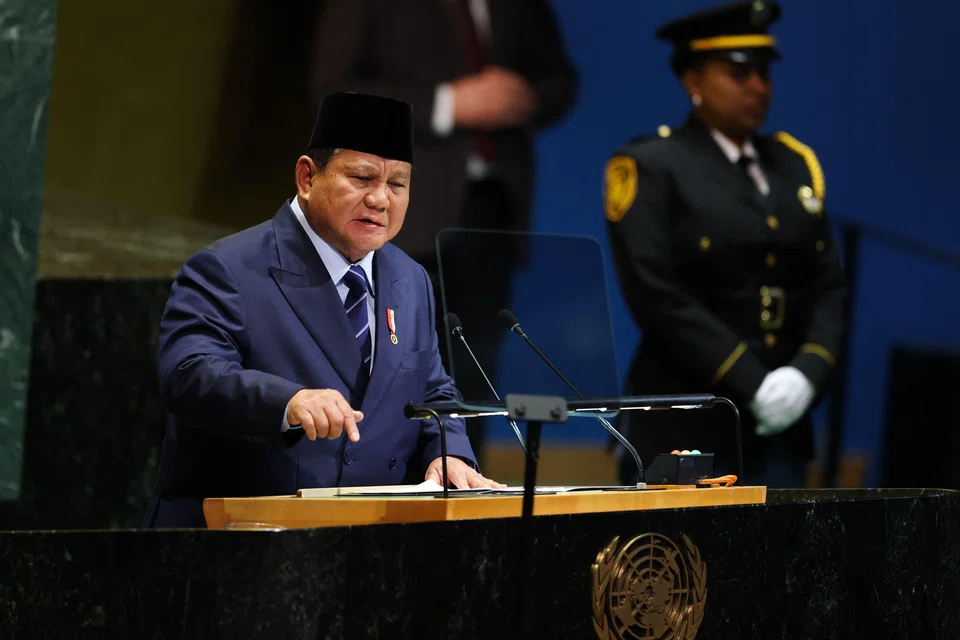
    • Indonesia's President Prabowo Subianto has made clear moves to assert Indonesia’s strategic weight, strengthening trade and security ties.
    • Indonesia's President Prabowo Subianto has made clear moves to assert Indonesia’s strategic weight, strengthening trade and security ties. PHOTO: AFP

    [JAKARTA] One year into office, Indonesian President Prabowo Subianto faces the twin tests of delivering at home and projecting strength abroad.

    His ambitious economic agenda to boost growth and ease household burdens has come up against rising costs and middle-class unease. 

    On the global stage, however, he has made clear moves to assert Indonesia’s strategic weight, strengthening trade and security ties in an increasingly fragmented world.

    The former military general won a sweeping victory last year, pledging to continue his predecessor Joko Widodo’s programmes while putting the people at the centre of his policies.

    He also vowed to tackle persistent challenges such as corruption, poverty and dependence on foreign energy. Yet, the measures may not fully offset broader economic anxieties among the country’s population of 280 million.

    Analysts said the violent protests in late August were a wake-up call for him, in that they revealed that his policies have yet to address the root causes of public discontent.

    George Xu, Fitch Ratings’ director of sovereign ratings for the Asia-Pacific, told The Business Times: “The protests in part reflect persistent public discontent over higher living costs, eroding purchasing power and relatively weak economic conditions for some large segments of society.”

    He said recent political uncertainty, including the major Cabinet reshuffle, could dampen medium-term investor sentiment by raising doubts about the fiscal outlook.

    Xu warned that the unrest could further erode confidence and complicate efforts to attract investments, especially as the global competition for capital intensifies.

    Waning confidence

    Indonesia’s economy expanded by 5.1 per cent in the second quarter, yet its middle-income class continues to shrink. The number of Indonesians classified as “middle income” has fallen from more than 57 million in 2019 to just under 48 million this year.

    Indonesia’s experience mirrors a wider regional trend, with similar financial pressures rippling across South-east Asia, where the middle class is also showing signs of strain in Malaysia, Singapore and Thailand.

    Director and head of Indonesia corporates at Fitch Ratings who goes by Felita, said several factors have contributed to this decline in Indonesia, including income levels, income growth, inflation, job availability and the overall economic environment.

    Yongky Susilo, a Jakarta-based consumer behaviour and retail strategist and adviser to the Indonesia Retailers Association, said the middle-income class – long considered the engine of the country’s economic growth – has become “underpowered”, a trend which has in turn depressed consumption.

    Indonesia’s retail sales grew 3.5 per cent in August, slower than the average growth of around 6 per cent posted in previous years.

    “Middle-income households are more than just consumers. They are the nation’s most dependable taxpayers, reliable borrowers and steadfast supporters of small businesses.”

    Dr Wijayanto Samirin, an economist at Paramadina University, said Prabowo’s administration has yet to craft a budget with balanced allocations.

    He noted that Prabowo’s policymaking lacks a solid technocratic foundation and meaningful public consultation, a shortcoming that has alienated many middle-income Indonesians.

    Prabowo’s policies, he said, have also yet to create a sustainable investment climate, as reflected in weak legal reforms and the persistence of corruption.

    University students holding placards showing varying demands in a street protest in Jakarta in September. PHOTO: REUTERS

    Indonesian consumer confidence hit a three-year low in September, signalling strain in an economy heavily reliant on household spending.

    Despite more than 20 trillion rupiah (S$1.6 billion) in stimulus rolled out since early this year, a BMI report noted that consumers’ willingness to buy durable goods has fallen to a three-year low, and expectations for jobs and income have turned negative.

    World Bank data showed that at least one in seven young Indonesians is out of work. More than 45,000 people have lost their jobs this year alone.

    Growth hangs in the balance

    Indonesia’s growth hangs in the balance as Prabowo struggles to revive investment and stimulate consumer demand. Foreign direct investment fell 7 per cent in the second quarter, amid intensified global competition for capital.

    He has taken an expansionary fiscal approach to boost key spending, while keeping the deficit under the legal limit of 3 per cent of gross domestic product. He also replaced long-serving finance minister Sri Mulyani Indrawati with economist Purbaya Yudhi Sadewa to make fiscal policy a stronger growth driver.

    Indonesia’s Finance Minister Purbaya Yudhi Sadewa at his swearing-in ceremony at the Presidential Palace in Jakarta in September. PHOTO: AFP

    For a country whose economy has been stubbornly stuck at around 5 per cent in the last decade, Prabowo is quite confident Indonesia can hit 8 per cent growth.

    He is banking on a boost in domestic consumption through his flagship programmes, such as the US$10 billion free nutritious meals initiative, which aims to showcase his administration’s laser focus on social welfare.

    The programme – not without its fair share of supply and logistics setbacks – has benefited more than 20 million Indonesians since its January launch and is being rapidly scaled up to target 83 million women and children by end-year.

    The Indonesian leader said at the Forbes Global CEO Conference in Jakarta on Wednesday (Oct 15): “Yes, there were some shortcomings, including cases of food poisoning. But when we tally all the meals served, the deviations, deficiencies or errors amount to just 0.00017 per cent.”

    He added that he is confident the programme can generate millions of jobs.

    Tightening the grip

    Yet, some of the 74-year-old politician’s policy reforms have left investors on edge about the country’s prospects.

    Foreign investors have pulled roughly US$3.2 billion from Indonesian equities this year as at Friday, with most of the sell-off concentrated in banking stocks.

    The rupiah has weakened by around 3 per cent since early this year, making it one of Asia’s worst-performing currencies.

    The decline contrasts sharply with regional peers. The Malaysian ringgit has strengthened against the greenback, and the Singapore dollar and Thai baht have been broadly stable. Economists said the divergence reflects Indonesia’s softer investor sentiment and aggressive monetary easing cycle.

    Prabowo is further extending the state’s reach by deepening its role in managing national assets, primarily through sovereign wealth fund Danantara.

    Bank Indonesia’s planned “burden-sharing scheme” to fund food, housing and healthcare has sparked concern that the administration is encroaching on central bank independence and eroding its monetary credibility.

    Fakhrul Fulvian, chief economist at Trimegah Securities, said: “A stronger framework should be implemented in the financial sector, with the Finance Ministry and Bank Indonesia clearly outlining the country’s macroeconomic and microeconomic objectives.”

    Global outreach

    One clear sign is that Prabowo is bringing multilateralism back to Indonesia’s foreign policy agenda. Unlike Widodo, he appears more determined to restore Indonesia’s prominence on the global stage.

    Joining Brics was among his earliest diplomatic priorities, underscoring his intent to recalibrate Indonesia’s global standing. Indonesia has also sought a more active role in promoting peace in the Israel-Palestine conflict.

    Indonesia’s recent success in securing a free-trade agreement with the European Union is seen as a strategic move to diversify its trade relationships and to reduce reliance on the US and Chinese markets. The country also managed to lower the US tariffs to 19 per cent, from an initially proposed 32 per cent.

    Dr Wijayanto of Paramadina University described the deal as a breakthrough, noting that Prabowo’s approach to international trade diplomacy has been both assertive and pragmatic.

    “Prabowo has proven quick on his feet in building global partnerships. His foreign policy strengthens Indonesia’s bargaining leverage in an increasingly fragmented world order,” he said.



