



Rate cuts on the cards for South-east Asia once US Fed starts easing cycle
SE-Asia central banks are unlikely to ease ahead of US Federal Reserve; Thailand may be first to pull trigger among regional peers

MAJOR central banks across South-east Asia are expected to hold interest rates steady in the near term, keeping an eagle eye on their waning currencies while awaiting the US Federal Reserve’s next move in the global chess game of monetary policy.
By and large, Asean central banks are unlikely to slash rates ahead of the world’s largest central bank, as the move could risk further currency weakness and capital outflows.
The Fed left interest rates unchanged at its recent March meeting, while top officials said in April they are in “no rush” to trim rates.
Economists across the board expect the first cut to come in June, and rates across South-east Asia are anticipated to fall ensuing the Fed’s move. However, should the Fed choose to delay the cuts, some Asean central banks may begin to lower their rates ahead of the US central bank.
First mover
Analysts believe that, among its neighbours, Thailand appears most likely to cut rates at its next meeting and before the Fed, though the cut is expected to be modest.
The central bank of South-east Asia’s second-largest economy has been standing pat against Thai Prime Minister Srettha Thavisin’s repeated calls to reduce rates to boost the sluggish economy.
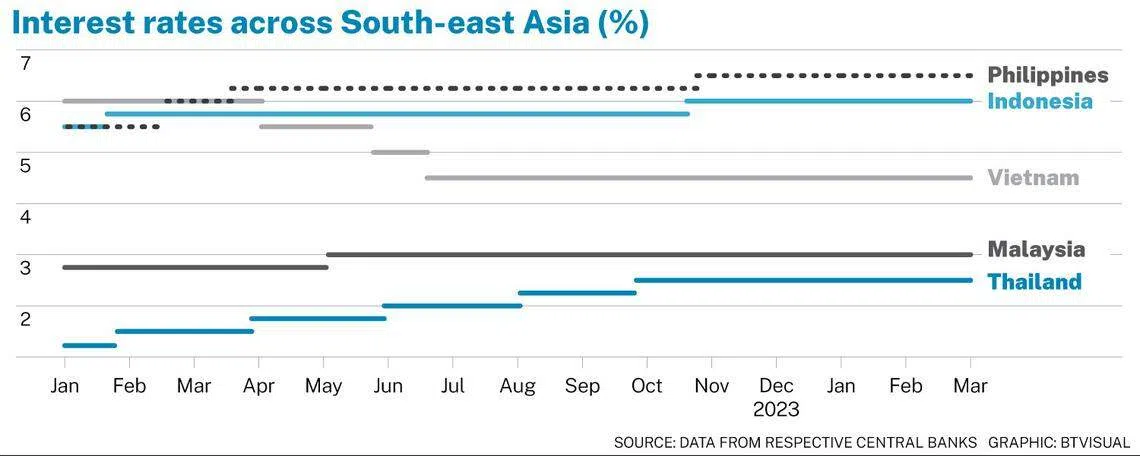
For a second straight meeting on Feb 7, the Bank of Thailand (BOT) kept its one-day repurchase rate unchanged at a decade high of 2.5 per cent.
This could all change at the upcoming policy meeting – held six times a year – on Apr 10.
Seven out of 24 economists polled by Bloomberg expect BOT to cut its rate by 25 basis points to 2.25 per cent at the meeting, as the country’s core inflation continues trending downwards.
On Apr 5, it was reported by the commerce ministry that Thailand’s March headline consumer price index fell for the sixth consecutive month on lower food and energy costs driven by government subsidies.
“With core inflation on a continuous downtrend and real policy rates hovering at the 3 per cent mark, the case for a rate cut to support the economic recovery is building,” said the Maybank analysts in a report.
In an earlier report, Maybank also pointed to “strong hints” by the BOT, citing assistant governor Piti Disyatat’s comments on the April meeting that “whatever is being considered is more like a recalibration rather than an easing cycle to support the economy”.
The analysts wrote: “His words seem to be some attempt to soothe markets by implying that they are not intending to aggressively cut this year, although we stay wary about the extent they may go given the weak economy and government pressure.”
Likewise, DBS economist Chua Han Teng believes the BOT is rethinking its neutral interest rate on its still-soft economic performance after last year’s growth deceleration. He expects any adjustments to be mild.
Meanwhile, OCBC expects a first cut of 25 basis points to come only in June, followed by another quarter-point cut in Q3 2024.
Its economists wrote in a Friday report: “We do not think the BOT will want to front-run Fed rate cuts, especially given recent baht underperformance relative to regional peers, seasonal dividend repatriation in Q2 and rising global oil prices.”
Following the Fed’s footsteps
The Philippines – South-east Asia’s fastest-growing economy last year – also released inflation data on Apr 5 but, unlike Thailand, its consumer prices in March rose on higher rice prices.
As risks to the nation’s inflation outlook “continue to lean towards the upside”, Bangko Sentral ng Pilipinas (BSP) held its target reverse repurchase rate unchanged at 6.5 per cent for a fourth consecutive meeting on Monday (Apr 8), in line with expectations.
Interest rates on the overnight deposit and lending facilities also remained unchanged at 6 per cent and 7 per cent, respectively.
BSP’s risk-adjusted inflation forecast for 2024 rose to 4 per cent from 3.9 per cent at the previous February meeting, but the monetary board maintained that inflation remains “within target”.
BSP said: “Possible further price pressures are linked mainly to higher transport charges, elevated food prices, higher electricity rate and global oil prices. Potential minimum wage adjustments could also give rise to second-round effects.”
The central bank – which holds eight monetary policy meetings a year – will meet next on May 16.
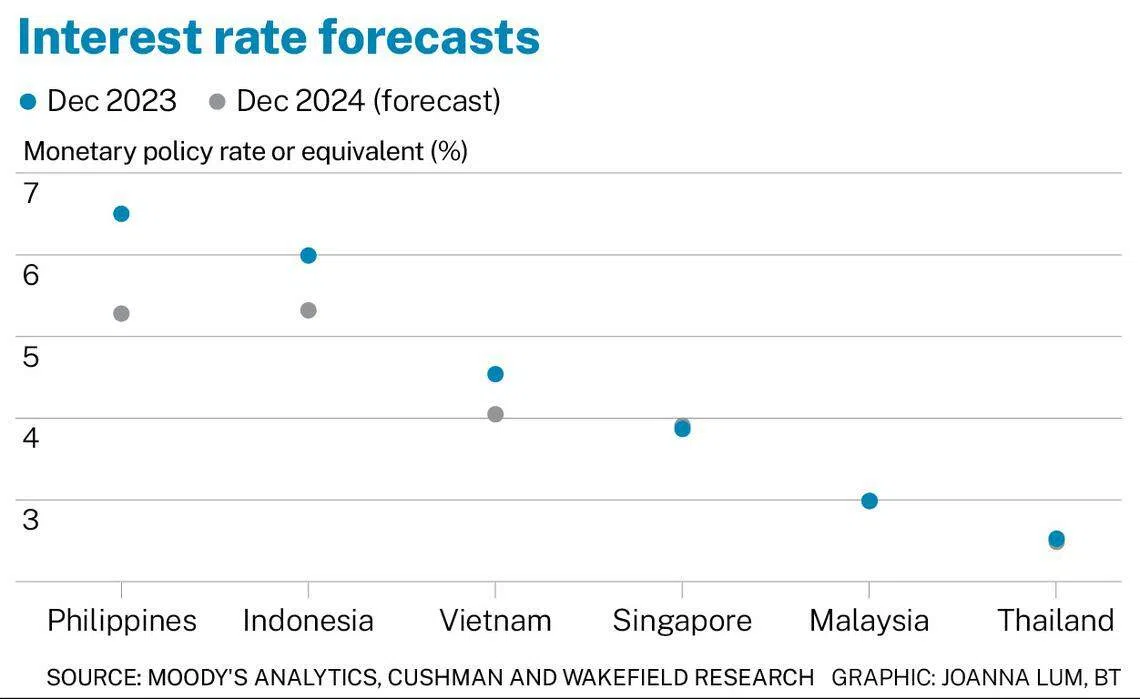
Maybank’s in-house economists expect a first cut to come in the third quarter of this year, with cumulative cuts of 75 basis points by year-end.
Whither rupiah?
While Bank Indonesia (BI) will likely walk in lockstep with the Fed with rate cuts, analysts said risks of rate hikes are rising as the rupiah has been hammered. The currency fell to a four-year low against the US dollar on Apr 2.
BI maintained its benchmark BI-Rate at 6 per cent for a fifth straight month on Mar 20 as it zeroes in on maintaining currency stability.
Economists from Barclays anticipate four quarter-point cuts – one each in June, September and December this year and one in Q1 2025 – from Indonesia’s central bank.
Barclays’ senior regional analyst Brian Tan in an Apr 2 research report said: “Rupiah stability will remain an important factor – in our view, greater stability could encourage BI to cut more, while a re-emergence of volatility could cut short the expected easing cycle.”
Tan further noted that a rate hike is not out of the question for BI, should the US dollar-Indonesia rupiah levels remain relatively elevated by its next monthly policy meeting on Apr 24.
Days ago, the rupiah fell within a whisker of the psychologically key 16,000 level against the US dollar.
The previous time this happened in October 2023 – the rupiah had then only breached the 15,800 mark – BI raised its policy rate by 25 basis points in a surprise move.
Tan added: “Policymakers appear still satisfied with recent gross domestic product prints, and we have not sensed that the central bank is particularly worried about economic activity or sees an urgent need to cut rates.”
For now and for long
The monetary policy trajectory appears relatively clear in Malaysia and Vietnam with expectations that the central banks in both countries will maintain their respective interest rates over the near term.
Malaysia’s robust domestic economic fundamentals “should reduce the pressure on Bank Negara Malaysia (BNM) to cut rates and, in turn with a US easing, help reduce the impact that the wide rate differentials have had on the ringgit”, said Maybank.
BNM left its overnight policy rate unchanged at 3 per cent for a fifth consecutive meeting at its latest Mar 7 meeting.
The central bank consistently reiterated its stance that the ringgit is undervalued, and ought to be trading higher given the nation’s positive economic prospects.
Its next policy meeting – held six times a year – will take place on May 8 and 9.
Maybank economists expect BNM to stay on hold this year.
Meanwhile, the State Bank of Vietnam – among the first in Asia to lower rates in 2023 – is expected to hold interest rates further through next year.
UOB research head Suan Teck Kin wrote in an Apr 1 research note that this is due to Vietnam’s improving pace of economic activities and better growth prospects for the year coupled with the recent acceleration in inflation.
“Instead of further lowering interest rates, which are constrained by the lower bound, the government has turned its focus to non-interest rate measures to support the economy,” he said.






