Ringgit strength, robust spending set stage for Malaysia’s strongest quarterly growth in 2025
Domestic consumption is expected to remain the country’s main growth driver


[KUALA LUMPUR] Malaysia’s economy is likely to clock its fastest quarterly growth this year, lifted by a rallying ringgit and resilient domestic demand that is keeping investor confidence steady amid ongoing global trade challenges.
Economists expect third-quarter gross domestic product year-on-year expansion to be in the range of 5 per cent to 5.3 per cent – accelerating from 4.4 per cent in the previous quarter – when the official data is released this Friday (Nov 14).
In October, the Department of Statistics Malaysia (DOSM) reported an advance estimate of 5.2 per cent growth, surpassing a Bloomberg consensus forecast of 4.2 per cent and marking the strongest quarterly performance of 2025. The momentum signals that Malaysia’s post-pandemic recovery is firming, even as global manufacturing and electronics cycles remain soft.
UOB senior economist Julia Goh and economist Loke Siew Ting said the upside surprise in Q3 advance GDP growth was propelled by broad-based expansion across key sectors. For instance, the mining and quarrying sector rebounded with double-digit growth of 10.9 per cent, while the construction sector continued to post double-digit gains, DOSM data indicated.
Following the strong advance estimate, UOB revised its 2025 GDP forecast to 4.6 per cent from 4 per cent previously. It cited sustained domestic momentum and the anticipated boost from the government’s one-off RM100 (S$32) cash assistance for 22 million Malaysians announced in July, alongside the lagged effects of US trade tariffs.
Consumption, construction and confidence
Household spending remains the backbone of Malaysia’s growth. Rising wages, stable employment and targeted government support under the Budi Madani scheme – which redirected fuel-subsidy savings to lower-income groups – have kept consumption robust.
Tourism, meanwhile, has roared back to near pre-pandemic levels, boosting services, retail and accommodation. Construction activity has accelerated on the back of large-scale projects such as MRT3, flood-mitigation works and developments linked to the Johor-Singapore Special Economic Zone, helping to sustain employment and domestic investment.
OCBC senior Asean economist Lavanya Venkateswaran said domestic demand will “remain resilient, supported by policies to bolster household consumption, while investment spending stays aligned with medium-term growth plans” such as the National Industrial Master Plan, the 13th Malaysia Plan and the National Energy Transition Roadmap.
However, she expects growth to moderate to 3.8 per cent in 2026, from 4.6 per cent this year, as external demand softens and exports to the US ease amid front-loaded orders normalising. “Exports to the US were significantly higher in early 2025 compared with previous years, suggesting there could be some payback in early 2026,” she added.
Ringgit strength adds shine
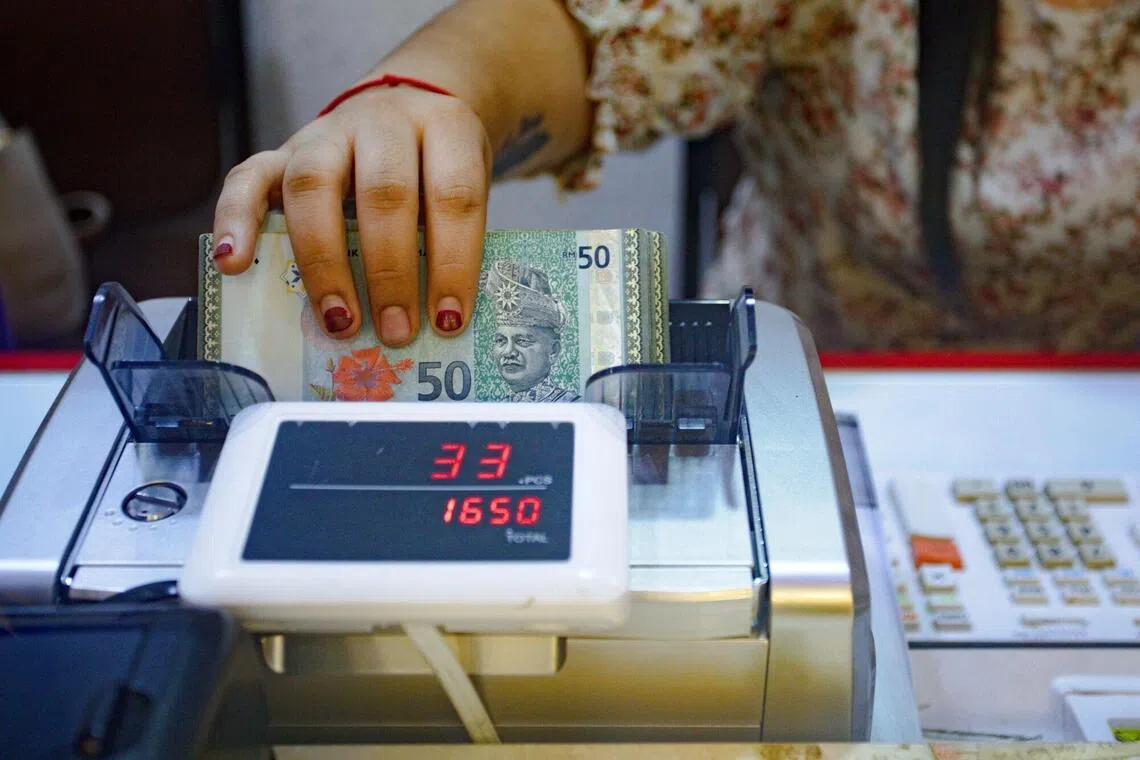
The ringgit’s rebound has added much lustre to the macro picture. Since September, the currency has appreciated nearly 8 per cent against the US dollar to trade around 4.1253 as at end-September, its strongest in close to a year. In the year to Nov 12, the ringgit was up 7.6 per cent at 4.1327 versus the greenback; against the Singapore dollar, it strengthened about 3.2 per cent against to 3.1706.
Analysts attribute the rally to expectations of US Federal Reserve rate cuts in 2026, renewed portfolio inflows into Asian assets, and Malaysia’s steady macro fundamentals.
OCBC FX and rates strategist Christopher Wong said the ringgit has held relatively steady, supported by stronger domestic growth and exports. He forecast the ringgit to reach 4.16 against the US dollar by end-2025, firming to 4.15 and 4.14 by the first and second quarters of 2026.
Against the Singdollar, he noted that the pace of ringgit appreciation is likely to moderate after a 3.5 per cent increase in the second half of the year. He expects the ringgit to stabilise around 3.2248 by end-2025, before easing towards 3.2346 and 3.2394 in early 2026.
Economists say the ringgit’s recovery underscores investor confidence in Malaysia’s fundamentals.
MBSB Research noted that the expected narrowing of the US-Malaysia interest-rate differential is the main driver of the ringgit’s appreciation. It said in a report: “Although we foresee a lower probability of another rate cut this year by the Fed, markets continue to expect another in January 2026, extending the easing cycle throughout next year.”
It believes Bank Negara Malaysia will hold the overnight policy rate (OPR) at 2.75 per cent.
Private consumption cushions external risks
MBSB expects private consumption to remain Malaysia’s growth anchor, supported by a strong labour market, rising wages in domestic services, and stable inflation that preserves household spending power.
Tourism recovery ahead of the Visit Malaysia 2026 campaign and lower fuel prices under the Budi95 subsidy reform are expected to spur discretionary spending in services and retail.
The new US-Malaysia agreement on reciprocal trade could further boost sentiment among consumers and exporters.

Still, MBSB warned that near-term sentiment may soften amid fiscal consolidation and targeted subsidy adjustments for essentials such as sugar, rice and cooking oil.
Retail sales growth is projected to ease to 4.6 per cent in 2026 from 5.5 per cent this year, though spending will continue to be underpinned by low inflation, wage gains and tourism inflows.
The Budi95 rationalisation, which lowered pump prices, should further encourage discretionary spending, MBSB said. But fiscal-tightening measures could temporarily weigh on sentiment.
“Overall, domestic consumption is likely to remain the key growth driver, cushioning the economy against external trade uncertainties, though downside risks persist from possible US tariffs on semiconductors and weaker global demand,” the research firm added.
Inflation and monetary policy
With inflation easing and growth recovering, most economists expect the Malaysian central bank to keep its OPR unchanged at 2.75 per cent until the year-end. Bank Negara Malaysia maintains that its monetary stance is “neutral” amid balanced assessments of global and domestic conditions.
OCBC’s Venkateswaran expects slower exports to weigh on activity next year and, in view of that softer growth profile, projects another rate cut in 2026. “The risk, however, is that domestic growth sustains, reducing the need for further rate cuts from Bank Negara next year,” she said.
UOB’s Goh and Loke share a similar view, anticipating a 25-basis-point reduction that would bring the OPR down to 2.5 per cent in the first half of 2026.