



S-E Asia’s Brics interest raises eyebrows as largest Asean members stir the US-China balancing act
Status check: Indonesia snags full membership; Thailand partners up; Malaysia, Vietnam stay in the wings; others wait and see
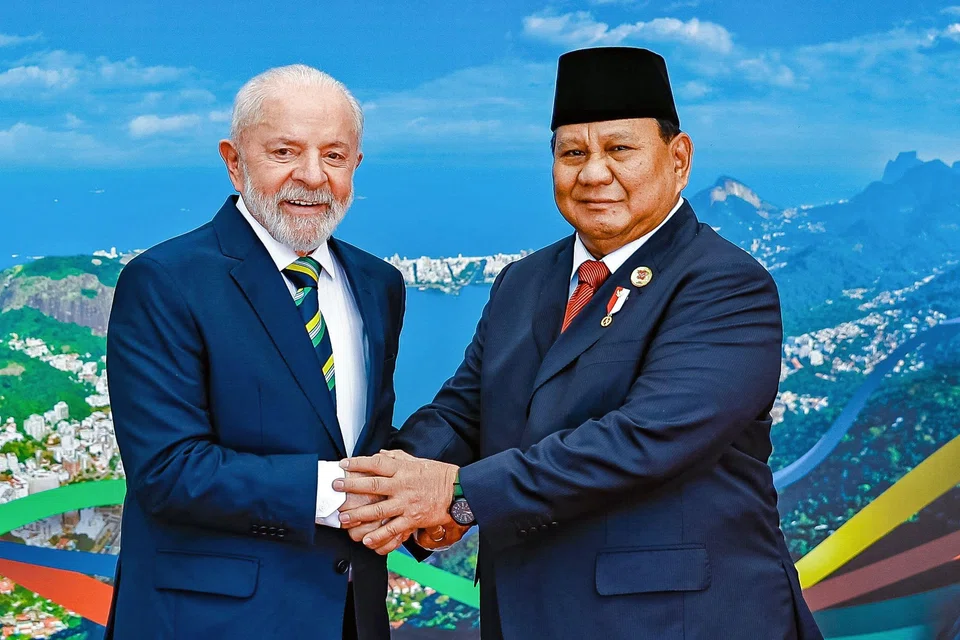
SOUTH-EAST Asia’s two largest economies are the newest recruits of Brics, lending significant clout to the bloc that already commands more than 40 per cent of the world’s gross domestic product as it seeks to strengthen its role as a counterbalance to the West.
Thailand on Jan 1 confirmed it had joined Brics as a partner country; the kingdom is South-east Asia’s second-largest economy.
Indonesia was hot on its heels, announcing its full membership in Brics on Jan 7. The regional economic heavyweight accounts for about a third of Asean’s combined GDP and is South-east Asia’s largest market, with a young and growing population of 280 million.
Things remain quiet on the Malaysian front for now, though Prime Minister Anwar Ibrahim confirmed last July that the country had submitted its application to join the bloc.
Vietnam has not formally made any announcements, but Russia said on Jan 15 in a joint statement following Russian Prime Minister Mikhail Mishustin’s visit to Hanoi that it would help Vietnam join Brics as a partner country.
Brics is piquing South-east Asia’s interest and pundits tell The Business Times that the development is one to watch.
“The gravitation of South-east Asian countries towards Brics ought to be seen as indicative of a growing regional appetite to carve out more room for geopolitical manoeuvring amid intensifying competition between the US and China,” said Harrison Cheng, South-east Asia lead analyst at global risk consultancy Control Risks.
While regional governments have long pushed back against the concept of a zero-sum game between both superpowers and sought for a win-win situation, success has been elusive, said Cheng.
This is where Brics comes in, offering the opportunity of an alternative platform for South-east Asia to exercise a more independent foreign policy, he added.
Brics in brief

- 2001: The acronym “Bric” is coined by an economist studying the growth potential of Brazil, Russia, India and China
- 2006: Informal discussions transpire among the four under Russia’s lead
- 2009: Club is formed, holds first summit in Russia
- 2010: Club expands to include its smallest member South Africa
- Aug 2023: Club leaders invite Argentina, Egypt, Ethiopia, Iran, Saudi Arabia and the United Arab Emirates (UAE) to join
- Dec 2023: Argentina backs out after a new president takes over; Saudi Arabia keeps mum
- Jan 2024: Club expands to include Egypt, Ethiopia, Iran and the UAE
- Oct 2024: Club reportedly invites Malaysia, Indonesia, Thailand and Vietnam to join as partners; as well as Algeria, Belarus, Bolivia, Cuba, Kazakhstan, Nigeria, Turkey, Uganda and Uzbekistan
- Jan 2025: Indonesia joins as full member; Thailand as partner country
Malaysia: Next in line?
The next likeliest South-east Asian addition to Brics is Malaysia, which also happens to be this year’s Asean chair.
Although PM Anwar did not show up at the Brics Summit last year, he invited Russia’s President Vladimir Putin to attend this year’s Asean Summit. The 2024 event was attended by Russian Foreign Minister Sergey Lavrov.
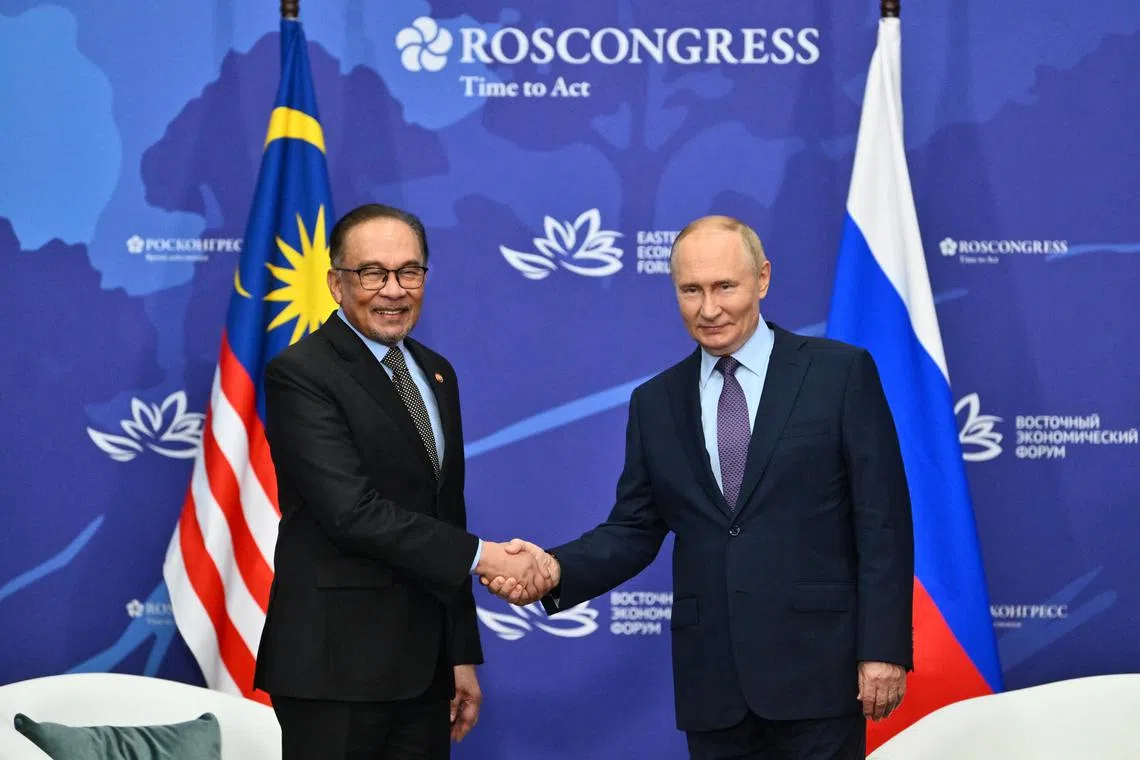
Indonesia’s earlier admission could bolster Malaysia’s prospects of joining Brics, said Lee Pei May, an assistant professor of political science at the International Islamic University of Malaysia.
“Given the close relationship between (Indonesia’s) President Prabowo (Subianto) and PM Anwar, Indonesia is likely to endorse Malaysia’s membership,” explained Dr Lee. “Together, they could advocate for Asean’s interests within Brics.”
“Malaysia’s strategic alignment with Brics makes its eventual acceptance likely,” she said. “For Malaysia, joining Brics represents not just economic gains but also an opportunity to amplify Asean’s voice on the global stage.”
Vietnam: Wary of Trump’s ire
Vietnam faces rougher seas than its neighbour – it risks drawing US president-elect Donald Trump’s ire given its soaring trade surplus with the US just two weeks before his inauguration on Monday (Jan 20), making the country a possible target for US tariffs.
When asked early this month about Vietnam’s intention to join Brics, a foreign ministry spokesperson said at a press briefing that the country “consistently pursues its foreign policy of independence, self-reliance, multilateralisation and diversification of international relations”.
The spokesperson added that Vietnam takes into account its conditions and capabilities when considering its participation in international mechanisms.
At last year’s three-day Brics summit in the Russian city of Kazan in October, Vietnamese Prime Minister Pham Minh Chinh said that the socialist republic “stands ready” to work with Brics countries, but stopped short of elaborating.
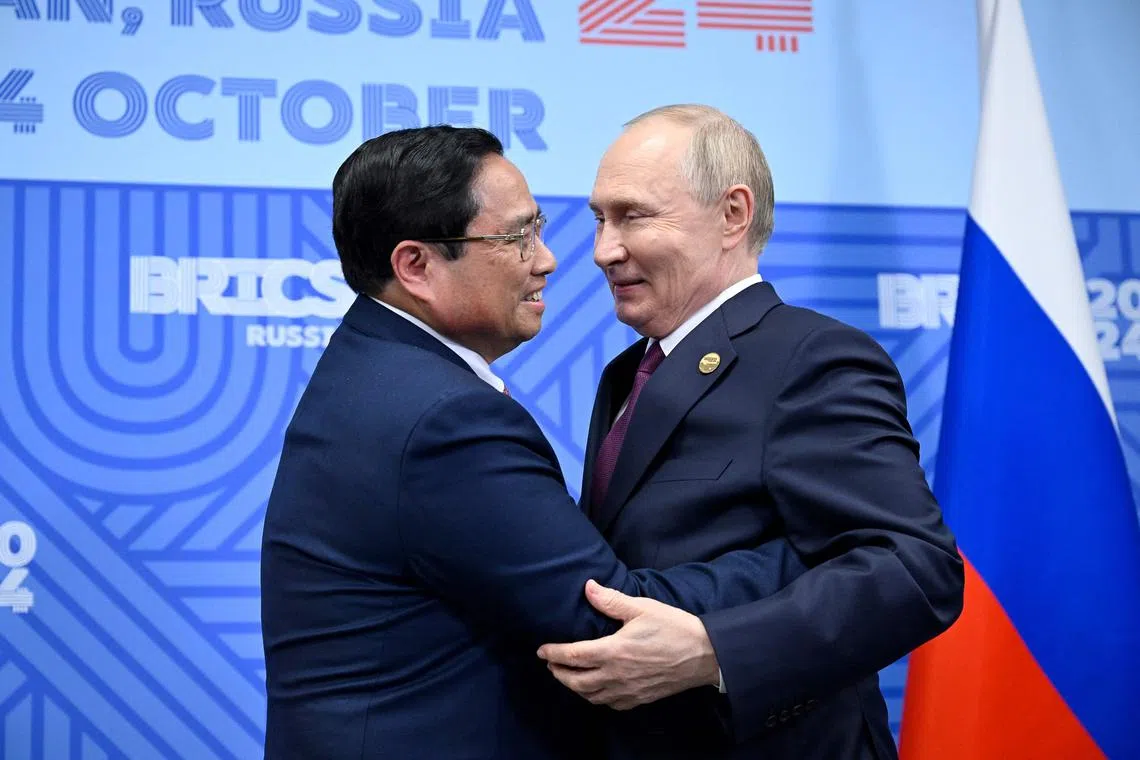
Chinh greeted Putin at the event with a hug, a belated birthday wish and a gift of two dragons.
The Kremlin quoted Chinh as having said: “In Vietnam and Asia, dragons are believed to be the supreme authority. So, the small dragon symbolises your authority within Russia while the big one is a symbol of your influence outside the country, around the world.”
Le Truong Giang, an analyst at Control Risks, believes that Vietnam’s participation in Brics – whether as a partner country or a full member – is “just a matter of timing”, citing Vietnam’s pro-foreign trade attitude and extensive ties with the bloc’s most important members.
The country has formed comprehensive strategic partnerships – its highest level of bilateral relationship – with three of Brics’ founding countries: China, Russia and India. Vietnam has such relations with only seven nations in the world, including the US, South Korea, Japan and Australia.
Despite this, Vietnam remains hesitant to formally establish a relationship with the bloc due to perceived risks vis-a-vis the US – its largest export market – as well as amid recent personnel changes and bureaucratic reforms in its state apparatus, added Giang.
Though the country has not been identified as an immediate target of Trump’s tariff threats, Vietnam is vulnerable to such renewed trade protectionist policies due to its export-reliant economy.
“Being formally associated with Brics can disproportionately increase Vietnam’s risk exposure, relative to any potential benefits of joining now,” concluded Giang.
A snowball’s chance in hell
Other South-east Asian countries – including the remaining six Asean member nations: Brunei, Cambodia, Laos, Myanmar, the Philippines and Singapore – are standing still for now.
The Philippines is unlikely to join Brics, given that it is one of the US’ oldest Asian allies, and shares American interests in maritime security issues, including countering Chinese influence in the South China Sea.
Singapore, while maintaining strategic ambiguity, appears to lean towards prioritising Asean cohesion.
When asked last June about its neighbours’ interest in Brics, Singapore Foreign Minister Vivian Balakrishnan responded that there exists “no substitute for Asean as an organising unit, a single production zone, a single investment zone (and) a competitive zone”.
He noted that “the key game in town in our part of the world is Asean”.
“All these exploratory mechanisms are useful in their own right. It is not either-or; it is additive,” he said.
Dr Balakrishnan added: “So long as all these measures lead to greater openness, inclusiveness, a level playing field, and make Asean member states more attractive for investments and promote trade, we are in support of all these exploratory moves.”
Iseas-Yusof Ishak Institute visiting senior fellow Jayant Menon believes a small country such as Singapore has little to gain by joining Brics.
“While it is true that the US is likely to become more transactional as it disengages globally under Trump, this in itself is not a sufficient reason to rock the boat by joining Brics,” he said.
Dr Menon added: “The South-east Asian countries that have joined or expressed an interest to join have done so for very specific reasons, usually closely tied to the interests and preferences of their respective leaders.”
He concluded that Singapore’s stance against Russia, following its invasion of Ukraine, could be another factor in dissuading even an application for Brics membership.
Asean unity v Brics influence
Observers across the board contend that Asean is expected to remain a priority and the main platform to address issues concerning South-east Asia.
Control Risks’ Cheng noted that it remains too early to tell if the Asean member nations in Brics will act in concert within the global alliance.
“Each country would have its own interests and agendas to consider, and its own sense of what the right equilibrium in its conduct of foreign policy looks like,” he said.
Even within Asean, there are stark differences in the way member states have responded to growing geopolitical tensions and intra-regional challenges, he added.
“Because Asean may not always act in concert in Brics, it remains difficult at this nascent stage of their membership in the grouping to argue that they would be able to exert a markedly greater influence at the global level than they are currently doing through Asean.”






