Singapore, Asean have to be proactive to stay relevant in volatile world: Chan Chun Sing
Energy, finance and data are ‘commanding heights’ of new regional economy, says the minister

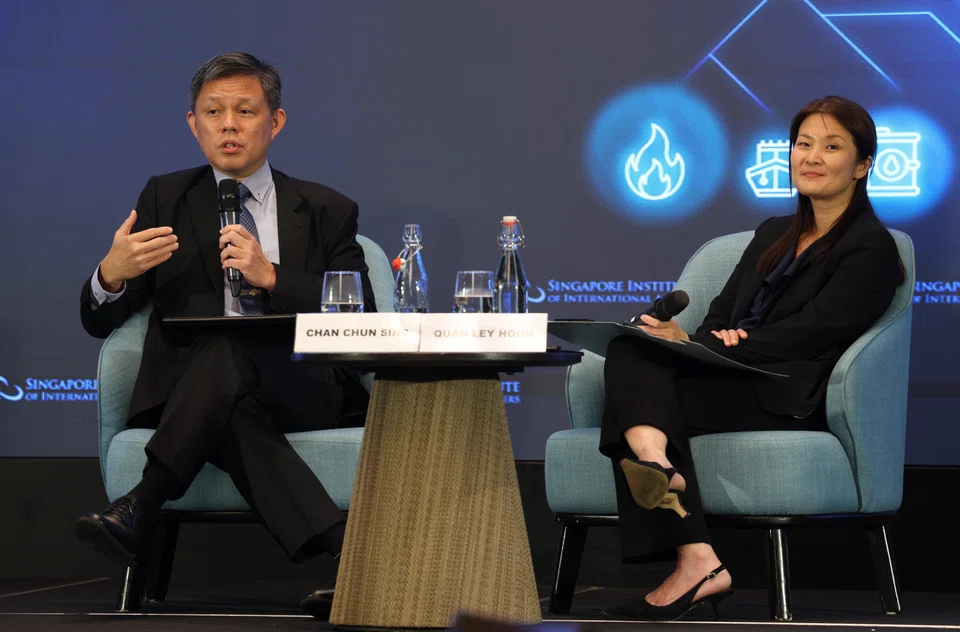
[SINGAPORE] Amid geopolitical volatility, Singapore’s competitive advantage must come from proactive efforts to remain relevant globally, said the Republic’s Coordinating Minister for Public Services and Minister for Defence Chan Chun Sing.
Geopolitics should not be seen as a passive backdrop which cannot be responded to. Instead, Singapore must proactively take action to find new competitive advantages, noted Chan.
“Competitive advantage is something that we have to constantly seek and work on,” he pointed out. “There is no single panacea that will give us eternal competitive advantage.”
The minister was speaking during a keynote dialogue at the 18th Asean & Asia Forum organised by the Singapore Institute of International Affairs (SIIA) on Monday (Aug 3). The Business Times is the official media partner of the event.
Chan said that Singapore has to consistently create new value propositions, which are not based simply on price or scale, but also on capabilities that are difficult for other countries to bypass.
“Nobody invests in Singapore for our domestic market, given how small it is,” he noted. “People invest in Singapore because of our ability to consistently deliver and to connect with the rest of the world. If we are not relevant, if we have no bargaining power, then we can rightfully expect to be squeezed.”
'%3e%3cpath%20d='M12.1475%2025.5262C13.7713%2025.4295%2014.94%2023.913%2014.94%2021.8832C14.94%2019.5359%2013.474%2018.093%2011.5917%2018.093C11.3745%2018.093%2010.9582%2018.093%2010.8393%2018.1413V25.2086L11.8891%2025.5745C11.8891%2025.5745%2012.207%2025.5262%2012.1475%2025.5262ZM11.4934%2017.6281C13.2567%2017.6281%2014.3843%2016.4292%2014.3843%2014.4501C14.3843%2012.372%2013.275%2011.2973%2011.4339%2011.2973H10.8393V17.6305H11.4934V17.6281ZM6.66078%2025.6482L7.39265%2025.5492C8.02617%2025.4502%208.26403%2025.3053%208.26403%2025.1097V11.6149C8.26403%2011.4193%208.1451%2011.3709%207.23484%2011.249L6.68137%2011.173L6.6219%2010.7588H11.9508C15.7153%2010.7588%2017.0624%2012.0797%2017.0624%2014.1578C17.0624%2015.9666%2015.7748%2017.1909%2013.4969%2017.6305V17.7041C16.111%2017.948%2017.6571%2019.5382%2017.6571%2021.7636C17.6571%2024.3318%2015.8937%2026.0417%2012.1109%2026.0417H6.60132L6.66078%2025.6482Z'%20fill='%232B2B2B'/%3e%3cpath%20d='M20.6287%2025.6505L21.5596%2025.5515C22.1725%2025.4779%2022.4104%2025.3076%2022.4104%2025.112V11.249H21.9346C20.073%2011.3479%2018.982%2013.0095%2018.408%2014.6227L18.1907%2015.5018H17.6555L18.1701%2010.7588H29.3837L29.6421%2015.4787H29.1664L28.9491%2014.6227C28.3728%2012.8645%2027.3047%2011.2743%2025.5002%2011.249H24.9856V25.1856C24.9856%2025.3812%2025.1251%2025.4548%2025.9965%2025.5515L26.7695%2025.6505L26.829%2026.0417H20.5693L20.6287%2025.6505Z'%20fill='%232B2B2B'/%3e%3c/g%3e%3cdefs%3e%3cclipPath%20id='clip0_5242_21648'%3e%3crect%20width='24'%20height='16.8'%20fill='white'%20transform='translate(6%2010)'/%3e%3c/clipPath%3e%3c/defs%3e%3c/svg%3e)
Policy consistency is a major driver of these competitive advantages, said the minister during the dialogue moderated by Quah Ley Hoon, group chief corporate officer for CapitaLand Investment and council member at SIIA.
Investments in sectors such as energy, semiconductors and biopharmaceuticals may take many years to translate into real returns.
Investors therefore are more likely to favour destinations where policies and execution remain predictable over the long term, Chan pointed out. This playbook can also translate into the wider region, as Asean works to capture economic value in an increasingly unpredictable world, he added. Cooperation in energy, finance and data can make the region more than a collection of separate markets.


With several Asean countries having strong access to renewable energy sources, the region has the potential to become a major producer of cleaner power. Meanwhile, strong and integrated financial and data infrastructure are essential to reducing friction in doing business. As the “commanding heights” of Asean’s new economy, these three areas will become important to drive the region’s economic growth.
Mobilising private capital
But even amid the need for regional cooperation, Chan stressed that growth should not be steered by intergovernmental cooperation alone. Instead, the private sector must be allowed to drive “bankable projects” that make economic sense.
Such projects, even if not designed with regional cooperation in mind, can eventually overlap into wider networks across the region, he said. “In fact, I would be cautious if governments start to intervene, because you need a certain market discipline for investments to flow,” he added.
Instead, governments should focus on providing a “foundation of certainty” that would offer investors the confidence to support such projects.
He cited the Asean Power Grid as among the infrastructure projects that have the potential to underpin the region’s future development through securing its energy needs.
During another discussion titled “Asean’s competitive future amidst trade turbulence”, panellists observed that financing long-term projects remains a challenging task amid a highly volatile business environment globally.

Dr Ludger Schuknecht, vice-president of policy and strategy at the Asian Infrastructure Investment Bank, said that multilateral development banks can support mobilisation of private and blended financing for projects that provide long-term returns. Such institutions offer more than just financing, but also instil greater certainty in investors regarding timelines and standards. He noted that regional countries, including Thailand and Vietnam, have become increasingly willing to work with multilateral development banks in recent years.
Kevin Wong, chief executive for Asia-Pacific at global financial messaging network Swift, said that clear road maps on both national and regional levels are essential in attracting long-term investment, even amid an unpredictable external environment.
He cited collaboration between Asean’s central banks in strengthening the region’s financial infrastructure through initiatives such as Project Nexus, a multilateral effort to connect domestic instant payment systems.
“Regional collaboration is important to design these road maps and think about the additional risks and frictions that may come along,” he noted.
SIIA chairman Simon Tay, who moderated the panel, pointed out that government efforts have sometimes emphasised “white elephant” projects, which are not bankable and soak up unnecessary capital. “There is a lot of money out there, but the ability to mobilise capital is not easy. The markets cannot supply where there is no demand.”
Tay concluded that Asean must emphasise a “new discipline” in funding development projects. On the one hand, the region must identify strategic sectors that are attractive by offering investors returns, he said. On the other, it must involve philanthropic and blended finance which can support projects, while seeking lower return.
Decoding Asia newsletter: your guide to navigating Asia in a new global order. Sign up here to get Decoding Asia newsletter. Delivered to your inbox. Free.
Copyright SPH Media. All rights reserved.