Turning constraints into assets could help Singapore remain competitive in an age of global fragmentation
Transport Minister Jeffrey Siow explains how the country can ride the challenges of energy scarcity and demographic headwinds

[SINGAPORE] The past few years have been a period of significant turmoil for both the global economy and politics. Shifting supply chains, rapid technological advancement and increasing trade barriers all pose challenges to Singapore’s economy.
Yet the city-state still possesses factors that can help it thrive in an ever-changing world, and even turn some of its constraints into a position of strength.
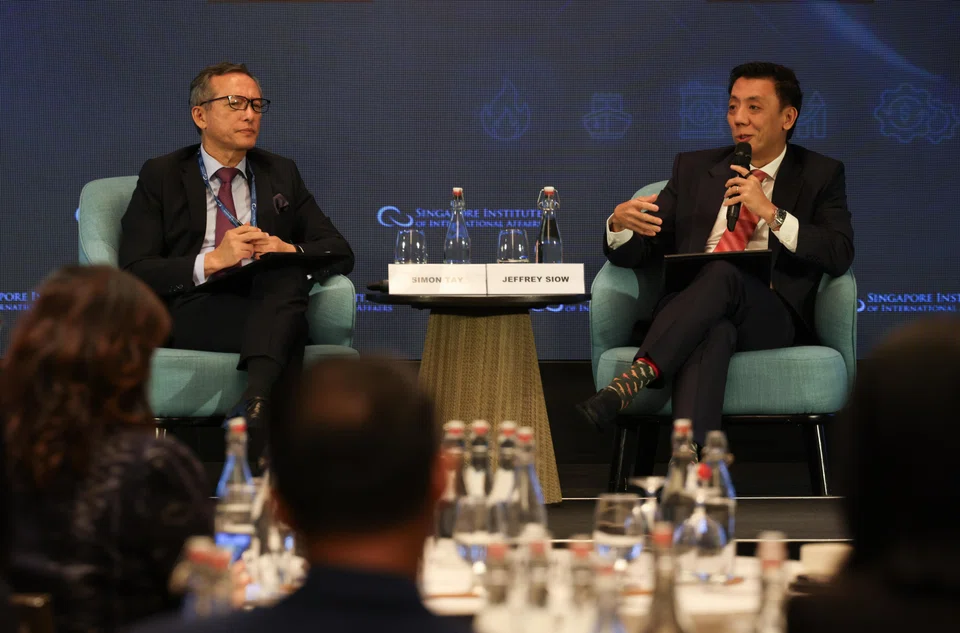
“Demography is a huge constraint for us. Our population is ageing very quickly, our total fertility rate (TFR) is dismal, and we have to integrate whoever comes into Singapore better,” Jeffrey Siow, Singapore’s minister for transport.
“At the same time, the cost structure of the economy is also going up, (and) I think the biggest constraint going forward for us will be energy,” said Siow. He was speaking at a keynote dialogue at the 18th Asean & Asia Forum organised by the Singapore Institute of International Affairs on Monday (Aug 3). The Business Times is the official media partner of the event.
Siow, who is also Singapore’s second minister for finance, explained that the government is already aware of many of these challenges, and that they have also been highlighted in the government’s Economic Strategy Review.
Identifying these constraints allows Singapore to focus capital where it matters. For instance, a smaller Singapore population means an opportunity to invest more per person in terms of training or reskilling.
“Help companies, incentivise them to retrain Singaporeans and prioritise those efforts. That is not something many cities or countries can do,” Siow said. The Republic already has a SkillsFuture programme where Singaporeans receive monetary credits to attend training courses. Siow added that Singapore “can do more in that aspect”.
There are, however, limits to what Singapore can do on the energy front. Even if the country was “plastered” with solar panels, Singapore may not even be able to cover 10 per cent of its energy needs, he noted.
There are also global events that are beyond the city-state’s control that put further strains on energy demand, such as the Iran conflict. The Strait of Hormuz, which carries about 20 per cent of global oil and liquified natural gas, has remained effectively blocked since the start of the conflict in late February.
What Singapore is trying to do is diversify its sources of energy, including exploring nuclear energy.
In an era where supply chains can be significantly negatively affected by geopolitical events, port operator PSA’s global network was highlighted by Siow as an example of turning constraints into a position of strength.
“We (PSA) have a very big network of ports around the world and where there are services that are disrupted in one area, PSA has the ability to orchestrate the movement of ships and containers to its own ports. We want to do more of that,” Siow said.
Siow added that he is also encouraging PSA to increase its ability to reroute shipments. It is part of a larger drive for Singapore to be at the centre of how trade flows are orchestrated, as being agile and competitive means being able to ride out shocks better.
PSA has grown together with Singapore’s economy to become a global port operator and is now present in 45 countries.
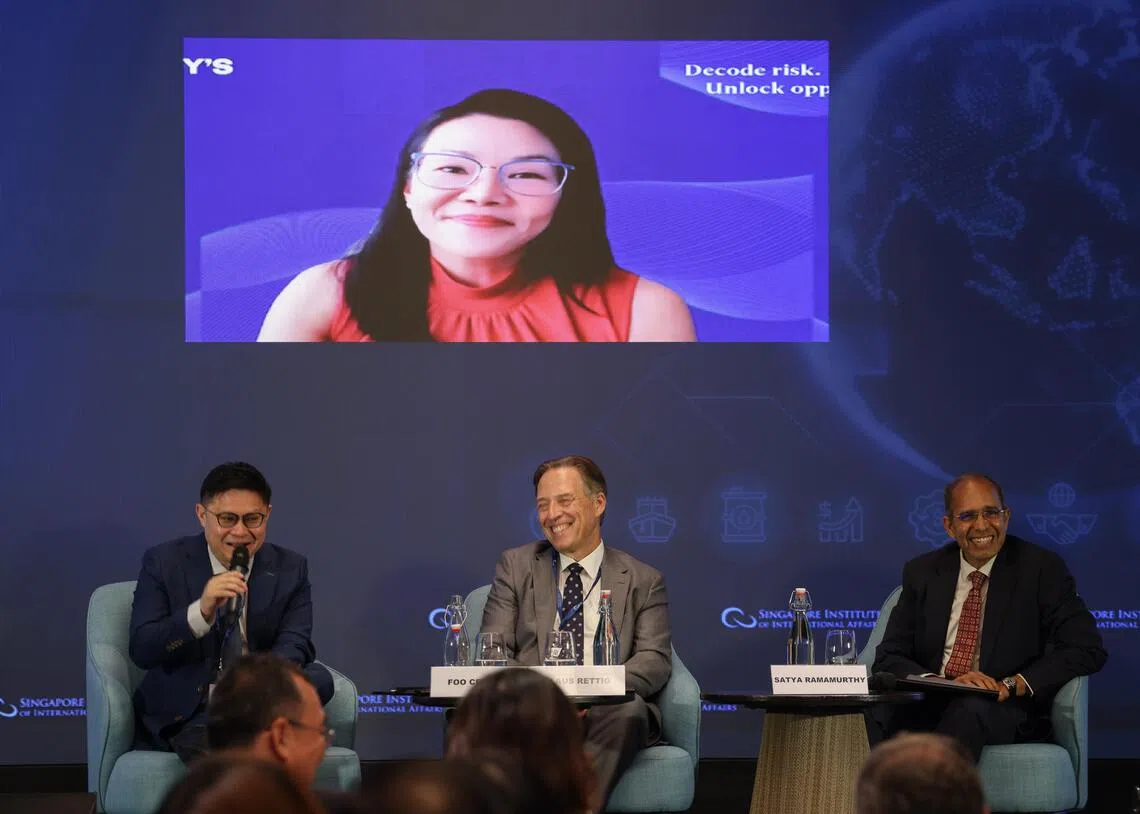
In a panel discussion following Siow’s keynote dialogue, PSA Singapore’s vice-president of port ecosystem development, Foo Cexiang, said the operator has been trying to “strengthen” its value proposition to customers, not only through its Singapore operations but its global network.
“When you face supply chain disruptions, that ability for your supply chain orchestrator to swim the goods from port to port to reach your end destinations in time, I think that will be a strong value proposition,” Foo said.
Foo noted that despite a seemingly fragmented world, container volumes have been increasing along with trade from certain regions such as Africa to Asia, and that PSA plays a big part in these regions.
The other two panellists – Claus Rettig, president for the Asia-Pacific at Evonik; and Wendy Cheong, managing director and regional head for the Asia-Pacific at Moody’s Ratings – elaborated that Singapore can leverage several assets it has, such as its stability, market credibility and deep financial markets.
Rettig explained that Singapore is the German speciality chemical company’s Asia headquarters even though the city-state does not offer sufficient scale. Yet what the country offers is its connectivity and the ability to serve as the hub to manage operations in the rest of South-east Asia to India.
Cheong noted that Singapore’s “triple A” rating from Moody’s – the rating agency’s top rating – is the highest in South-east Asia. That is a plus for Singapore to attract companies to anchor operations in the city-state and use it as a base to connect with the region.
One point that panellists discussed that looks past Singapore’s constraints and leverages its assets could potentially be to serve as a regional food hub.
“If you look at Asean, we (Singapore) are very advanced in terms of food manufacturing.
Thailand, for example, is at the forefront of food manufacturing processing as well, so can Singapore play a role as a gateway for Asean to the world,” Foo said.
He added that this will also increase the amount of intra-Asean trade, which stagnated in recent years.
Decoding Asia newsletter: your guide to navigating Asia in a new global order. Sign up here to get Decoding Asia newsletter. Delivered to your inbox. Free.
Copyright SPH Media. All rights reserved.