



Singapore, South Korea reshape Vietnam’s FDI mix as Chinese inflows halve
Hanoi’s push up the value chain is helping Vietnam attract more quality Asian capital in H1
FRESH Chinese investment pledges into Vietnam slumped by more than half in the first half of 2026, while Singaporean and South Korean investors are making bigger bets, reshaping the South-east Asian country’s foreign direct investment (FDI) mix.
This shift has unfolded as Vietnam faces closer scrutiny over trade flows, while Hanoi targets to steer investments towards higher-value projects.
Recent official data showed that total registered foreign investment – comprising newly pledged capital, adjusted capital for existing projects, and foreign investors’ capital contributions and share purchases – hit US$34.65 billion, up 61 per cent from a year earlier.
This underscores Vietnam’s continued appeal despite the marked shift in sources of capital.
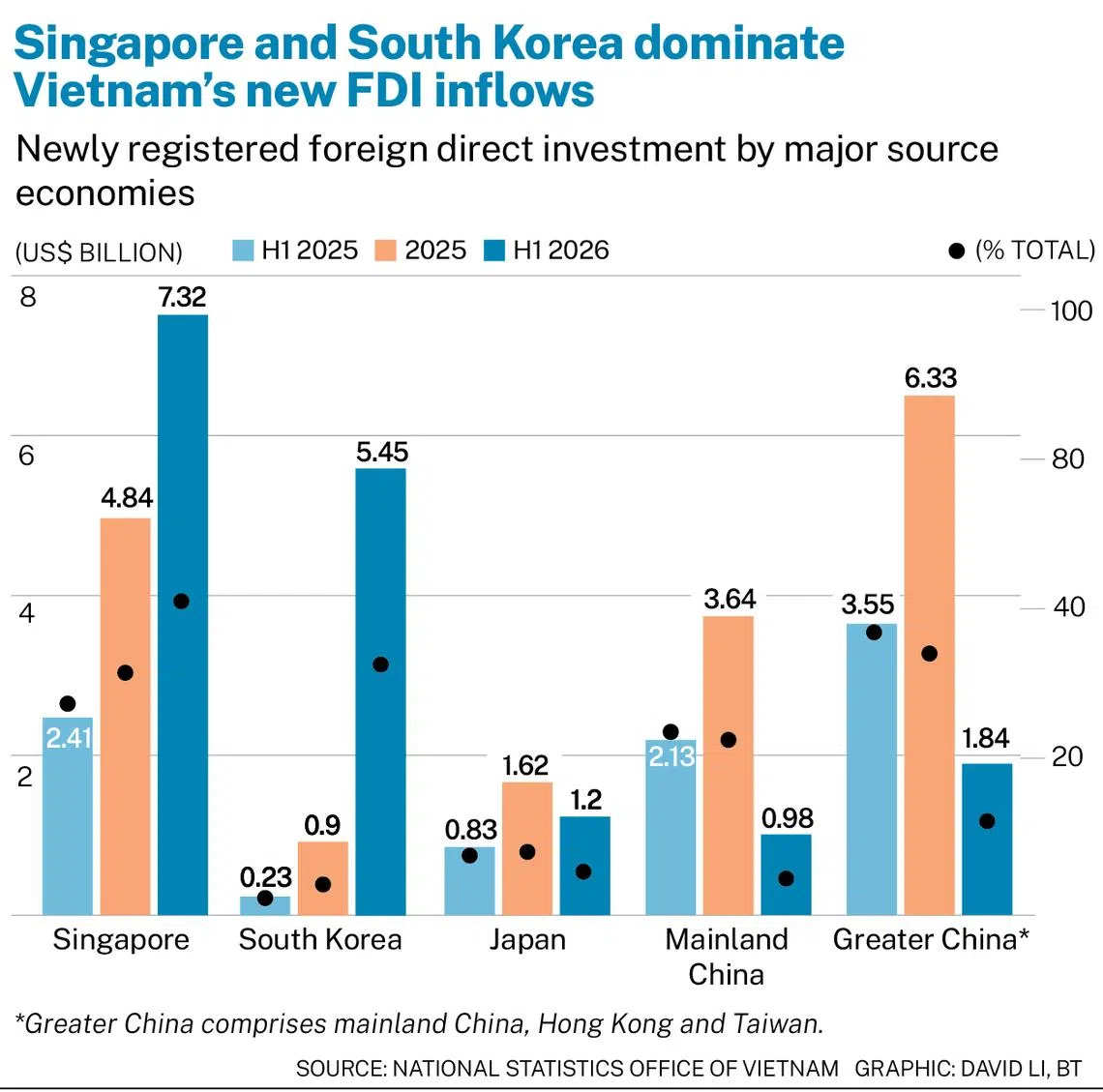
New commitments from mainland China fell 54 per cent to US$977 million in the first six months of this year, cutting its share of the total to 5.6 per cent from 22.9 per cent a year earlier. Including inflows from Hong Kong and Taiwan, investment from Greater China also fell more than 48 per cent to US$1.84 billion, from US$3.55 billion.
At the end of June, the bloc only represented 10.6 per cent of the total new commitments to Vietnam, from 38.2 per cent in the first half of 2025 and 36.5 per cent at the end of last year.
This reversed an earlier trend that saw Greater China rise to become Vietnam’s largest source of foreign investment in 2025, as manufacturers sought alternatives to China amid rising US tariffs and geopolitical tensions.
Meanwhile, Singapore and South Korea together accounted for about 73 per cent of Vietnam’s US$17.39 billion in newly registered capital in the first half, a total already exceeding the amount attracted in all of 2025.
Fresh commitments from the city-state alone more than tripled to US$7.32 billion, making it Vietnam’s largest source of newly registered FDI with a 42 per cent share. The increase, however, should be interpreted cautiously, as Singapore has long served as a regional base for holding companies and project-financing vehicles of global firms.



Chinese investors grow more cautious
Tyler Manh Dung Nguyen, chief market strategist at Ho Chi Minh City Securities, said the drop showed Chinese investors had now become more cautious amid heightened uncertainty over US trade policy. This includes three US Section 301 investigations against Vietnam, alongside stricter scrutiny of transshipment and certificate-of-origin compliance.
“Investments primarily aimed at using Vietnam as a transshipment base to circumvent US tariffs have become less viable under tighter regulatory scrutiny.
“Chinese firms are delaying or reassessing investment decisions until there is greater clarity on the trade outlook,” he added.
The smaller ticket size of Chinese projects also suggests that investment is becoming more fragmented rather than disappearing altogether.
In the first half, they registered 697 new projects, up from 600 a year earlier, but total committed capital fell by more than half. That reduced the average Chinese investment per project to US$1.4 million, from US$3.6 million last year.
However, Nguyen believed that official figures may understate Chinese interest because some companies invest through regional holding structures, including entities in Singapore.
South Korean investors make bigger bets
South Korea’s jump may be a clearer sign that Vietnam is attracting larger, more capital-intensive commitments.
With the number of projects broadly unchanged at over 200, average capital per project surged to about US$25.8 million from just US$1.1 million.
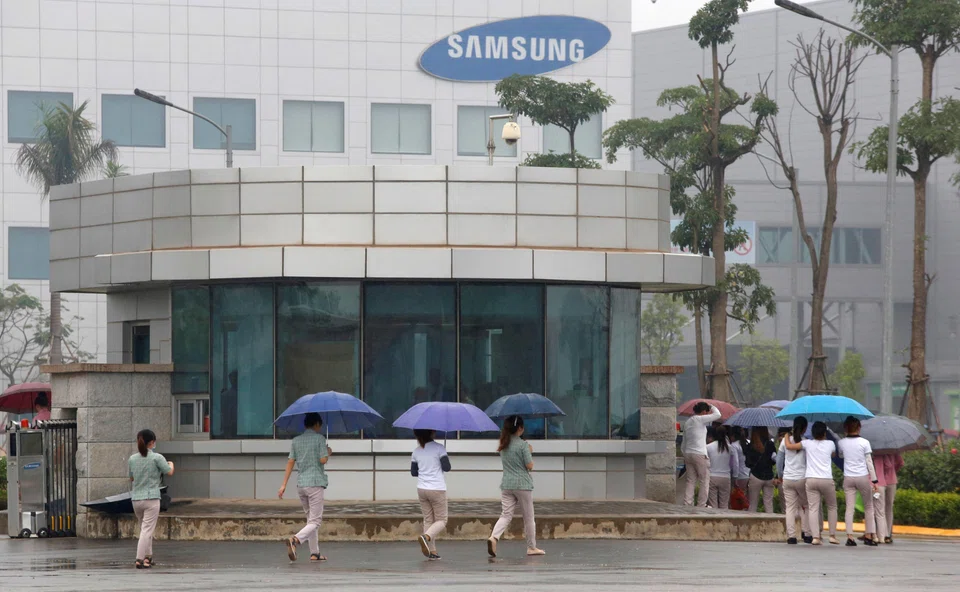
Major projects include Samsung’s planned additional US$1 billion investment to expand electronics manufacturing, LG Innotek’s US$1 billion semiconductor package substrate facility in Hai Phong, an SK Innovation-led consortium’s US$2.2 billion Quynh Lap liquefied natural gas power project and Lotte’s US$2.3 billion Thu Thiem Eco Smart City development.
These sectors fit Vietnam’s efforts to move beyond labor-intensive manufacturing and deepen its role in Asia’s technology supply chain.
In June, the Politburo’s Resolution 10 sharpened Vietnam’s FDI strategy by naming priority sectors including semiconductors, artificial intelligence and biotechnology.
Official sectoral data shows a similar transition.
In a July interview with Bao Dau Tu, an investment newspaper under the Ministry of Finance, Phi Huong Nga, head of industrial and construction statistics at the National Statistics Office, said capital within manufacturing – which historically accounted for about 62 to 65 per cent of newly registered FDI in Vietnam – was gradually moving away from garments and footwear towards electronics, semiconductors and other higher-value activities.
Electricity and gas production and distribution have now overtaken real estate to rank second among the sectors attracting foreign capital, she said.
Emerging semiconductor hub
Semiconductors and AI are emerging as key examples of this shift, with Vietnam becoming a growing hub for global chipmakers, especially major South Korean groups.
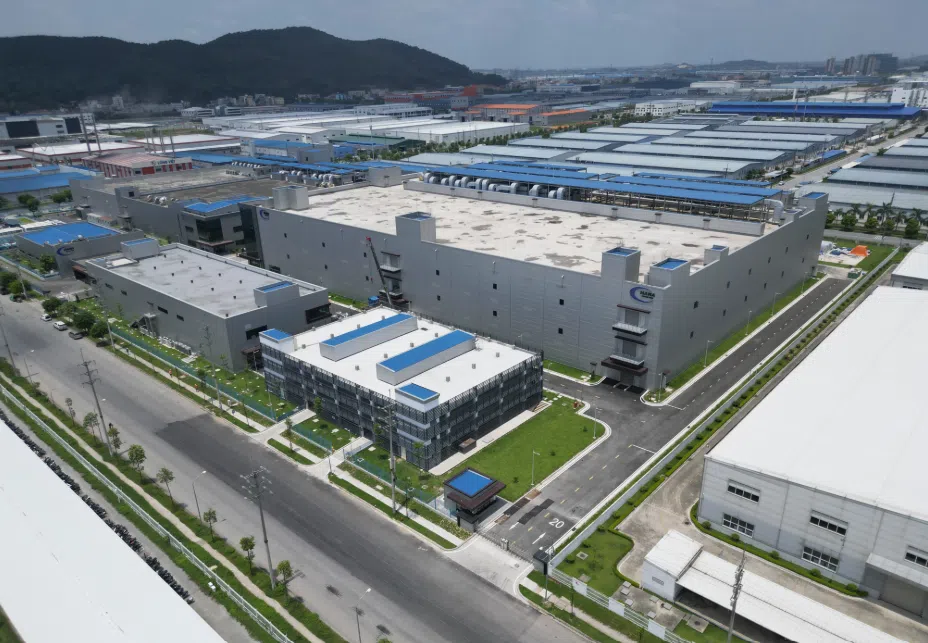
Alongside LG Innotek’s latest pledged investment, Hana Micron operates a chip-packaging and testing plant in Bac Giang and plans to invest a further US$930 million through 2026 to expand capacity.
Samsung Electro-Mechanics also produces semiconductor package substrates at an US$850 million plant in Thai Nguyen and pledged a further US$1.2 billion in May for its Vietnam manufacturing operations.
Tim Evans, CEO of HSBC Vietnam, said intra-Asian trade in AI-enabled chips, components and equipment doubled from pre-pandemic levels to almost US$2 trillion in 2025.
Vietnam is increasingly positioned at the centre of those flows. Its share of global trade in AI-related equipment rose to 12.4 per cent in 2025 from 1.2 per cent in 2015, the largest gain recorded by any single economy over the period, according to data compiled by HSBC Research.
It added that in the three months to May, Taiwan’s imports from Vietnam surged 173 per cent year on year, driven largely by machinery, electrical equipment and appliances. South Korean exports to Vietnam, meanwhile, recorded the fastest growth among Asean markets in early 2026.
“These figures represent a major shift,” Evans wrote in a note on Jul 15. “Vietnam is no longer a low-cost assembly point at the end of someone else’s supply chain but a node in a multidirectional network.”
The localisation challenge
Attracting larger and more sophisticated projects, however, will not automatically create more value for Vietnamese companies.
Despite decades of strong FDI inflows, linkages between foreign-invested manufacturers and local companies remain relatively weak.
Many multinational groups continue to rely on established supplier networks from their home countries, while local firms are often confined to lower-value activities or struggle to meet requirements on technology, scale, quality and delivery.
Under Resolution 10, Vietnam aims to raise its localisation rate to between 45 and 50 per cent by 2030. It also wants about 10,000 domestic enterprises to participate in the value and supply chains of foreign-invested companies, including between 500 and 1,000 Tier 1 suppliers.
Truong Thi Chi Binh, vice-chairwoman and general-secretary of the Vietnam Association for Supporting Industries, said localisation should be measured by the value generated by Vietnamese manufacturers, particularly in high-technology components, rather than simply by the value of goods produced within the country.
“To change the tendency of FDI companies to utilise their traditional supplier networks, Vietnam needs specific policies that encourage them to increase purchases from Vietnamese suppliers,” she said.
These could include recognition, awards or investment incentives for foreign companies that expand local procurement, she added.
For new FDI projects, investors should disclose early which components and products they intend to localise, Binh said. This would give Vietnamese companies sufficient time to prepare machinery, technology, workers and quality-management systems before the projects begin production.
“Most importantly, supply-chain development cannot be left to market forces alone,” she said, calling for close coordination among the government, foreign investors and local companies.
“The state must act as a coordinator, create the necessary mechanisms and provide support so that the two business communities can connect more effectively,” she added. THE BUSINESS TIMES
Decoding Asia newsletter: your guide to navigating Asia in a new global order. Sign up here to get Decoding Asia newsletter. Delivered to your inbox. Free.
Share with us your feedback on BT's products and services
TRENDING NOW

DBS, OCBC, UOB rout lops billions off STI as inflation, rate concerns spook investors

Grab CEO’s wife Chloe Tong on life with Anthony Tan and finding her purpose

OCBC sheds S$8 billion in value as shares close nearly 6% down; analysts cautious on banks

Deal between tycoon friends sparks scrutiny of Philippine power sector

