



As Singapore squeezes, Malaysia tempts F&B operators across the Causeway
Restaurant groups are looking to Malaysia for cheaper space and a longer runway, but operators say lower costs do not make it any easier to crack
[KUALA LUMPUR] As the Johor Bahru-Singapore Rapid Transit System link edges closer to launch and focus sharpens on Johor’s next phase of investment-led growth, F&B operators are revisiting a long-held formula: Singapore for stability, Malaysia for savings.
“Singapore gives you reliability but squeezes your margins,” said Pinaki Rath, chief executive of Les Bouchons, a Singapore steakhouse chain best known for its French-style steaks.
“Malaysia gives you margin opportunities, but demands far more patience and market education,” he elaborated in an interview with The Business Times.
Singapore’s F&B sector is under pressure, even if the latest sales figures show some rebound.
The volatility has carried into 2026, with F&B services sales falling 3.2 per cent year on year in January before rebounding 5.5 per cent in February due to Chinese New Year.
On a January-February basis, sales were up a more modest 1 per cent.
The city-state remains one of the region’s more stable F&B markets, with strong spending power and a structurally sound operating environment. But the scope for expansion is narrowing.
Malaysia, by contrast, offers more room to grow, with lower rents, a more accessible workforce and greater site optionality. But operators and analysts with ground-level experience across both markets are quick to add a caveat: more room does not automatically make it an easier market.
Reliability versus healthier margins
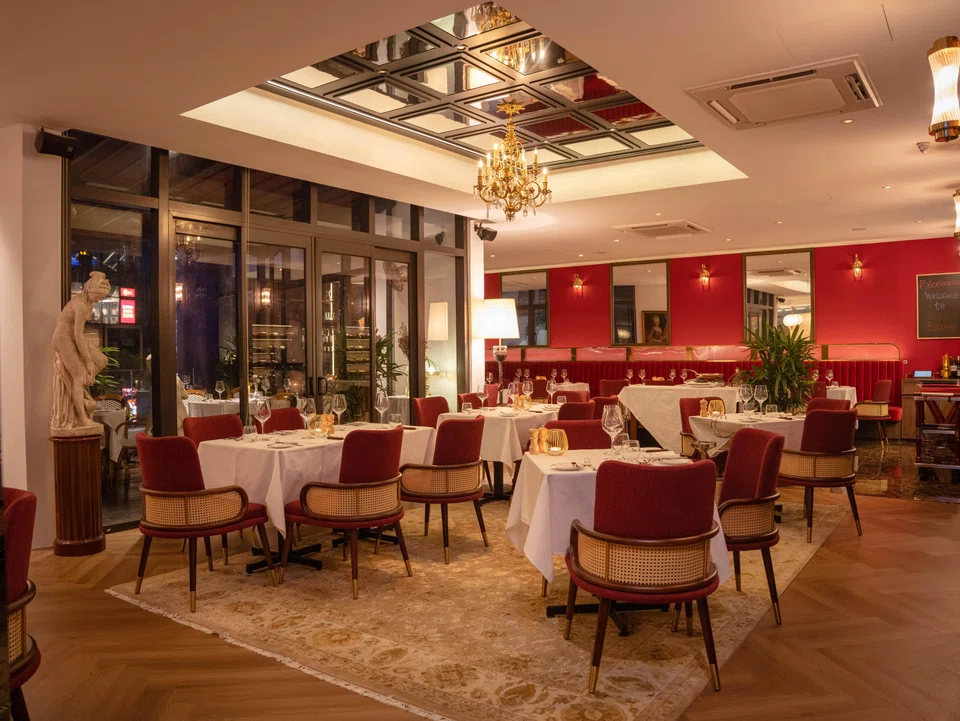
Rath speaks from cross-border operating experience. His steakhouse brand began on Ann Siang Road in 2002 and has since expanded to five outlets across Singapore and Malaysia – three in Singapore at Ann Siang Road, Robertson Quay and Rochester Commons, and two in Malaysia at Puteri Harbour in Iskandar Puteri and Jalan Mayang in Kuala Lumpur.
“The biggest challenge is unlearning the assumption that what works in Singapore will automatically work in Malaysia,” he told BT.
Singapore, he noted, is frequency-driven and intensely competitive; Kuala Lumpur more occasion-led and receptive to premium positioning; and Iskandar Puteri more dependent on residential catchment and weekend destination traffic.
Expected synergies across markets, he added, are also more limited than operators typically assume, because of logistics and customs friction.
The friction is structural rather than incidental – and it shapes how both markets need to be approached, said Damien Yeo, consumer and retail analyst at BMI.
Malaysia’s more price-sensitive mass market and greater demand variability make it harder for operators to pass through cost increases, even where rents and wages are lower.
Singapore, despite its cost intensity, offers stronger average spending power and clearer scope for differentiated concepts to defend margins through productivity and premiumisation.
“Malaysia generally offers a lower absolute cost base and greater site optionality,” Yeo told BT, “but that does not automatically make it the easier market.”
Singapore retail rents rose 1.9 per cent in 2025, adding to the pressure operators cite as a driver of cross-border expansion.
Klang Valley shopping centre rents vary considerably by submarket, based on Napic data – a pattern analysts say reflects greater site flexibility, even as overall rent levels have firmed.
On the ground in Johor Bahru, demand for well-positioned F&B space remains anything but soft. Paradigm Mall, a major suburban mall serving a sizeable residential catchment in Johor Bahru, is running at about 99.8 per cent occupancy, with F&B operators still expanding – though with sharper criteria than before.
“Operators are more selective,” said Selena Chua, chief executive and executive director of Paradigm Reit’s manager. “The focus is on assets with proven traffic, strong catchment demographics and sustainable sales potential.”
Singapore-linked brands, she added, continue to show strong interest in Johor Bahru, attracted by the city’s proximity to Singapore, favourable exchange rates, affordable rents and a more accessible workforce and supply chain.
Shoppers looking for distinctive concepts

Further up the value chain, landlords are being pushed to raise their own game. OSK Property Investment chief executive Hoe Mee Ling said that shoppers are becoming less drawn to malls with repetitive brand mixes and more interested in distinctive concepts.
“Consumers are increasingly seeking authentic and differentiated concepts,” said Hoe. “That raises the bar for both landlords and tenants.”
It is this environment that Hwa Heng Beef Noodles is now stepping into – carefully, and with deliberate intent. The 79-year-old Singapore heritage brand is preparing to open its first Malaysian mall outlet at Atria Shopping Gallery in Damansara, Klang Valley, marking its first foray across the Causeway.
Eric Lim, managing director of Hwa Heng Beef Noodles, said that the timing reflects both external opportunity and internal readiness.
“We have strengthened our internal systems, standardised our recipes and built a more scalable operating model, which gives us the confidence to expand beyond Singapore at this stage.”
That expansion starts with a targeted site selection. Lim said Atria offered a commercially sensible entry point: a stable residential catchment in a mature demographic area, a mall that is actively rejuvenated, and no direct beef noodle competitor in the current tenant mix.
He was equally clear-eyed about the differences he expects to navigate. Malaysian consumers, he said, place greater emphasis on value, portion size and overall dining experience – a meaningfully different brief from the speed and consistency that Singapore diners prioritise.
“As with any new market, localisation is always the biggest uncertainty,” Lim said. “We are approaching this with a test and learn mindset – starting with one outlet and refining the model before expanding further.”
For a brand bringing nearly eight decades of identity into an unfamiliar market, that discipline may be its most valuable asset.
This is not a story of operators abandoning Singapore for Malaysia. It is a story of what growth now requires. Singapore still offers stability and spending power, while Malaysia offers room to expand.
Lower costs alone will not carry a concept across the Causeway. The brands that succeed will be the ones that stop treating Malaysia as a cheaper extension of Singapore, and start treating it as a market that has to be won on its own terms.
TRENDING NOW

Once staunchly pro-China, Malaysian Chinese businesses are now distancing themselves from Beijing

Looking beyond looming CEO succession, should UOB potentially pursue a transformative merger?

Could stablecoins be the future of money?

Grab CEO’s wife Chloe Tong on life with Anthony Tan and finding her purpose

