



South-east Asia risks missing global chip boom as fab investments bypass region
Only a handful of new plants planned as region races to move beyond back-end manufacturing

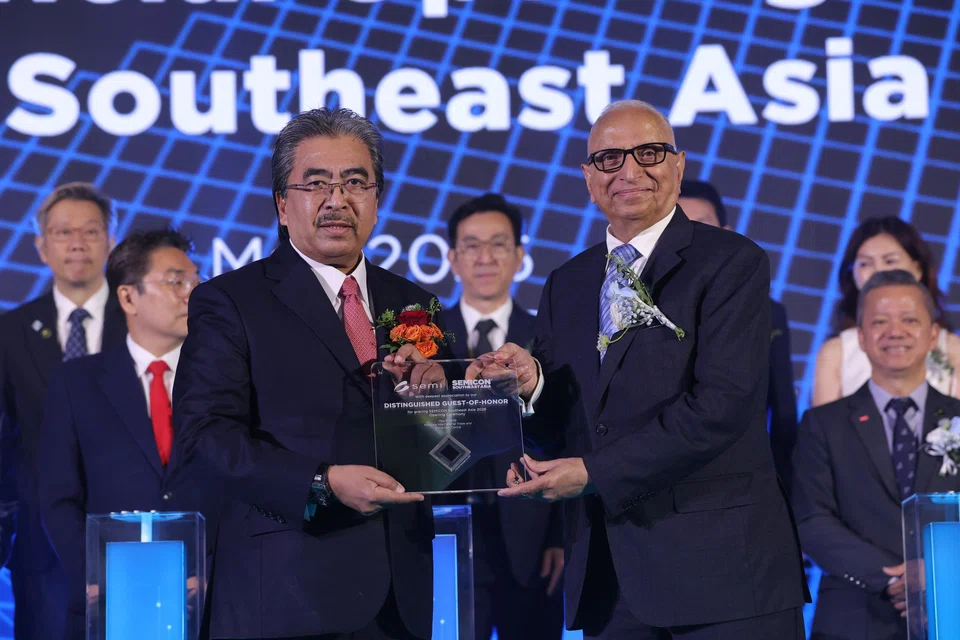
[KUALA LUMPUR] South-east Asia risks being left out of the global semiconductor manufacturing boom unless it moves faster to build front-end capabilities, industry leaders warned, as billions of dollars in new chip plants are set to come online elsewhere.
Ajit Manocha, president and CEO of Semiconductor Equipment and Materials International (Semi), said 89 new wafer fabrication plants are expected to start operations globally by 2029, the bulk of them outside South-east Asia.
Of the 89, 16 are expected to be in the US, nine in Europe and 64 in Asia. But of that number in Asia, South-east Asia is expected to host only about six.
“That’s a very small share,” Manocha said at the Semicon Southeast Asia conference on Tuesday (May 5).
“South-east Asia needs more wafer fabs to strengthen its position. This would benefit not only the region, but also the global economy,” he said.
The warning comes as the semiconductor industry enters what he described as a structural growth phase, driven by artificial intelligence, data centres and next-generation computing.
He noted that another 50 fabs will be coming by 2035 to support the industry’s growth. “South-east Asia is well-positioned, but it needs to step up,” he said. “The opportunity is there; the question is whether the region can move fast enough to capture it.”
Semiconductor sector value approaching US$2 trillion
What was once considered an ambitious target of a US$1 trillion industry by 2030 is now likely to be exceeded, said Manocha. “By 2035, the semiconductor sector could exceed US$2 trillion… this is the multi-trillion-dollar journey,” he added.
He noted that capturing that growth will require more than technical capability as the biggest constraints are policy-related.
SEE ALSO




“Moving up the value chain is less about capability and more about strategy,” he told The Business Times in a separate interview, noting that countries need clear national plans and must be willing to deploy large-scale incentives to attract these investments.
Wafer fabrication plants are among the most capital-intensive industrial projects, often requiring tens of billions of dollars in upfront investment and long-term policy certainty.
Beyond their status as one of the most profitable sectors globally, semiconductors have become a cornerstone of national security, essential to both economic stability and long-term prosperity, he said.
Their importance to humanity is only accelerating as they sit at the convergence of transformative technologies such as AI, quantum computing and next-generation healthcare.
“Countries must align their strategies around three pillars: national security, economic prosperity and societal impact. Without strong motivation in these areas, progress will be limited,” he added.
Malaysia looks beyond back-end role
In the opening remarks, Malaysia’s Investment, Trade and Industry Minister Johari Abdul Ghani acknowledged the urgent need to move from back-end assembly to front-end innovation in the semiconductor value chain.
Despite decades of success, Malaysia’s semiconductor sector remains concentrated in assembly, testing and packaging, with heavy reliance on imports, due to limited capabilities in integrated circuit design and wafer fabrication.
Malaysia’s electrical and electronics sector remains its largest export category, valued at RM711 billion (S$229 billion). Of that, semiconductor exports accounted for RM465 billion.
However, semiconductor imports (particularly integrated circuits) stood at RM308 billion, reflecting the country’s limited presence in higher-value segments such as chip design and wafer fabrication.
“This highlights the urgency of moving up the value chain,” Johari said.
The government has rolled out a national semiconductor strategy aimed at transitioning Malaysia from a service provider into what it calls a “technology owner”, with a focus on attracting investments in fabrication, design and advanced packaging.
Data centres as a stepping stone
Malaysia has also seen a surge in investment in data centres, particularly in Johor, as global technology firms expand their regional footprint.
The country has solidified its position as a top data-centre hub in South-east Asia, with 143 approved data-centre investment projects worth RM144.4 billion recorded between 2021 and mid-2025.
While some critics have described these facilities as little more than “digital warehouses” with limited technology transfer, Manocha said they represent a necessary starting point.
“There’s nothing wrong with being a host for data centres,” he said. “But the next step is to move up the value chain – into ownership, management and the broader digital ecosystem.”
That includes building capabilities in chip design, advanced manufacturing and in emerging technologies such as AI and quantum computing.
Ecosystem gains from supply chain shift
Meanwhile, Li Li Mow, vice-president of solution business (automation) for South-east Asia at Delta Electronics, said the region is already seeing tangible benefits from the global shift in supply chains, as companies diversify production under “China plus one” strategies.
While Malaysia remains strong in back-end semiconductor activities, such investments continue to anchor a broader ecosystem, she observed.
“When semiconductor players invest, the entire supply chain follows – from machine builders to raw material suppliers,” she told BT.
Over time, she expects adoption of automation, AI and digital technologies to help firms improve productivity and move into higher-value segments, rather than relying solely on cost advantages.
Decoding Asia newsletter: your guide to navigating Asia in a new global order. Sign up here to get Decoding Asia newsletter. Delivered to your inbox. Free.
Copyright SPH Media. All rights reserved.
TRENDING NOW

LTA proposes combining car COE categories, adding rebate-surcharge system

StarHub to acquire MyRepublic’s mobile business amid ongoing telco consolidation

DBS, OCBC, UOB rout lops billions off STI as inflation, rate concerns spook investors

Grab CEO’s wife Chloe Tong on life with Anthony Tan and finding her purpose

